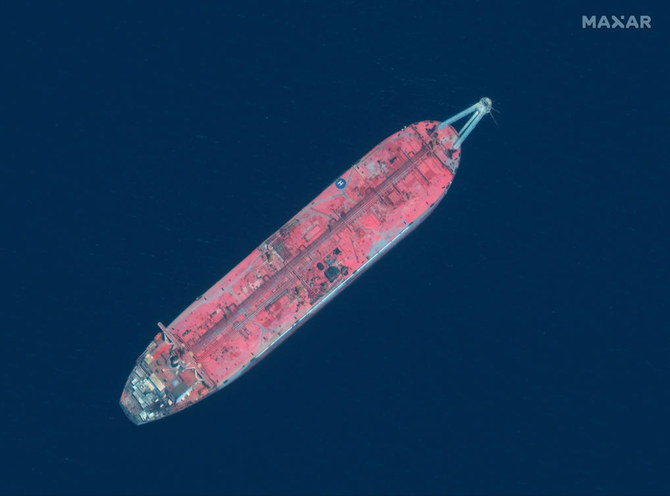
DUBAI: For years, a rusty oil tanker has been moored off war-torn Yemen — abandoned and threatening to break up or explode in what would be an ecological and humanitarian catastrophe.
On Tuesday the United Nations said it had reached an “agreement in principle” with Houthi militia to pump out the volatile cargo from the FSO Safer vessel and transfer it to another ship.
The 45-year-old ship, long used as a floating oil storage platform, has been moored off Yemen’s western port of Hodeidah in the Red Sea since 2015, without being serviced.
It is moored about 60 kilometers (40 miles) from the nearest inhabited areas with 1.1 million barrels of crude on board.
Apart from corrosion to the aging hull, essential work on reducing explosive gases in the storage tanks has been neglected for years.
Greenpeace has warned the vessel could “explode at any moment.”
Experts said the latest problem emerged in May 2021 with a leak in a cooling pipe, which was later fixed.
The UN has said an oil spill could destroy ecosystems, shut down the fishing industry and close Yemen’s lifeline Hodeidah port for six months.
Independent studies show it could expose more than 8.4 million Yemenis to heightened pollution.
Maritime traffic and coastal countries including Djibouti, Eritrea and Saudi Arabia could also be affected.
About 80 percent of Yemen’s population depends on some form of aid for survival, with the civil war between the internationally-recognized government and Iran-backed Houthi militia showing no signs of abating.
Inspection of the deteriorating ship has dragged on for years with UN requests for access repeatedly declined by the Houthis, who control much of Yemen’s north including Hodeidah port.
The militia have said they want guarantees that the value of the oil on board the Safer would be used to pay salaries of their employees.
The Yemeni government has said the money should be used for health and humanitarian projects.
In November 2020, the Houthis said they gave the green light for a mission to assess the fuel tanker.
The UN initially planned it in early 2021, but it has been repeatedly delayed.
The UN last year urged the Houthis to “facilitate unconditional and safe access for UN experts to conduct a comprehensive and impartial assessment and initial repair mission without further delay.”
The UN said on Tuesday that an “agreement in principle” has been reached to transfer the toxic cargo from the tanker to another ship, without giving further details or a timeline.
“I am pleased to report recent progress in efforts to resolve the Safer tanker issue, including an agreement in principle to a UN-coordinated proposal to shift the oil to another ship,” said Martin Griffiths, the UN’s deputy chief for humanitarian affairs.


![]()

Abandoned oil tanker off Yemen a disaster waiting to happen: UN
Short Url
https://arab.news/mvg5p
Abandoned oil tanker off Yemen a disaster waiting to happen: UN
- The 45-year-old ship has been moored off Yemen's western port of Hodeidah in the Red Sea since 2015
- Greenpeace has warned the vessel could “explode at any moment”


Latest updates


© 2026 SAUDI RESEARCH & PUBLISHING COMPANY, All Rights Reserved And subject to Terms of Use Agreement.