

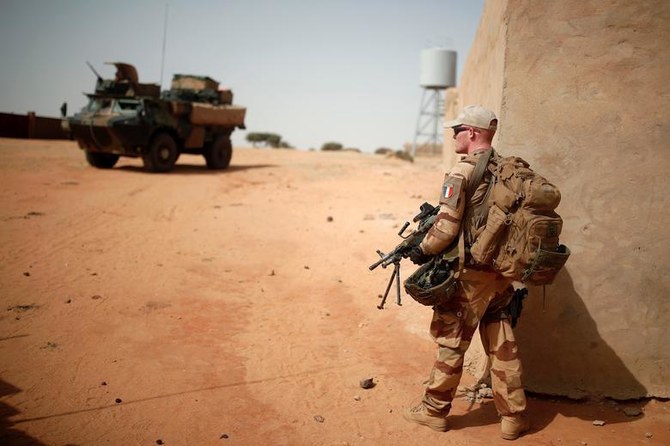
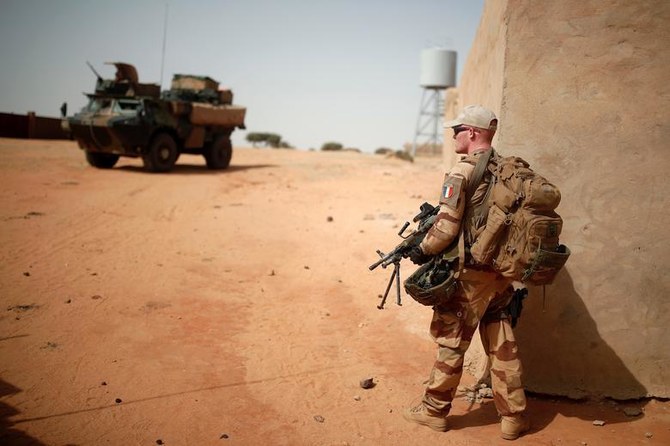
NIAMEY: France’s welcome in its former colonies in the Sahel region of West Africa, where its forces have fought extremist insurgents for nearly a decade, is wearing thin.
For decades after it was forced to relinquish its African territories in the 1960s France was accused of pulling the strings, militarily or economically, by propping up autocratic leaders who served its interests.
While France insists it is no longer trying to control the fate of West African countries it is now under fire in the region for having failed to vanquish the extremist groups that have have killed thousands of people and displaced more than two million people over the past 10 years.
In Mali, the animosity has deep roots, dating back to colonial days.
The military junta that seized power twice, in 2020 and 2021, is trying to capitalize on that, said Rodrigue Kone, a researcher at the South African-based Institute for Security Studies.
“There has always been latent anti-French feeling due to a sort of condescension, the arrogance of French policy in Africa, which hasn’t seen real change since the end of colonization,” he said.
Abdourahmane Idrissa, a senior researcher in African studies at Netherlands’ Leiden University, wrote that France, under post-war president Charles de Gaulle, imposed a neo-colonial policy from the start.
Military interventions became routine in a region France viewed as its “backyard,” he said.
That history looms large over France’s military operations in West Africa today.
Analysts say Operation Barkhane, which is trying to root out extremists in the Sahel, is widely perceived as yet another attempt to meddle in African affairs, even if local armies have joined in to fight alongside insurgent groups.
France first intervened in Mali in 2013 at the request of the local government, beating back an extremist advance from the desert north of the country.
But the extremists regrouped and spilled into central Mali, as well as neighboring Burkina Faso and Niger, inflaming ethnic tensions along the way.
In Niger, hostility toward Operation Barkhane deepened in November when three people were shot dead during protests against a French military convoy.
The protesters were trying to block the convoy at the town of Tera as it was traveling across Niger bound for Mali.
In regional powerbroker Chad, anti-government protesters burned French flags — an unprecedented sight, according to researcher Kelma Manatouma, a Chadian researcher at Paris-Nanterre university.
Tournons la Page (TLP), a pan-African civil society group set up in 2014 to promote democracy on the continent, is calling for the closure of ALL foreign military bases.
“France’s colonial past, its meddling in our internal affairs and looting of our resources like uranium are making our youths think,” said Maikoul Zodi of TLP’s Niger branch. “We don’t have win-win contracts with France.”
Some commentators on social media even go as far as to accuse France of complicity with the extremists.
France’s defense chief of staff Thierry Burkhard complains of a disconnect between the good relations his forces enjoy with their Malian counterparts and a lack of appreciation and understanding on the part of the local population.
But not everyone is resentful of the French.
Boubacar Diallo, who heads an association of livestock farmers in Niger’s Tillaberi region, which has been especially hard hit by extremist attacks, defended France’s counterterrorism efforts.
“All the extremist leaders held or killed in Niger are thanks to Barkhane (so) how can you speak of collusion between Barkhane and the terrorists?,” he said.
“On the ground, people have more confidence in Barkhane than in their own armies,” he claimed.
Other international players meanwhile, are watching from the wings, notably Russia.
Western intelligence has pointed to the growing presence of Russian paramilitaries from the Wagner group in Mali, which Bamako denies.
A degree of public support for Moscow was evidenced by the Russian flags waved at celebrations of a recent military takeover in Burkina Faso.
“Burkina Faso needs to forge bonds with other more credible powers and count on its own army to eradicate terrorism,” said Alassane Sanfo, a civil society activist.
“The (security) situation is only getting worse,” TLP’s Zodi added.
“It’s not that people have more confidence in the Russians. But if you have tried a remedy and it’s not effective, you want to experiment with other approaches.”
Kone of the ISS faulted a failure of democracy. “We are seeing deep resentment over a democratic system that has not produced first-rate elites,” he said.
“There’s a wish to return to strongman rule, and Russia is not too bothered about that.”


