Houthis ‘primary obstacle to peace efforts’ in Yemen: US special envoy

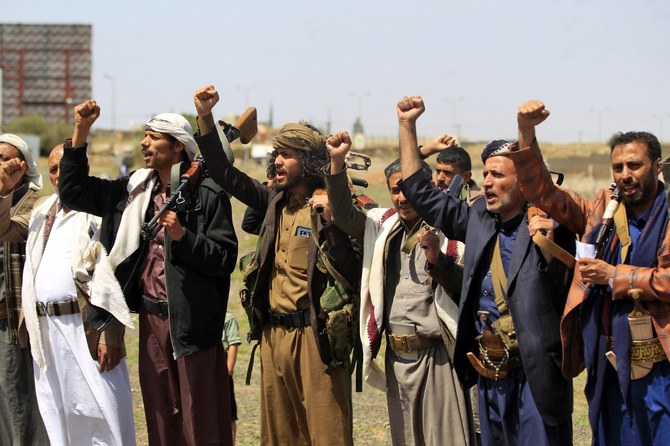
The Houthi militia has been the “primary obstacle to peace efforts” in Yemen, US Special Envoy Timothy A. Lenderking said on Monday. (File/AFP)
Short Url
Updated 14 February 2022
Follow

Houthis ‘primary obstacle to peace efforts’ in Yemen: US special envoy

  • Timothy A. Lenderking was speaking at conference in Washington DC attended by Arab News
  • Yemeni govt negotiator: Iran “trying to create mayhem in region through different militias”

CHICAGO: The Houthi militia has been the “primary obstacle to peace efforts” in Yemen, US Special Envoy Timothy A. Lenderking told a conference in Washington DC attended by Arab News on Monday.

Lenderking was joined by Mohammad Al-Amrani, a member of the Yemeni government’s negotiating team, who said the Houthis are not only backed by Iran but are following its strategy of using negotiations as a means to force concessions and make gains.

Lenderking and Al-Amrani were the opening speakers at the conference hosted by the Center for Conflict and Humanitarian Studies and the Arab Center Washington DC.

The Houthis’ recent losses “should indicate to them and to all the parties that there’s no military solution,” Lenderking said.

“We’ve also seen the Houthis threaten to strike international commercial airports and other targets in Abu Dhabi and Riyadh. This concerns the US and the international community greatly,” he added.

“The Houthis have pursued a dangerous pattern of increasingly obstructive and aggressive actions against Yemenis, Yemen’s neighbors and the entire international community, harming civilians and civilian infrastructure.”

Al-Amrani said the Houthis have “obstructed” every attempt at peace talks held in Kuwait, Geneva and Stockholm through “intransigence.”

The Houthis are “creating a generation … that believes that death is the message of life and that violence is the only solution to the Yemeni crisis,” he added.

“Iran … is trying to create mayhem in the region through different militias ... This is an issue. The affiliation of the Houthis to Iran is problematic.”

Al-Amrani said in many instances when it appeared that the Houthis might engage in constructive dialogue, the Iranians sent instructions to stop. The Houthis have been “trying to avoid any binding agreements,” he said.

“The peace process requires two parties that have the same determination to put an end to the conflict.” The Houthis “haven’t been a party” to peace efforts, Al-Amrani said.

Lenderking said the US is committed to “helping improve Yemeni lives, creating the space for Yemenis to collectively determine their own future and to advance a durable resolution that ends the conflict in Yemen.

“We’re not talking about a ceasefire here. We’re talking about ending the conflict and getting Yemen back on its feet. This remains a top US foreign policy priority.”

He added: “In terms of humanitarian assistance, the US has provided the people of Yemen more than $4 billion since the crisis began more than seven years ago.”

Lenderking said the US is “concerned with the UN’s estimated $3.9 billion funding gap in 2022,” and urged donors to “fulfil their pledges to the people of Yemen and to step up to give generously.”

Saudi Arabia is the world’s biggest donor of humanitarian aid to Yemen, having pledged more than $18 billion to the country over the past six years, according to the King Salman Humanitarian Aid and Relief Center.


Jailed Turkish Kurd leader calls on government to broker deal for Syrian Kurds

Updated 7 sec ago
Follow

Jailed Turkish Kurd leader calls on government to broker deal for Syrian Kurds

  • Clashes between Syrian forces and the SDF have cast doubt over a deal to integrate the group’s fighters into the army
ANKARA: Jailed Turkish Kurd leader Abdullah Ocalan said Tuesday that it was “crucial” for Turkiye’s government to broker a peace deal between the Kurdish-led Syrian Democratic Forces (SDF) and the Damascus government.
Clashes between Syrian forces and the SDF have cast doubt over a deal to integrate the group’s fighters into the army, which was due to take effect by the end of the year.
Ocalan, founder of the Kurdistan Workers’ Party (PKK) militant group, called on Turkiye to help ensure implementation of the deal announced in March between the SDF and the Syrian government, led by former jihadist Ahmed Al-Sharaa, whose forces ousted longtime ruler Bashar Assad last year.
“It is essential for Turkiye to play a role of facilitator, constructively and aimed at dialogue,” he said in a message released by Turkiye’s pro-Kurdish DEM party.
“This is crucial for both regional peace and to strengthen its own internal peace,” Ocalan, who has been jailed for 26 years, added.
“The fundamental demand made in the agreement signed on March 10 between the SDF and the government in Damascus is for a democratic political model permitting (Syria’s) peoples to govern together,” he added.
“This approach also includes the principle of democratic integration, negotiable with the central authorities. The implementation of the March 10 agreement will facilitate and accelerate that process.”
The backbone of the US-backed SDF is the YPG, a Kurdish militant group seen by Turkiye as an extension of the PKK.
Turkiye and Syria both face long-running unrest in their Kurdish-majority regions, which span their shared border.
In Turkiye, the PKK agreed this year at Ocalan’s urging to end its four-decade armed struggle.
In Syria, Sharaa has agreed to merge the Kurds’ semi-autonomous administration into the central government, but deadly clashes and a series of differences have held up implementation of the deal.
The SDF is calling for a decentralized government, which Sharaa rejects.
Turkish Foreign Minister Hakan Fidan, whose country sees Kurdish fighters across the border as a threat, urged the SDF last week not to be an “obstacle” to stability.
Syrian Kurdish leader Mazloum Abdi said Thursday that “all efforts” were being made to prevent the collapse of talks.