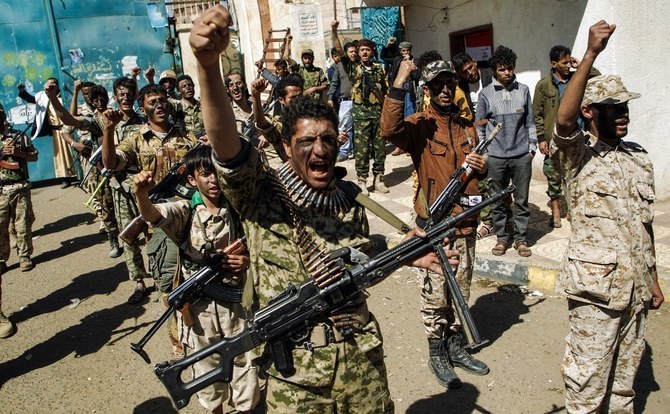

ALMUKALLA, Yemen: Yemeni Prime Minister Maeen Abdul Malik Saeed has welcomed the ongoing deliberations inside US President Joe Biden’s administration to reclassify the Houthis as a terrorist organization, as dozens of local and international rights groups renewed their demands to punish the militia for its crimes.
Speaking to the Riyadh-based Al-Sharq channel, Saeed said the fresh discussions showed that the Americans had “belatedly” realized that the delisting decision proved counterproductive.
“Its position now is excellent and clear,” he said, adding that, since the reversal of the designation, the Houthis had increased their deadly strikes in and outside the country, claiming the lives of many civilians.
They had undermined international maritime security through the Red Sea by planting water-borne explosive devices and launching attacks on ships, he said.
“For us, it is clear that the Houthis are a terrorist organization because of their crimes committed against the Yemenis,” Saeed said.
The Washington Post reported that the escalating missile attacks by the Houthis, mainly the latest strikes on the UAE, had prompted some US and Middle Eastern officials to call on the Biden administration to re-name the Houthis a terrorist organization after reversing the designation a year ago.
HIGHLIGHT
The Washington Post reported that the escalating attacks by the Houthis had prompted some US and Middle Eastern officials to call on the Biden administration to re-name the Houthis a terrorist organization.
The new demands came days after the UAE pushed for designating the Houthis as a terrorist organization after explosive-rigged drones and ballistic missiles struck civilian targets in the UAE.
They were based on the argument that the designation would dry up Houthi financial sources and smuggling routes for weapons.
“This designation will help disrupt illicit financial and weapons networks feeding the Houthi terror machine. It will add to mounting pressure on the Houthis to engage in UN-led peace efforts that can end hostilities in a war that has gone on far too long,” said the UAE embassy in Yemen.
The prime minister said he had warned the US that the delisting would not lead to peace in Yemen and that the Houthis would misinterpret good gestures from the international community.
“Unfortunately, there was leniency (with the Houthis). We have warned that these things will lead to more escalation, not calm. Pressure on Al-Houthi is the only way for achieving a solution in Yemen.”
He assured local and international aid organizations that his government would work on mitigating any possible repercussions of the decision on the flow and distribution of humanitarian assistance in Yemen. “We are keen that the classification does not affect the flow of aid,” he added.
Yemeni human rights activists, mainly those who were forced to flee the country due to the Houthi crackdown, have also demanded slapping tough sanctions on the militia to deter it from abusing Yemenis and mounting strikes against civilians.
Baraa Shiban, a Yemeni human rights activist, warned that keeping the Houthis in power would lead to expanding violence in the country, citing the militia’s attacks on civilian sites in Yemen and Saudi Arabia, including Abha airport.
“With the Houthis in charge, the conflict in #Yemen will spill over, that is what many Yemenis have been saying since day one,” Shiban tweeted.
Zafaran Zaid, a Yemeni human rights activist and lawyer who was sentenced to death in absentia by a Houthi-run court last year, told Arab News on Saturday that the Houthis should be blacklisted for killing thousands of Yemenis, looting private and public property, planting hundreds of thousands of land mines, prosecuting journalists, and raiding villages with heavy weapons.
“They (the Americans) should answer a simple question: How did you find the Houthis after canceling the designation? The Houthis became more brutal and shelled cities and tents of the displaced,” she said.