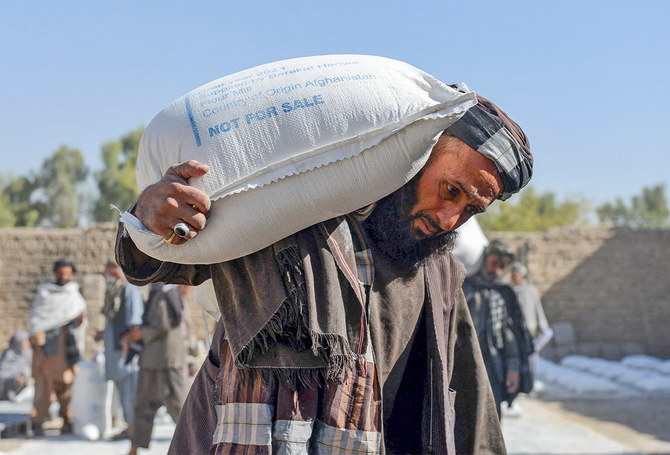
ISLAMABAD: Pakistan is allowing nuclear rival India to deliver tons of wheat to Afghans struggling through intensifying food shortages, two foreign ministry officials said Monday.
Under a deal with New Delhi, dozens of trucks from Afghanistan will be allowed to collect wheat from India by way of Pakistan’s Wagha border near the city of Lahore, beginning Feb. 21. The trucks filled with wheat will then head back to Afghanistan’s Jalalabad city via Pakistan’s Torkham border the next day, the officials said.
They spoke on the condition of anonymity because they were not authorized to speak to media on the record.
The arrangement comes more than three months after India announced it would deliver 50,000 metric tons of wheat and life-saving medicines to Afghanistan.
Pakistan said at the time it would allow the Indian aid to pass through its territory en route to Afghanistan, but New Delhi could not finalize modalities until last week, said the officials.
Pakistan and India have a history of bitter relations. The two sides cut trade ties after deadly attacks in India’s section of the disputed territory of Kashmir three years ago. More than 40 Indian soldiers were killed. New Delhi blamed Pakistan-based militants for the attack in Indian-controlled Kashmir, a charge Pakistan denied, demanding evidence.
Since then, normal diplomatic and trade ties between them have not resumed.
Pakistan now says it is allowing India to deliver food to Kabul through its territory under a special arrangement.
Afghanistan’s economy is teetering on the brink of collapse in the wake of the Taliban takeover in August.
Recently, the United Nations made a $5 billion appeal for Afghanistan. The UN warns that 1 million children are in danger of starving and 90 percent of Afghans live below the poverty level of just $1.90 a day.
Pakistan in recent months has also sent food and medicines to Afghanistan.
Like the rest of the world, Pakistan and India have so far not recognized the Taliban government.
New Delhi has no diplomatic presence in Kabul after evacuating its staff ahead of the US withdrawal from Afghanistan in August. It did, however, meet with a Taliban representative in Qatar on Aug. 31.
Before the Taliban took Kabul, India provided Afghan security forces with operational training and military equipment, even though it had no troops on the ground.


Pakistan allows India to deliver wheat to struggling Kabul

https://arab.news/n47ja
Pakistan allows India to deliver wheat to struggling Kabul
- UN warns 1 million children in danger of starving and 90 percent Afghans live below poverty level of $1.90 a day
- India would deliver 50,000 metric tons of wheat, life-saving medicines to Afghanistan
IMF approves $1.1 billion funding for Pakistan
- The funding is the final tranche of a $3 billion standby arrangement Islamabad secured last year
- Islamabad is now seeking a new, larger long-term Extended Fund Facility agreement with the IMF
ISLAMABAD: The executive board of the International Monetary Fund approved $1.1 billion in funding for Pakistan on Monday, the agency said in a statement, amid discussions for a new loan.
The funding is the second and last tranche of a $3 billion standby arrangement with the IMF, which Islamabad secured last summer to help avert a sovereign default.
The approval came a day after Pakistan Prime Minister Shehbaz Sharif discussed a new loan program with IMF Managing Director Kristalina Georgieva on the sidelines of the World Economic Forum in Riyadh.
Islamabad is seeking a new, larger long-term Extended Fund Facility (EFF) agreement with the fund after the current standby arrangement expires this month. Pakistan’s Finance Minister, Muhammad Aurangzeb, has said Islamabad could secure a staff-level agreement on the new program by early July.
Islamabad says it is seeking a loan over at least three years to help achieve macroeconomic stability and execute long-overdue and painful structural reforms.
Aurangzeb has declined to give details on the amount the country is seeking.
Islamabad is yet to make a formal request, but the Fund and the government are already in discussions.
If secured, it would be Pakistan’s 24th IMF bailout.
The $350 billion economy faces a chronic balance of payments crisis, with nearly $24 billion to repay in debt and interest over the next fiscal year — three-time more than its central bank’s foreign currency reserves.
Four militants killed in northwest Pakistan operation — military
- The development comes amid a surge in violence in Khyber Pakhtunkhwa province, mostly blamed on Pakistani Taliban
- Last week, Taliban militants also abducted a district and sessions judge in the same province, who was freed two days later
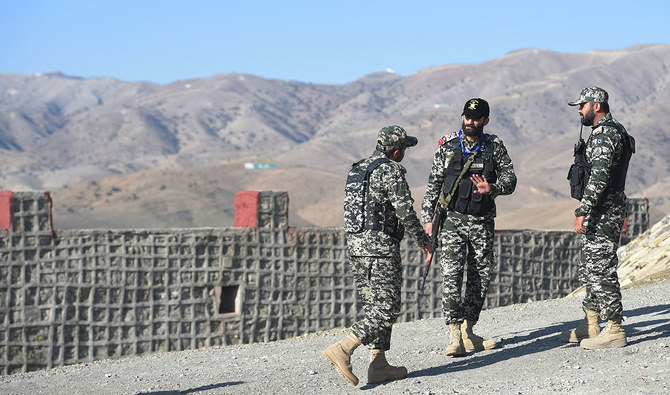
ISLAMABAD: Four militants were killed during an intelligence-based operation in northwest Pakistan on Monday, the Pakistani military said, amid a spate of militant violence in the region.
The operation was conducted in the Khyber tribal district of Pakistan’s Khyber Pakhtunkhwa province, according to the Inter-Services Public Relations (ISPR), the military’s media wing.
An intense exchange of fire during the operation killed four militants.
“Terrorists’ hideout was also busted during the operation and a large cache of weapons, ammunition and explosives was recovered,” the ISPR said in a statement.
A sanitization operation was being carried out to eliminate any other threats in the vicinity, the ISPR added.
The development came amid a surge in violence in Pakistan’s northwest, mostly blamed on the Tehreek-e-Taliban Pakistan (TTP), since the group ended a ceasefire with the central government in November 2022.
Last week, TTP militants abducted a district and sessions judge, Shakirullah Marwat, in the same province. The judge was recovered after a joint operation by police and security forces, police said on Monday.
Earlier this month, six people, including five customs department officials, were killed in an attack in Dera Ismail Khan. Two customs officers were also killed in the area in a separate attack earlier.
Militants have also targeted security officials in the province in recent weeks, killing a number of police and counterterrorism department officials.
Both Pakistan and Afghanistan have traded blame in recent months over who is responsible for the recent spate of militant attacks in Pakistan.
Islamabad says the attacks are launched mostly by TTP members who operate from safe havens in Afghanistan. Kabul denies this and blames Islamabad for not being able to handle its own security challenges.
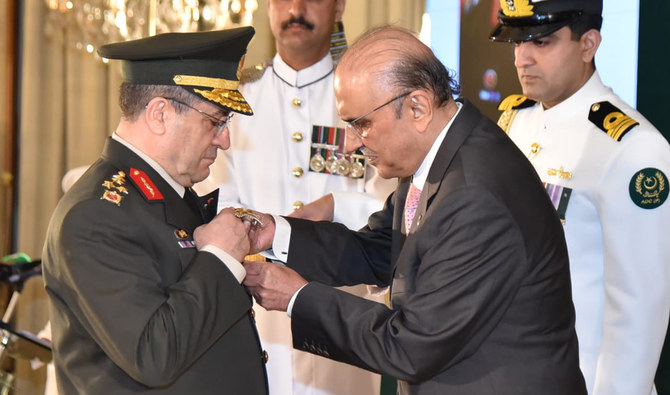
Pakistan confers military award on Turkish land forces commander
- President Asif Ali Zardari conferred the award at a special investiture ceremony held in Islamabad
- General Selcuk Bayraktaroglu, who is currently visiting Pakistan, also met Army Chief Gen Asim Munir
ISLAMABAD: Pakistan on Sunday conferred a military award, Nishan-i-Imtiaz, on Commander of the Turkish Land Forces, General Selcuk Bayraktaroglu, during his visit to Islamabad, Pakistani state media reported.
Pakistan President Asif Ali Zardari bestowed the Turkish general with the award at a special investiture ceremony held at the Presidency in Islamabad, the state-run Radio Pakistan broadcaster reported.
“The award was conferred upon him in recognition of his illustrious services and contribution toward strengthening Pakistan-Turkiye defense relations,” the report read.
The investiture ceremony was attended by foreign diplomats and high-ranking military officials.
Separately, General Bayraktaroglu called on Pakistan’s army chief, General Asim Munir, and General Sahir Shamshad Mirza, chairman of the Joint Chiefs of Staff Committee, the Pakistani military said.
During his meeting with Gen Munir, matters of mutual interest and measures to further enhance bilateral defense cooperation were discussed, according to the Inter-Services Public Relations (ISPR), the Pakistani military’s media wing.
“Both sides expressed satisfaction over deep-rooted relations between the two countries, based on historic, cultural and religious affinity,” the ISPR said.
“COAS emphasized the need to further strengthen existing military to military cooperation between the two Armed Forces.”
During the meeting, the ISPR added, the visiting dignitary appreciated the role of Pakistan Army in ensuring peace and stability in the region.
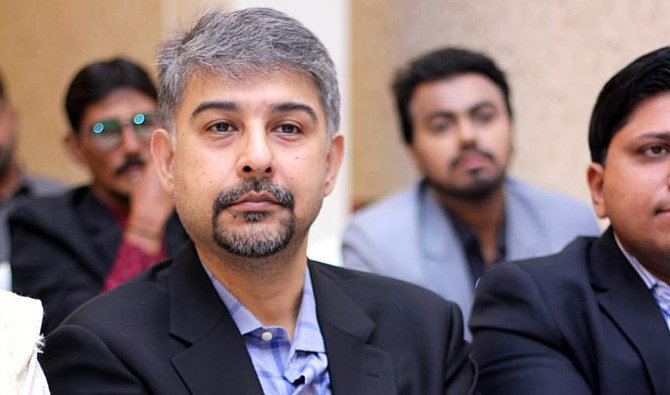
Pakistan court hands life sentences to four in 2018 murder of lawmaker
- The accused were convicted of aiding, abetting, reconnaissance, and facilitating murder of Syed Ali Raza Abidi
- Court suspends proceedings against prime accused, citing Supreme Court ruling that prohibits judgments in absentia
KARACHI: A Pakistani court on Monday handed life sentences to four accused who were convicted of aiding, abetting, reconnaissance and facilitating the murder of a Pakistani lawmaker in the southern city of Karachi in 2018.
Ali Raza Abidi, a businessman and politician, who belonged to the Muttahida Qaumi Movement-Pakistan (MQM-P) party, was shot dead outside his residence in the Defense Housing Authority (DHA) area of Karachi.
Police had registered a case against the suspects in the Gizri police station under the Anti-Terrorism Act.
“The evidence shows that all the accused persons in furtherance of their common intention are involved in the commission of murder of Syed Ali Raza Abidi and they are equally responsible for the act,” Zeeshan Akhter Khan, the Anti-Terrorism Court judge, stated in his detailed judgment.
The convicts, Muhammad Farooq, Muhammad Ghazali, Abu Bakar and Abdul Haseeb, were also fined under various sections of the Pakistan Penal Code. They can appeal the verdict within 15 days.
The court, citing a Supreme Court judgment, said since a case against absconding accused, Bilal, Hasnain, Ghulam Mustafa and Faizan, could not be proceeded in absentia, it was placed on dormant status until their arrest or appearance before the court.
Abidi was elected as a Member of the National Assembly (MNA) on the ticket of the MQM-P in the 2013 general election. He, however, quit the MQM-P following the party’s formation of an alliance with the rival Pak Sarzameen Party (PSP).
Despite briefly rejoining the MQM-P in December 2017, Abidi ultimately parted ways with the party in September 2018. He was killed months later on December 25, 2018.
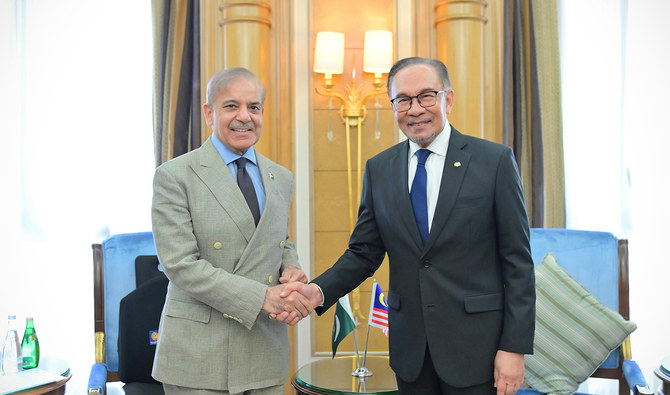
Pakistani PM meets Malaysia’s Ibrahim on WEF sidelines, invites on official Islamabad visit
- Shehbaz Sharif was in Riyadh to attend a WEF special meeting on Global Collaboration, Growth and Energy for Development on April 28-29
- The Pakistan PM invited Malaysian traders and businessmen to visit Pakistan to discuss expansion of bilateral trade, investment relations
ISLAMABAD: Pakistan’s Prime Minister Shehbaz Sharif on Monday met his Malaysian counterpart Anwar Ibrahim in Riyadh and invited him to visit the South Asian country, Sharif’s office said.
The two leaders met on the sidelines of a two-day World Economic Forum (WEF) summit in Saudi Arabia’s capital of Riyadh, according to PM Sharif’s office.
During the meeting, both sides agreed to further develop relations.
“The two leaders also agreed to hold the next meeting of the Joint Ministerial Commission in Islamabad soon,” Sharif’s office said in a statement.
“The prime minister reiterated his invitation to Malaysian Prime Minister Anwar Ibrahim to pay an official visit to Pakistan.”
The two leaders discussed bilateral ties in the fields of education, science and technology, livestock and trade, and vowed to further enhance cooperation in the future, according to the statement.
PM Sharif also invited Malaysian traders and businessmen to visit Pakistan to discuss the expansion of bilateral trade and investment relations.
The Pakistan prime minister was in Riyadh to attend the WEF special meeting on Global Collaboration, Growth and Energy for Development on April 28-29.
Sharif spoke about Gaza at the closing plenary of the two-day summit and held several bilateral meetings, particularly with Saudi officials, during the visit.