

Global collaborations crucial to address global challenges, says Saudi official

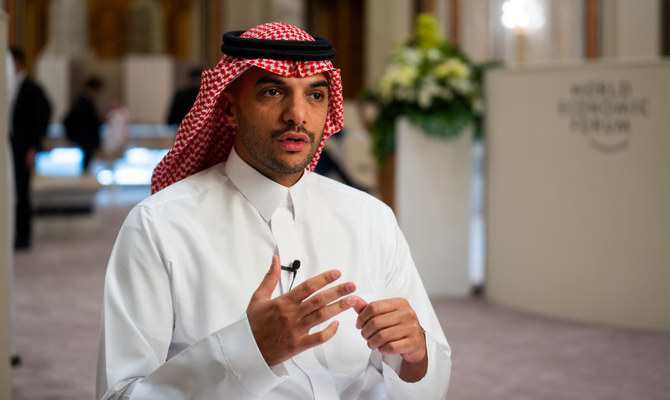
The Kingdom’s vice minister of economy and planning, Ammar Nagadi. (AN photo by Abdulrahman Bin Shalhoubh)
Short Url
Updated 30 April 2024
Follow

Global collaborations crucial to address global challenges, says Saudi official

  • Ammar Nagadi, vice minister of economy and planning, talks to Arab News on the sidelines of World Economic Forum Special Meeting in Riyadh

RIYADH: Global collaborations are a crucial element in efforts to tackle economic and social challenges, especially given the current state of the world, a leading Saudi official said.

In an interview with Arab News on the sidelines of the two-day World Economic Forum Special Meeting on Global Collaboration, Growth and Energy for Development, which concluded on Monday in Riyadh, the Kingdom’s vice minister of economy and planning, Ammar Nagadi, spoke about the important role such gatherings can play in advancing economic cooperation to address global challenges.

He believes the world is going through a “unique” time, with economic and social challenges worldwide and human development at a critical stage.

“Because of this, global collaboration and the world convening together becomes more and more important,” Nagadi said.

“We have seen that over the last few years Saudi Arabia is becoming a platform that brings together different people from different parts of the world to discuss challenges and to address these challenges” and the World Economic Forum special meeting is a continuation of that process, he added.

“We have more than 1,000 leaders today from different sectors (attending the meeting). We have heads of states, private sector and public sector leaders, and entrepreneurs from more than 70 countries across the globe.

“I think this diverse group, coming together to discuss and address global challenges is a unique opportunity and we are very happy to have it here in Riyadh today.”

Describing the economic landscape in the Kingdom, Nagadi said the Saudi economy is going through a very strong period of transformation that is reflected in the progress the country has made in terms of growth and diversification.

“Last year, Saudi Arabia’s non-oil activities grew by 4.4 percent but I think the most important thing to realize is that non-oil activities, as a percentage of total gross domestic product, have reached, for the first time in history, 50 percent of the total GDP,” he added.

This represents a significant milestone that reaffirms the progress made in efforts to diversify the national economy, he added, which have created numerous benefits, including investment opportunities and improved job prospects for Saudis.

“If I take one example, you will see that unemployment last year in the last quarter has reached an all-time low of 7.7 percent and we hope to see that momentum continuing,” Nagadi said.

He believes this momentum will also continue in terms of growth and diversification.

“We target to grow around 5 percent for non-oil activities this year but we have seen recent forecasts by the IMF (International Monetary Fund) where they’re expecting Saudi Arabia to further grow in 2025 by around 6 per cent,” he added.

Saudi Arabia is also making progress toward achieving sustainability goals, which Nagadi said is another important topic.

“What we have today is Vision 2030, which is very ambitious, and sustainability is an integral part of that vision,” he added.

“We have economic goals, social goals, environmental goals. If I were just to take the environmental part of the sustainable development goals, you will see that Saudi has put in a lot of efforts as part of Vision 2030.”

The Saudi Green Initiative, announced in March 2021, is a great example of what the Kingdom is doing not only to drive economic growth but also protect the planet, Nagadi said.

“The aim is to achieve net-zero emissions by 2060, and the goals are to increase the renewable energy mix to 50 percent of the total energy mix and plant 10 billion trees by 2030 as well as protecting land and sea,” he said, adding that 50 million trees have already been planted.


Gulf-EU value chain integration signals shift toward long-term economic partnership: GCC secretary general

Updated 03 February 2026
Follow

Gulf-EU value chain integration signals shift toward long-term economic partnership: GCC secretary general

RIYADH: Value chains between the Gulf and Europe are poised to become deeper and more resilient as economic ties shift beyond traditional trade toward long-term industrial and investment integration, according to the secretary general of the Gulf Cooperation Council.

Speaking on the sidelines of the World Governments Summit 2026 in Dubai, Jasem Al-Budaiwi said Gulf-European economic relations are shifting from simple commodity trade toward the joint development of sustainable value chains, reflecting a more strategic and lasting partnership.

His remarks were made during a dialogue session titled “The next investment and trade race,” held with Luigi Di Maio, the EU’s special representative for external affairs.

Al-Budaiwi said relations between the GCC and the EU are among the bloc’s most established partnerships, built on decades of institutional collaboration that began with the signing of the 1988 cooperation agreement.

He noted that the deal laid a solid foundation for political and economic dialogue and opened broad avenues for collaboration in trade, investment, and energy, as well as development and education.

The secretary general added that the partnership has undergone a qualitative shift in recent years, particularly following the adoption of the joint action program for the 2022–2027 period and the convening of the Gulf–European summit in Brussels.

Subsequent ministerial meetings, he said, have focused on implementing agreed outcomes, enhancing trade and investment cooperation, improving market access, and supporting supply chains and sustainable development.

According to Al-Budaiwi, merchandise trade between the two sides has reached around $197 billion, positioning the EU as one of the GCC’s most important trading partners.

He also pointed to the continued growth of European foreign direct investment into Gulf countries, which he said reflects the depth of economic interdependence and rising confidence in the Gulf business environment.

Looking ahead, Al-Budaiwi emphasized that the economic transformation across GCC states, driven by ambitious national visions, is creating broad opportunities for expanded cooperation with Europe. 

He highlighted clean energy, green hydrogen, and digital transformation, as well as artificial intelligence, smart infrastructure, and cybersecurity, as priority areas for future partnership.

He added that the success of Gulf-European cooperation should not be measured solely by trade volumes or investment flows, but by its ability to evolve into an integrated model based on trust, risk-sharing, and the joint creation of economic value, contributing to stability and growth in the global economy.

GCC–EU plans to build shared value chains look well-timed as trade policy volatility rises.

In recent weeks, Washington’s renewed push over Greenland has been tied to tariff threats against European countries, prompting the EU to keep a €93 billion ($109.7 billion) retaliation package on standby. 

At the same time, tighter US sanctions on Iran are increasing compliance risks for energy and shipping-related finance. Meanwhile, the World Trade Organization and UNCTAD warn that higher tariffs and ongoing uncertainty could weaken trade and investment across both regions in 2026.