Libya demands improvements after leaked photos show tiny cell of Muammar Qaddafi’s son in Beirut

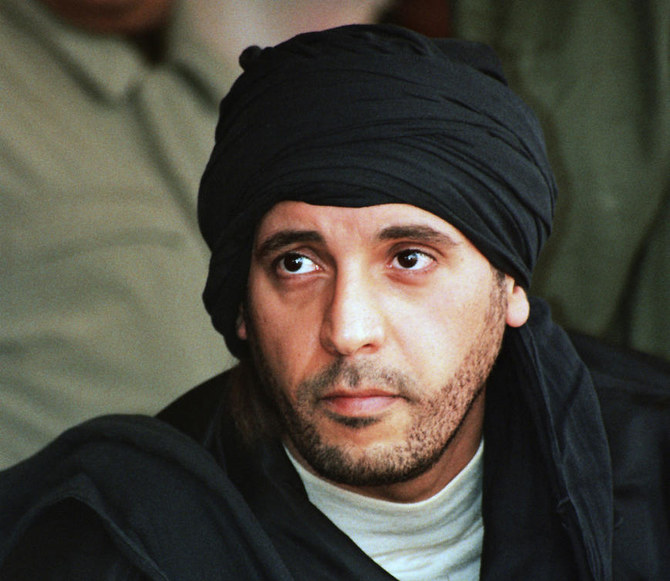
Hannibal Qaddafi, son of ousted Libyan leader Muammar Qaddafi, watches an elite military unit exercise in Zlitan, Libya, Sept. 25, 2011. (AP Photo)
Short Url
Updated 29 April 2024
Follow

Libya demands improvements after leaked photos show tiny cell of Muammar Qaddafi’s son in Beirut

  • Hannibal Qaddafi has been held in Lebanon since 2015 after he was kidnapped from neighboring Syria
  • Qaddafi was abducted by Lebanese militants demanding information about the fate of prominent Lebanese Shiite cleric Moussa Al-Sadr

BEIRUT: Leaked photographs of the son of Libya’s late dictator Muammar Qaddafi and the tiny underground cell where he has been held for years in Lebanon have raised concerns in the north African nation as Libyan authorities demand improvements.
The photos showed a room without natural light packed with Hannibal Qaddafi’s belongings, a bed and a tiny toilet. “I live in misery,” local Al-Jadeed TV quoted the detainee as saying in a Saturday evening broadcast, adding that he is a political prisoner in a case he has no information about.
Two Lebanese judicial officials confirmed to The Associated Press on Monday that the photographs aired by Al-Jadeed are of Qaddafi and the cell where he has been held for years at police headquarters in Beirut. Qaddafi appeared healthy, with a light beard and glasses.
A person who is usually in contact with Qaddafi, a Libyan citizen, said the photos were taken in recent days. All spoke on condition of anonymity because they were not authorized to speak to media outlets.
Qaddafi has been held in Lebanon since 2015 after he was kidnapped from neighboring Syria, where he had been living as a political refugee. He was abducted by Lebanese militants demanding information about the fate of prominent Lebanese Shiite cleric Moussa Al-Sadr, who went missing during a trip to Libya in 1978.
The fate of Al-Sadr has been a sore point in Lebanon. His family believes he may still be alive in a Libyan prison, though most Lebanese presume Al-Sadr, who would be 95 now, is dead.
A Libyan delegation visited Beirut in January to reopen talks with Lebanese officials on the fate of Al-Sadr and the release of Qaddafi. The talks were aimed at reactivating a dormant agreement between Lebanon and Libya, struck in 2014, for cooperation in the probe of Al-Sadr. The delegation did not return to Beirut as planned.
The leaks by Al-Jadeed came after reports that Qaddafi was receiving special treatment at police headquarters and that he had cosmetic surgeries including hair transplants and teeth improvements. Al-Jadeed quoted him as saying: “Let them take my hair and teeth and give me my freedom.”
Qaddafi went on a hunger strike in June last year and was taken to a hospital after his health deteriorated.
Libya’s Justice Ministry in a statement Sunday said Qaddafi is being deprived of his rights guaranteed by law. It called on Lebanese authorities to improve his living conditions to one that “preserves his dignity,” adding that Lebanese authorities should formally inform the ministry of the improvements. It also said Qaddafi deserves to be released.
After he was kidnapped in 2015, Lebanese authorities freed him but then detained him, accusing him of concealing information about Al-Sadr’s disappearance.
Al-Sadr was the founder of the Amal group, a Shiite militia that fought in Lebanon’s 1975-90 civil war and later became a political party that is currently led by the country’s Parliament Speaker Nabih Berri.
Many of Al-Sadr’s followers are convinced that Muammar Qaddafi ordered Al-Sadr killed in a dispute over Libyan payments to Lebanese militias. Libya has maintained that the cleric, along with two traveling companions, left Tripoli in 1978 on a flight to Rome.
Human Rights Watch issued a statement in January calling for Qaddafi’s release. The rights group noted that Qaddafi was only 2 years old at the time of Al-Sadr’s disappearance and held no senior position in Libya as an adult.


UN nuclear watchdog says it’s unable to verify whether Iran has suspended all uranium enrichment

Updated 58 min 22 sec ago
Follow

UN nuclear watchdog says it’s unable to verify whether Iran has suspended all uranium enrichment

VIENNA: Iran has not allowed the United Nations nuclear watchdog to access nuclear facilities affected by the 12-day war in June, according to a confidential report by the watchdog circulated to member states and seen Friday by The Associated Press.
The report from the International Atomic Energy Agency stressed that therefore it “cannot verify whether Iran has suspended all enrichment-related activities,” or the “size of Iran’s uranium stockpile at the affected nuclear facilities.”
The IAEA report on Friday warned that due to the continued lack of access to any of Iran’s four declared enrichment facilities, the agency “cannot provide any information on the current size, composition or whereabouts of the stockpile of enriched uranium in Iran.”
The report stressed that the “loss of continuity of knowledge over all previously declared nuclear material at affected facilities in Iran needs to be addressed with the utmost urgency.”
Iran long has insisted its program is peaceful, but the IAEA and Western nations say Tehran had an organized nuclear weapons program up until 2003.
Highly enriched material should be verified regularly
According to the IAEA, Iran maintains a stockpile of 440.9 kilograms (972 pounds) of uranium enriched up to 60 percent purity — a short, technical step away from weapons-grade levels of 90 percent.
That stockpile could allow Iran to build as many as 10 nuclear bombs, should it decide to weaponize its program, IAEA director general Rafael Grossi warned in a recent interview with the AP. He added that it doesn’t mean that Iran has such a weapon.
Such highly enriched nuclear material should normally be verified every month, according to the IAEA’s guidelines.
The IAEA also reported that it had observed, through the analysis of commercially available satellite imagery, “regular vehicular activity around the entrance to the tunnel complex at Isfahan.”
The facility in Isfahan, some 350 kilometers (215 miles) southeast of Tehran, was mainly known for producing the uranium gas that is fed into centrifuges to be spun and purified.
Israel has struck buildings at the Isfahan nuclear site, among them a uranium conversion facility. The US also struck Isfahan with missiles during the war last June.
The IAEA also reported that through the analysis of commercially available satellite imagery, it has observed “activities being conducted at some of the affected nuclear facilities, including the enrichment facilities at Natanz and Fordow,” but it added that “without access to these facilities it is not possible for the Agency to confirm the nature and the purpose of the activities.”
The confidential IAEA report also said Friday that Iran did provide access to IAEA inspectors “to each of the unaffected nuclear facilities at least once since the military attacks of June 2025, with the exception of Karun Nuclear Power Plan, which is in the early stages of construction and does not contain nuclear material.”
IAEA joined Geneva talks between Iran and US
The IAEA reported on Friday that Grossi attended negotiations between the US and Iran on Feb. 17 and Feb. 26 in Geneva at which he “provided advice on issues relevant to the verification of Iran’s nuclear program.” The report said that those negotiations are “ongoing.”
The Trump administration has held three rounds of nuclear talks this year with Iran under Omani mediation. Thursday’s round of talks in Geneva ended without a deal, leaving the danger of another Mideast war on the table as the US has gathered a massive fleet of aircraft and warships in the region.
Oman’s Foreign Minister Badr Al-Busaidi said technical talks involving lower-level representatives would continue next week in Vienna, the home of the IAEA. The agency is likely to be critical in any deal.
The US is seeking a deal to limit Iran’s nuclear program and ensure it does not develop nuclear weapons.
Iran says it is not pursuing weapons and has so far resisted demands that it halt uranium enrichment on its soil or hand over its stockpile of highly enriched uranium.
Similar talks last year between the US and Iran about Iran’s nuclear program broke down after Israel launched what became a 12-day war on Iran, that included the US bombing Iranian nuclear sites.
Before the June war, Iran had been enriching uranium up to 60 percent purity.