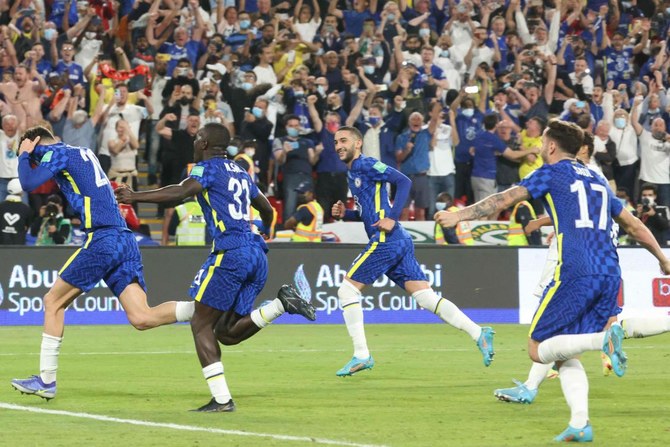
ABU DHABI: Kai Havertz scored a penalty deep into extra time as Chelsea defeated Palmeiras 2-1 in the Club World Cup final on Saturday to complete their collection of major trophies.
Romelu Lukaku’s superb header gave the European champions the lead on 54 minutes but Raphael Veiga levelled from the spot for the Copa Libertadores winners just past the hour in Abu Dhabi.
Havertz, the hero in the Champions League final against Manchester City, was Chelsea’s match-winner again as he converted a penalty on 117 minutes awarded following a VAR review.
Chelsea have now claimed every possible trophy since Roman Abramovich bought the club in 2003, and become the third English side to win the global tournament after Manchester United and Liverpool.
The Blues avenged their 1-0 loss to Corinthians in the 2012 final, but will have little time to celebrate with a critical stretch on the horizon once they return to London.
They face Lille in the Champions League last 16 either side of the League Cup final against Liverpool and FA Cup fifth round, playing in four different competitions in 12 days.
Chelsea coach Thomas Tuchel was back in the dugout having flown out to Abu Dhabi on Friday after missing the past two games following a positive test for Covid-19.
Edouard Mendy returned in goal in the wake of Senegal’s Africa Cup of Nations victory, at the expense of Kepa Arrizabalaga, whose much improved form is likely to attract interest from other clubs in the summer.
Chelsea’s decline in the Premier League has coincided with lack of authority and conviction, and despite controlling possession it wasn’t until the end of the first half they forced Weverton into a save.
Even then, Thiago Silva’s searing drive from distance appeared to be going wide.
In contrast, Palmeiras were twice left to rue their lack of efficiency as Dudu stabbed well wide before Andreas Christensen made a key intervention to negate a promising attack for the Brazilians.
Lukaku has struggled to meet expectations after rejoining Chelsea from Inter Milan as the club’s record signing, but the Belgian made it two goals in as many games here early in the second half.
Callum Hudson-Odoi, given the nod at left wing-back, whipped in a cross and Lukaku soared above two defenders to power beyond Weverton.
Christian Pulisic, brought on 30 minutes in for the injured Mason Mount, curled just wide after tidy interplay with Lukaku, but Chelsea gave Palmeiras a way back in when Silva handled in the area.
Australian referee Chris Beath was recommended to review the incident on the touchline monitor as Palmeiras players and coach Abel Ferreira appealed, and he almost immediately pointed to the spot.
Veiga, on target in the 2-0 win over Al Ahly, held his nerve to slam the penalty beyond Mendy, greeted with bellowing roars from many of the near-capacity 32,871 in attendance — the majority wearing the green and white of Palmeiras.
Pulisic again rolled an effort narrowly wide from an inviting lay-off and extra time came as little surprise, Chelsea forced to play an extra 30 minutes for the second time in a week.
A frantic scramble inside the six-yard box saw Pulisic bundle against the bar, although an offside in the build-up would have ruled out any goal.
Timo Werner curled over as time ticked away and Palmeiras defended deep, but Chelsea got the late breakthrough when Luan was penalized for blocking Cesar Azpilicueta’s volley with his arm.
Havertz sent Weverton the wrong way to spark wild celebrations, and a bitter night for Palmeiras culminated in them finishing with 10 men after Luan was sent off for scything down the German.

Havertz extra-time penalty secures Chelsea Club World Cup title
https://arab.news/2syuq
Havertz extra-time penalty secures Chelsea Club World Cup title
- Romelu Lukaku's superb header gave the European champions the lead on 54 minutes
- Havertz, the hero in the Champions League final against Manchester City, was Chelsea's match-winner again as he converted a penalty
MESIF 2026 wraps up in Riyadh with spotlight on legacy, fans and sustainable sports growth
- A recurring theme in panel discussions was the importance of moving beyond siloed planning toward connected strategies
- Abdullah Aldrees: I believe Saudi is a sleeping giant within the football ecosystem because of the high demand that exists
RIYADH: The sixth edition of the Middle East Sports Investment Forum concluded on Jan. 28 in Riyadh, reinforcing the need for long-term legacy planning, integrated infrastructure development and fan-centric strategies as the region’s sports ecosystem continues to mature.
Held over two days — Jan. 27-28 — at the ministry of investment headquarters and the Kingdom Arena, the forum brought together senior government officials, global sports executives, investors and technology leaders to assess how the Middle East — and Saudi Arabia in particular — can translate major event hosting and increased investment into sustainable impact.
A recurring theme in panel discussions was the importance of moving beyond siloed planning toward connected strategies that link infrastructure, finance, fan engagement and legacy from the earliest stages of project development.
Dr. Sakis Batsilas, deputy CEO of FIFA World Cup Qatar 2022, stressed that while international expertise has played a key role in the region’s rapid progress, long-term success depends on knowledge transfer and talent development.
“Yes, we do need experts and consultants and expatriates to help,” he said. “But the main, I would say, focus, is how we ensure that we transfer this knowledge and we build talent … to make sure we have the right talent.”
Drawing on his experience delivering major global events, Batsilas highlighted the need to embed legacy considerations during the bidding phase.
“Talking now from an operational point of view … I think everything starts with a bidding phase,” he said, adding that stronger legacy metrics would encourage greater long-term planning from host nations and rights holders alike.
Fan experience and commercialization also featured prominently, particularly as Saudi Arabia continues to expand its domestic leagues and host major international competitions. David Davies, chief experience officer of Catapult, said the Kingdom’s challenge lies in converting strong digital fandom into sustained in-stadium engagement.
“Saudi Arabia is … ranked consistently in the highest in the world” in terms of football fandom, Davies said. “However, attendance in-stadium is still developing.” He noted that younger, digitally native audiences require tailored engagement strategies. “The days of being able to ask them to come to you have gone,” he said.
From a government and delivery perspective, Abdullah Aldrees, chief of staff at the vice minister’s executive office at the ministry of sport, said MESIF highlighted the scale of opportunity ahead — and the importance of a joined-up approach.
“I believe Saudi is a sleeping giant within the football ecosystem because of the high demand that exists, the government support and the anchor IPs that we’re hosting,” Aldrees said. “So all of this can create a lot of opportunities for football to grow in Saudi.”
He said the Kingdom has entered a critical preparation phase as it gears up for a packed calendar of major events. “We are now living in the preparation phase. We’re preparing for all these IPs, we’re preparing for all these big events coming up,” Aldrees said. “So how do you make sure that you really reap the right benefit from them and have the right legacy?”
Pointing to upcoming milestones such as the AFC Asian Cup Saudi Arabia 2027 and the FIFA World Cup 2034, Aldrees emphasized the need to think beyond hosting.
“Yes, we’re hosting World Cup. We’re hosting Asia 2027, but how do you make sure that they have a long, lasting impact on the ecosystem?” he said.
Echoing a key message from the forum, Aldrees concluded: “The effective strategy is to be looking at these things together. We no longer can be looking at them as silos and test cycles.”
The transformation of Saudi football was also highlighted as a reflection of broader cultural and structural change. Juan Esteban Gomez, a football expert specializing in digitalization and artificial intelligence, said the shift has been tangible in recent years. “The people here are breathing football,” he said, describing the Saudi league as “one of the most enjoyable competitions in the world.”
As MESIF 2026 drew to a close, participants agreed that the next phase of sports investment in the Middle East will be defined by execution — ensuring that capital, policy and innovation align to deliver measurable legacy, deeper fan engagement and resilient ecosystems capable of sustaining growth well beyond headline events.


