Student hijab ban sparks fears over women’s access to education in India

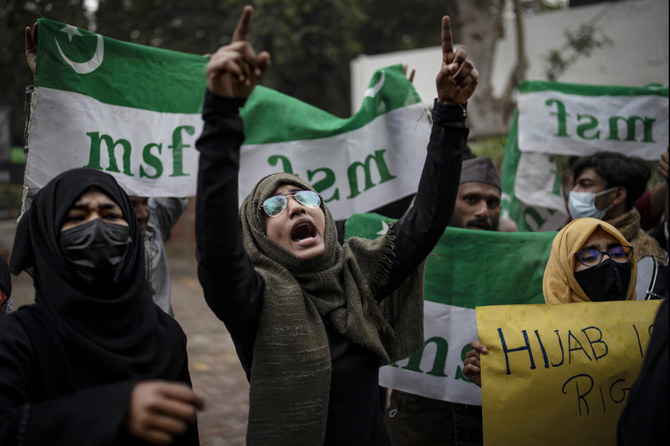
An Indian Muslim woman shouts slogans during a protest against barring Muslim girls wearing hijab from attending classes at some schools in the southern Indian state of Karnataka, in New Delhi, India, Tuesday, Feb. 8, 2022. (AP)
Short Url
Updated 12 February 2022
Follow

Student hijab ban sparks fears over women’s access to education in India

  • Girls barred from Karnataka school classes if wearing veil
  • More than 20 major women’s groups protest ban, calling it ‘apartheid’ practice

NEW DELHI: Major women’s rights groups in India have raised concerns over Muslim girls’ access to education after schools in the state of Karnataka barred them from wearing the hijab in classrooms.

The hijab controversy began in late January after Muslim girls at a government-run secondary school in the southern state’s Udupi district began protesting a new rule that prevented them from attending classes if they wore the Islamic head covering.

The local government earlier this month backed the school and banned the wearing of the hijab and “clothes which disturbed peace” at educational institutions.

The order sparked demonstrations in support of Muslim women’s right to wear the headscarf and counter protests by Hindu activists that soon escalated into violence, leading authorities to close local schools for three days.

Protests continued in several Indian cities on Friday, headed by more than 20 women’s organizations, which in an open letter to Karnataka’s chief minister said that the hijab ban was a practice of “apartheid.

“It is basically simply telling them that if you want to study, you will have to study in Muslim-only schools, which means you are enforcing apartheid,” Kavita Krishnan, secretary general of the All India Democratic Women's Association — one of the letter’s signatories — told Arab News on Saturday.

She added that ban was “an attack on Muslim women’s right to education.”

Vani Subramanian from Delhi-based women’s rights group Saheli, which also signed the letter, warned that the ban was more than an attack on education.

“The government is trying to whittle down on Muslim people’s rights in the country, like what you eat, what you wear,” she told Arab News.

Kavita Srivastva of the People’s Union for Civil Liberties — also a signatory — said that the government move was an “attack on Muslim women’s education.

“They don’t want Muslim women to study. The issue will die soon, but by the time it will put fear in so many girls and their families who will feel restrained to send their children to school,” she added.

“In Karnataka there was no such rule and people were free to wear whatever they wanted to wear, be it sari or headscarves.”

For Nabiya Khan, a Muslim activist, poet and writer, the whole controversy is an attempt to “otherize” Muslim women.

“They want to otherize us further and not let Muslims move towards an upward mobility,” she said.

Muslims make up about 12 percent of the population in Karnataka, which is a stronghold of Prime Minister Narendra Modi’s Bharatiya Janata Party.

Since coming to power in 2019, the local government has passed orders tightening the slaughter of beef in the state and introduced regulations making it difficult for interfaith couples to marry and for people to convert to Islam or Christianity.

The Karnataka High Court, which is hearing petitions against the ban, said on Thursday that students in the state should stop wearing religious garments in class until it makes a final ruling on whether schools can bar the wearing of the hijab.


Indonesia eyes investment boost from UAE after leaders’ meeting 

Updated 20 min 10 sec ago
Follow

Indonesia eyes investment boost from UAE after leaders’ meeting 

  • Indonesia-UAE trade was worth $6.4b in 2025, up from $5b in 2024
  • President Prabowo Subianto, MBZ also discussed increasing cooperation in renewable energy, tech, AI

JAKARTA: Indonesia is expecting more investments from the UAE, the Indonesian government said on Friday following talks between President Prabowo Subianto and his Emirati counterpart Sheikh Mohamed bin Zayed Al-Nahyan.

Indonesia’s relations with the UAE grew under former President Joko Widodo, who in 2021 secured more than $46 billion investment commitment from the Gulf state.

Subianto visited Abu Dhabi earlier this week accompanied by Foreign Minister Sugiono, and Energy and Mineral Resources Minister Bahlil Lahadalia on a trip aimed at strengthening cooperation under the Indonesia-UAE Comprehensive Economic Partnership Agreement. 

“The meeting discussed cooperation to increase investment (and) strengthen bilateral cooperation. The UAE wants to increase its investment in Indonesia,” Cabinet Secretary Teddy Indra Wijaya said in a statement, without disclosing any amount. 

Indonesia and the UAE signed the free trade deal in 2022, which came into force a year later. It was Jakarta’s first with a Gulf country and Abu Dhabi’s first with a Southeast Asian nation.

The Indonesia-UAE CEPA erases about 99 percent of existing tariffs and includes commitments to increase Indonesia’s services exports to the UAE by 6 percent while mutually recognizing each country’s halal certification.

Commerce between the two countries has seen a boost since then, with bilateral trade reaching more than $6.4 billion in 2025, according to Indonesian Trade Ministry data, showcasing an increase of nearly 27 percent from the previous year, when it was worth around $5 billion.

The Emirati state news agency WAM said the talks in Abu Dhabi also covered ways to increase cooperation in other sectors, including renewable energy, technology, artificial intelligence, sustainability, food security and culture.

“The (UAE) president noted the continuing progress of long-standing UAE-Indonesia relations, which are founded on mutual trust, respect and shared interests,” WAM said.

“He reaffirmed the UAE’s commitment to advancing its development and economic partnership with Indonesia for the benefit of both countries and their peoples.”

This year marks the 50th anniversary of diplomatic relations between Indonesia and the UAE.

The UAE was Subianto’s last stop on a multi-nation trip, which included the US, the UK and Jordan.