LONDON: Prince Charles has tested positive for COVID-19, his office said on Thursday, the second time that the heir to the British throne has contracted the disease.
Charles, 73, had been due to attend an event in Winchester, in southwestern England, to mark the 70th anniversary of the accession of his mother Queen Elizabeth and was “deeply disappointed” he could no longer attend, his office, Clarence House, said.
“This morning The Prince of Wales has tested positive for COVID-19 and is now self-isolating,” it said in a statement on Twitter.
There was no immediate comment on his condition or when he last saw his 95-year-old mother.
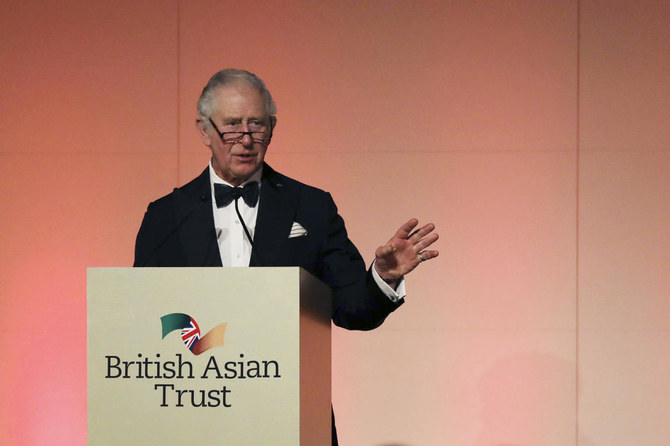
On Wednesday, the prince attended a reception for the British Asian Trust where pictures showed him chatting to other guests including British finance minister Rishi Sunak. Health minister Sajid Javid and interior minister Priti Patel were also among those who were due to attend.
Charles, who said in December both he and his wife Camilla had received their COVID-19 vaccine booster shots, previously tested positive for the virus in March 2020 when he said he had been “lucky” to have suffered only mild symptoms.
He spent seven days in self-isolation at his Birkhall home in Scotland before resuming his duties. Charles’s son Prince William also contracted COVID-19 shortly after his father in 2020.
Camilla was still performing engagements in London on Thursday. She said she was “very, very honored” and “very touched” by Elizabeth publicly stating her desire that Charles’s second wife should become Queen Consort when he becomes king.

UK’s Prince Charles tests positive for COVID-19 for a second time
https://arab.news/2yqam
UK’s Prince Charles tests positive for COVID-19 for a second time
- Charles, 73, had been due to attend an event in Winchester to mark the 70th anniversary of the accession of his mother Queen Elizabeth
- There was no immediate comment on his condition or when he last saw his 95-year-old mother
Stranded travelers scramble to make new connections as war shuts much of Middle East to air travel
- Airspace or airports in Israel, Qatar, Syria, Iran, Iraq, Kuwait, Bahrain, Oman and the United Arab Emirates were closed, according to flight tracking sites and government agencies there
DUBAI: Hundreds of thousands of stranded travelers scrambled to make new connections and get through to airlines on jammed phone lines Sunday after the attack on Iran by the United States and Israel shut down much of the Middle East to air travel.
Tourists and business travelers crowded hotels and airports, with no word on when many airports would reopen or when flights to and through the Middle East would resume. Some governments advised their stranded citizens to shelter in place.
Shutdown airports in Dubai, Abu Dhabi and Doha — including Dubai International Airport, one of the busiest in the world — are important hubs for travel between Europe, Africa and the West to Asia. All three were directly hit by strikes.
Mohammad Abdul Mannan, in the crowd at Hazrat Shahjalal International Airport in Dhaka, Bangladesh, said he wasn’t concerned about the war, but that he needs to get his flight to the Middle East to make a living.
“We have set out to go for work, and we must go,” he said. “My only concern is how to go abroad and how to earn an income.”
Confusion reigned for many travelers as they tried to get answers on online portals or through busy phone lines.
In Dubai, stranded travelers could hear fighter jets overhead and an explosion when the Fairmont Palm Hotel was hit by a missile strike.
Many were unable to get updated flight information from tour operators or Dubai-based Emirates, which suspended all flights to and from Dubai until at least Monday afternoon.
Louise Herrle and her husband had their flight to Washington canceled on their way back to their Pittsburgh home after a tour of Dubai and Abu Dhabi, with no word when they could reschedule.
“We’re in the hotel room, we are not leaving it, so you’re not going to give it up until we know we have a flight out of here,” Herrle said. “I’m sure everyone else is in the same situation.”
Flights canceled, airports and airspaces still closed
Cirium, an aviation analytics firm, said it is hard to calculate the number of travelers stranded worldwide.
However, it estimated that at least 90,000 people alone change flights daily in the airports in Dubai, Doha or Abu Dhabi on just three airlines, Emirates, Qatar Airways and Etihad Airways.
Airspace or airports in Israel, Qatar, Syria, Iran, Iraq, Kuwait, Bahrain, Oman and the United Arab Emirates were closed, according to flight tracking sites and government agencies there.
More than 2,800 flights were canceled Sunday to and from airports across the Middle East, including those that remained open in Saudi Arabia, Jordan and Egypt, according figures on flight tracking site FlightAware. International airports in London, Mumbai, Delhi, Bangkok, Istanbul, Sri Lanka and Paris each reported dozens of flights canceled, as well.
Cancellations will extend beyond Sunday, at least.
Emirates suspended all flights to and from Dubai until at least Monday afternoon. Air India suspended all flights to and from the United Arab Emirates, Saudi Arabia, Israel and Qatar until Tuesday. Israeli airline EL AL said it was preparing to fly home Israelis stranded abroad once the airspace reopened and closed ticket sales for flights through March 21 to ensure stranded customers get priority.
Two airports in the United Arab Emirates reported strikes as the government there condemned what it called a “blatant attack involving Iranian ballistic missiles” on Saturday.
Officials at Dubai International Airport said four people were injured, while Zayed International Airport in Abu Dhabi said one person was killed and seven others were injured in a drone strike. Strikes were also reported at Kuwait International Airport.
Iran did not publicly claim responsibility.
Flight disruptions are likely to continue
Airlines urged passengers to check their flight status online before heading to the airport. Some airlines issued waivers to affected travelers that will allow them to rebook their flight plans without paying extra fees or higher fares. Others offered full refunds.
“For travelers, there’s no way to sugarcoat this,” said Henry Harteveldt, an airline industry analyst and president of Atmosphere Research Group. “You should prepare for delays or cancelations for the next few days as these attacks evolve and hopefully end.”
Mike McCormick, who used to oversee air traffic control for the Federal Aviation Administration, said countries might reopen their airspace once American and Israeli officials tell airlines where military flights are operating and how capable Iran remains at firing missiles.
‘No one really knows what’s going on’
The reverberations echoed far outside the Middle East — for example, airport authorities in the resort island of Bali in Indonesia said more than 1,600 tourists were stranded at I Gusti Ngurah Rai International Airport on Sunday after five flights to the Middle East were canceled or postponed.
Airlines that are crossing the Middle East will have to reroute flights around the conflict with many flights headed south over Saudi Arabia. That will cause delays and higher costs.
Kristy Ellmer, an American who had been on business meetings in Dubai, said she was staying in a hotel and keeping multiple flights booked in case airports reopen.
She said she was gaining confidence in the government’s ability to protect the city from missiles, but also keeping away from windows when she hears explosions.
“You hear a lot of explosions at times, there’s hundreds of them,” Ellmer said. “And so when we hear them we sort of just don’t stay near the windows just in case the glass was to break or there was some impact.”


