


Britain’s Prince Charles in Cairo, first visit since 2006

1 / 8
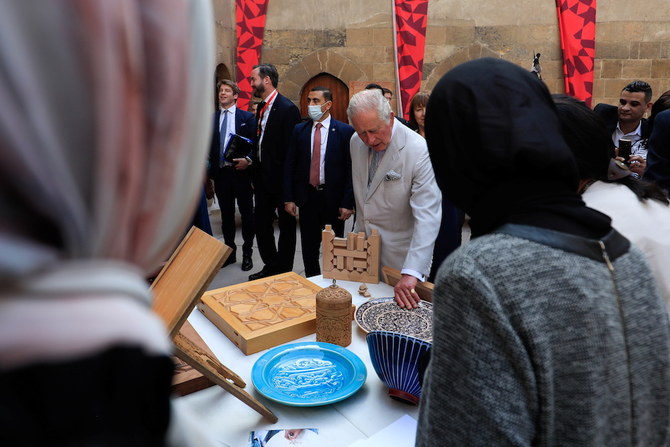
Britain's Prince Charles visits Bayt Al-Razzaz Palace in the Darb Al-Ahmar neighbourhood of old Cairo. (AP)
2 / 8
Britain's Prince Charles visits Bayt Al-Razzaz Palace in the Darb Al-Ahmar neighbourhood of old Cairo. (Reuters)
3 / 8
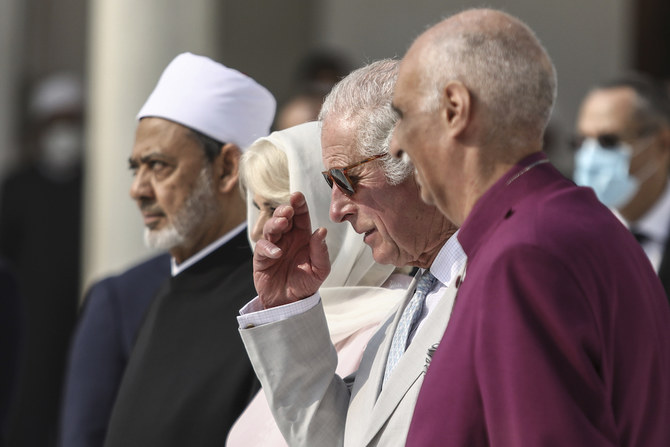
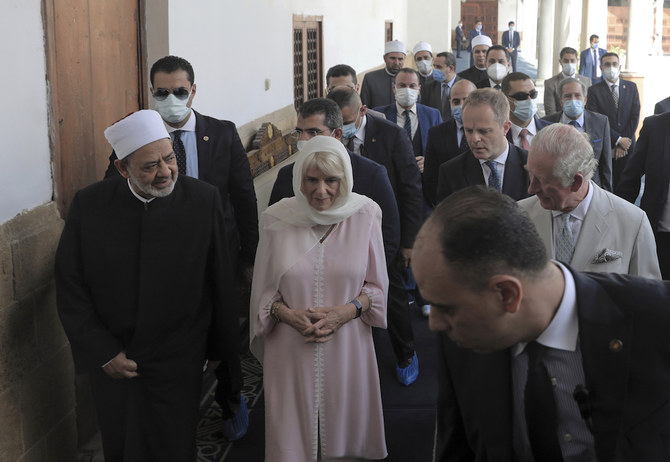
Prince Charles and his wife, Camilla visit the Al-Azhar Mosque, the oldest Sunni institution in the Muslim world with Grand Imam of Al-Azhar Mosque Ahmed Al-Tayeb. (AP)
4 / 8
Prince Charles and his wife, Camilla visit the Al-Azhar Mosque, the oldest Sunni institution in the Muslim world with Grand Imam of Al-Azhar Mosque Ahmed Al-Tayeb. (AP)
5 / 8
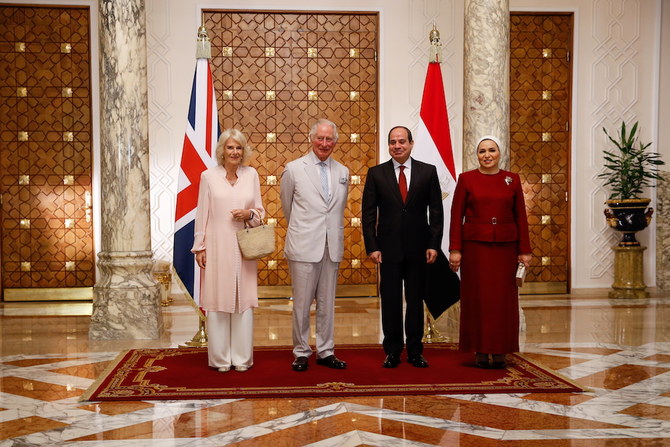
President Abdel Fatteh El-Sisi and his wife Intisar El-Sisi received the couple at the Federal Palace. (Reuters)
6 / 8
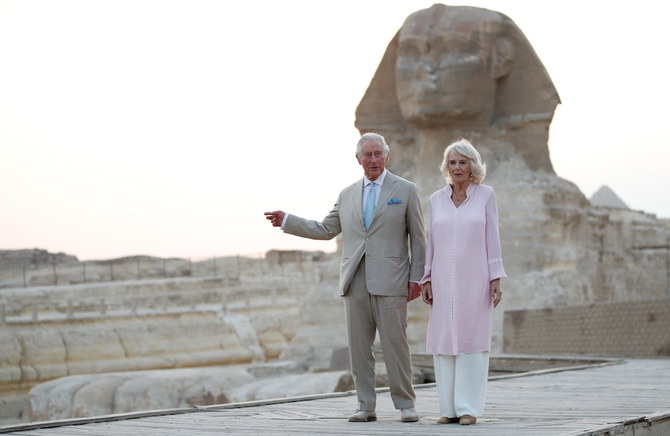
Britain's Prince Charles, Prince of Wales, and Camilla, Duchess of Cornwall, walk next to Egypt's Antiquities and Tourism Minister Khaled Al-Anany near the Pyramids of Giza. (Reuters)
7 / 8
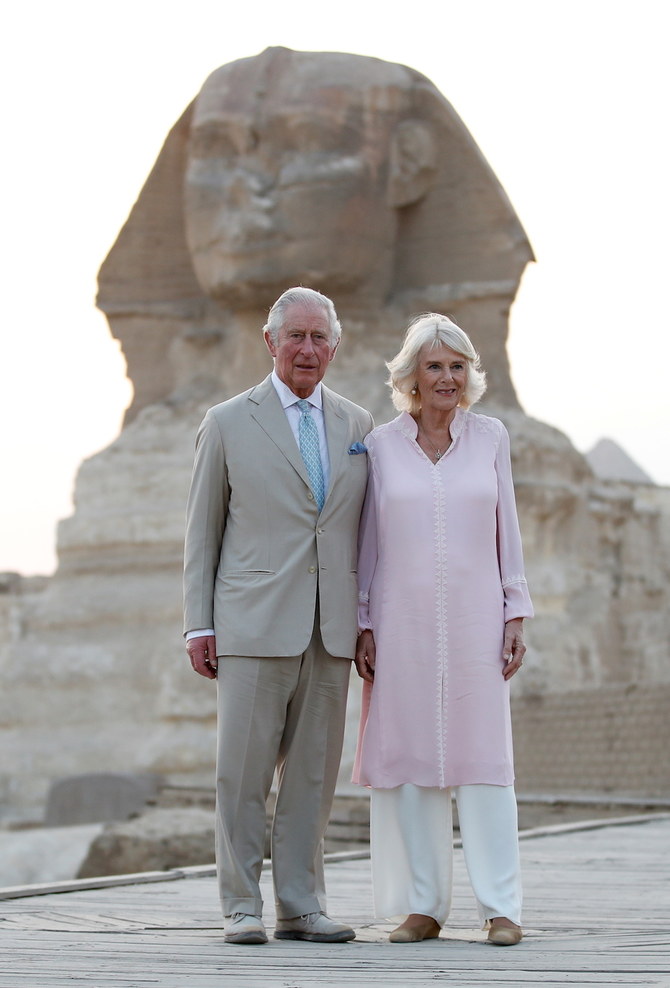
Britain's Prince Charles, Prince of Wales, and Camilla, Duchess of Cornwall, pose in front of the Sphinx, on the outskirts of Cairo. (Reuters)
8 / 8
Britain's Prince Charles, Prince of Wales, and Camilla, Duchess of Cornwall, pose in front of the Sphinx, on the outskirts of Cairo. (Reuters)
Short Url
Updated 18 November 2021
Follow

Britain’s Prince Charles in Cairo, first visit since 2006

  • Prince and wife Camilla received formal welcome by President Abdel Fattah El-Sissi and his wife

CAIRO: Prince Charles and Camilla, Duchess of Cornwall, began a two-day visit to Egypt on Thursday as part of a tour that also includes Jordan. 

It is their first official overseas trip since the start of the pandemic and their second to Egypt. 

They visited the country in 2006 as part of a tour that included Saudi Arabia and India, with the aim of promoting better understanding and tolerance between religions, supporting environmental initiatives, and encouraging sustainable job opportunities and training for young people.

Prince Charles visited Al-Azhar, Al-Azhar Park, Siwa Oasis, and inaugurated the British University in Cairo during that trip.

He said in his speech at Al-Azhar University: “I believe with all my heart that responsible men and women should work to restore mutual respect between religions, and we must do everything in our power to overcome the mistrust that poisons the lives of many people.”

He also visited Egypt in 1981 with the late Diana, Princess of Wales, on their honeymoon. They stopped on their yacht in Port Said and were received by President Anwar Sadat and his wife.

The British embassy in Cairo said the visit program would give the royal couple an opportunity to celebrate the culture of ancient Egypt and its spiritual importance, while also looking at modern Egypt, which embraces a more environmentally friendly future.

President Abdel Fatteh El-Sisi and his wife Intisar El-Sisi received the couple at the Federal Palace to officially welcome them. This meeting looks to strengthen the religious ties between the UK and Egypt.

The prince will meet artisans and conservators to celebrate traditional craftsmanship and the UK's support for cultural heritage preservation.

A reception to celebrate bilateral ties will be held in the Giza plateau area overlooking the pyramids and, on the last day of the trip, the couple will visit the ancient city of Alexandria.

They will visit programs and institutions in areas they are committed to supporting. 

The prince focuses on environmental issues, interfaith dialogue, heritage preservation, and providing jobs and opportunities for young men and women. The duchess continues her commitment to supporting women, as well as educating girls.

The embassy also said ​​the visit followed the UK’s hosting of COP26 and that Egypt would assume the presidency of COP27 next year. 

The prince has a deep interest in environmental issues and will look for ways to cooperate on climate change.


Gaza’s ceasefire had some momentum. Now, some fear a new war will distract the world

Updated 7 sec ago
Follow

Gaza’s ceasefire had some momentum. Now, some fear a new war will distract the world

  • Residents say they are scared of neglect and deprivation, with Israel in the wake of the weekend strikes closing all crossings into their shattered territory of over 2 million people

DEIR AL-BALAH, Gaza Strip: Some Palestinians say they fear the widening war sparked by US and Israeli attacks against Iran could overshadow the fragile situation in Gaza, just over a week after US President Donald Trump rallied billions of dollars in pledges for the territory’s reconstruction and tried to nudge a ceasefire forward.
Residents say they are scared of neglect and deprivation, with Israel in the wake of the weekend strikes closing all crossings into their shattered territory of over 2 million people.
Palestinians told The Associated Press they were rushing to markets, haunted by memories of painful food scarcity last year under months of Israel’s blockade. Part of Gaza, around Gaza City, was found to be in famine.
“When the crossings shut down, everything was suspended from the market,” said Osamda Hanoda from Khan Younis. “The prices go up, and people live in misery.”
Reports show prices of goods rising sharply
The shaky Israel-Hamas ceasefire had led to more humanitarian aid and other supplies entering Gaza, even as the United Nations and aid partners say more of everything from basic medical supplies to fuel is needed.
Now, Palestinians are hoarding again, with reports of prices rising sharply for basic goods such as bags of flour.
“We are afraid of not finding milk” and diapers for the kids, or food and water, said Hassan Zanoun, who was displaced from Rafah.
COGAT, the Israeli military body overseeing civilian affairs in Gaza, did not respond to a request for comment Sunday. In its announcement of the closings, it asserted that the food supply inside the territory “is expected to suffice for an extended period.” It added that the rotation of humanitarian workers in and out of Gaza is postponed.
It was not clear when any crossing might reopen. Israeli authorities focused on Iran, and citizens dashed repeatedly for shelter as sirens wailed.
Ramadan is disrupted
The war in Gaza began with the Hamas-led attack on Israel on Oct. 7, 2023, and it’s been marked from the start by restrictions on people and supplies being allowed into the territory — and terrified people, including medical evacuees in need of treatment, getting out.
A month ago, Gaza’s main Rafah border crossing with the outside world — its only crossing not with Israel — reopened, allowing a small and tightly controlled flow of Palestinian traffic in both directions. No cargo was allowed through.
Now all crossings are closed again in the middle of the holy Muslim fasting month of Ramadan, a time of chosen deprivation, evening feasts and prayer. Images have shown Palestinians lined up at long tables in the middle of bombed-out debris.
The strikes on Iran shook that routine.
“All the people rushed to markets, and they all wanted to shop and hide,” said Abeer Awwad, who was displaced from Gaza City, as word of the explosions in Tehran began to spread.
Under the Oct. 10 US-brokered ceasefire, the heaviest fighting has subsided, though regular Israeli fire continues in Gaza. The UN World Food Program has noted progress in the enclave but said in its latest food security analysis last week that hunger remains.
“Households reported an average of two meals per day in February 2026, compared to one meal in July,” it said. “Still, one in five households consumed only one meal daily.”
A challenge for aid groups and others
Refocusing the world’s attention on Gaza is a challenge for aid groups and others as Iran scrambles for new leadership and explosions continue in Tehran, Israel and around the Middle East.
Trump has said bombing in Iran could continue through the week or longer, and warned Tehran of “A FORCE THAT HAS NEVER BEEN SEEN BEFORE!” if it escalates attacks.
It’s a dramatic turn from Trump’s launch less than two weeks ago of his new Board of Peace, a gathering of world leaders that is aimed at ending the war in Gaza but has ambitions of resolving conflicts elsewhere.
Even with that bump in momentum on Gaza, major challenges remain for the ceasefire. They include disarming Hamas, assembling and deploying an international stabilization force, and getting a newly appointed Palestinian committee meant to govern Gaza into the territory.
As the Middle East turns to another war, some Palestinians see a benefit: Israel’s military is distracted.
“The good thing is that the sound of booms and demolitions is rare now near the yellow line,” said Ahmed Abu Jahl, of Gaza City, speaking about the line dividing Gaza and marking out roughly half the territory controlled by Israeli forces.
“Even the drones, they are still flying overhead, but their number has gone down.”