

US has not been an ‘all weather friend’ to Pakistan like China — PM Khan

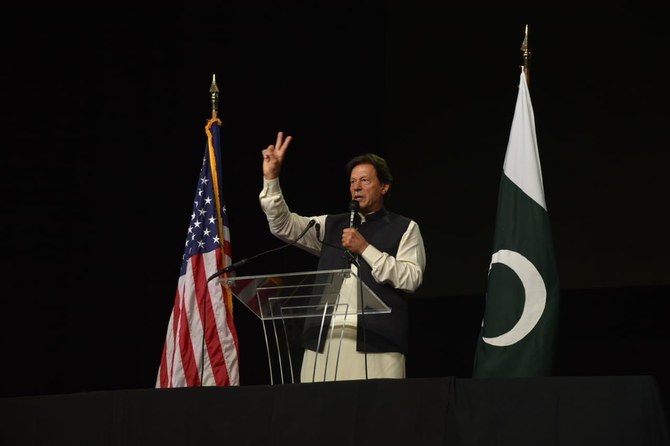
Prime Minister of Pakistan Imran Khan addressing Pakistani-Americans, at the Capital One Arena in Washington DC on Sunday, 21 July 2019. (Photo courtesy: Ministry of Foreign Affairs, Islamabad)
Short Url
Updated 10 February 2022
Follow

US has not been an ‘all weather friend’ to Pakistan like China — PM Khan

  • World does not want “second Cold War,” Pakistani PM says on US-China ties
  • Says his “first priority” after coming to power in 2018 was to normalize ties with India

ISLAMABAD: Prime minister Imran Khan has said the United States had not been an “all weather friend” to Pakistan the way China had been, saying the US had “abandoned” Islamabad when the South Asian nation was of "no use" to the Western superpower.
Despite being allies in the war on terror, Pakistan and the US have had a complicated relationship, bound for decades by Washington’s dependence on Islamabad to supply its troops in Afghanistan but plagued by accusations that Pakistan was playing a “double game.” Pakistan denies this.
Last year, US Secretary of State Antony Blinken said Washington would be reevaluating its relationship with Pakistan to formulate what role it would want Islamabad to play in the future of Afghanistan after it was retaken by the Taliban last August. He said Pakistani had a “multiplicity of interests some that are in conflict with ours.”
On the other hand, China and Pakistan consider each other “all-weather friends” and have close diplomatic, economic and security ties. China has also pledged an estimated $60 billion for infrastructure and energy projects in Pakistan under the China-Pakistan Economic Corridor.
“United States has also been a good friend to Pakistan but it hasn’t been a sort of, like with China, an all-weather friend,” Khan said in an interview with Dr. Eric Li, the director of the advisory committee of the China Institute of Fudan University. “There have been times where the US has been very friendly but then when you know, they think Pakistan is not of use to them, then we get abandoned, and then they again sort of become friendly."
The PM also warned against a “cold war” between China and the US.
The United States and China, the world’s top two economies, are at loggerheads over a wide range of issues from Beijing’s handling of the coronavirus to its imposition of a new security law in Hong Kong and ambitions in the South China Sea.
A US call for the Quad nations of the United States, Japan, India and Australia to form a united front against China’s growing influence is a sensitive subject for its regional allies, which are reliant on China for trade.
“If it [US-China rivalry] goes into a Cold War type of situation, like we witnessed after the second world war … I think the world does not want a second Cold War,” the Pakistani PM said, referring to a period of geopolitical tension between the US and then Soviet Union and their respective allies.
Speaking about relations with neighboring India, with whom Pakistan has been engaged in an over seven-decades long dispute over the Himalayan territory of Kashmir, Khan said Pakistan’s only “issue” with India was the disputed region where Muslims were being denied their right to self determination.
“When my government came into power [in 2018], my first priority was to normalize relations with India,” the PM said. “And we have only one issue with India and that is Kashmir, where India is denying the people of Kashmir the right of self-determination which was guaranteed by the UNSC resolutions,” he added, referring to the Security Council which has adopted several resolutions on the dispute, including one that says a plebiscite should be held to determine the region's future.


Pakistan, Canada explore deeper trade, mining and agriculture cooperation

Updated 5 sec ago
Follow

Pakistan, Canada explore deeper trade, mining and agriculture cooperation

  • The development comes as Pakistan seeks to boost trade, foreign investment to strengthen its more than $400 billion economy
  • Both sides reviewed the evolving global economic landscape, underscored the need for adaptive trade strategies, Islamabad says

KARACHI: Pakistani and Canadian officials have discussed ways to deepen cooperation in trade, mining and agriculture, the Pakistani commerce ministry said on Saturday, with both sides seeking to expand economic ties.

The statement came after Pakistani Commerce Minister Jam Kamal Khan’s meeting with Canadian High Commissioner to Pakistan Tarik Ali Khan that focused on expanding bilateral cooperation in trade, investment, mining, agriculture, energy and emerging sectors.

Pakistan, which is recovering from a prolonged economic meltdown under a $7 billion International Monetary Fund (IMF) program, has sought to boost trade, foreign investment to strengthen its more than $400 billion economy.

“During the meeting, both sides reviewed the evolving global economic landscape and underscored the need for adaptive trade strategies amid shifting supply chains and geopolitical realignments,” the Pakistani commerce ministry said in a statement.

“The federal minister emphasized Pakistan’s intent to diversify partnerships and attract quality foreign investment, particularly in value-adding and export-oriented sectors.”

A major focus of discussions was cooperation in the mining and minerals sector. Pakistan has vast mineral resources, including Reko Diq copper-gold mine, which is one of the world’s largest undeveloped mines.

The Reko Diq project, located in the Balochistan province, is also being developed by Canadian mining giant Barrick Gold in partnership with Pakistan’s federal and provincial governments.

Commerce Minister Khan highlighted Pakistan’s growing interest in developing small and medium-scale mining projects and stressed the importance of modern exploration techniques, surveying expertise and responsible mining governance.

“The Canadian high commissioner noted Canada’s global leadership in mining services and exploration technologies and expressed willingness to support Pakistan through capacity-building initiatives, technical assistance and business-to-business matchmaking,” the commerce ministry said.

“In this context, both sides discussed Pakistan’s participation in the Prospectors & Developers Association of Canada (PDAC) conference in Toronto, with an emphasis on linking Pakistani miners with reputable Canadian exploration companies and service providers.”

The meeting also covered agricultural cooperation, with particular reference to the recent resumption of Canadian canola exports to Pakistan, according to the statement. The two sides acknowledged the successful arrival of initial shipments and agreed to work closely on addressing regulatory and procedural bottlenecks to ensure smooth and timely imports.

“Discussions further explored potential cooperation in dairy and livestock development, including animal genetics, modern dairy farming technologies and disease-control mechanisms, aimed at enhancing productivity and quality standards in Pakistan,” the commerce ministry added.

“On the energy front, the Canadian High Commissioner raised issues related to Canadian investments in renewable energy projects in Pakistan and stressed the importance of regulatory predictability and timely approvals to sustain investor confidence. Both sides also reviewed progress on the Pakistan–Canada Bilateral Investment Treaty (BIT) and agreed on the need to maintain momentum in negotiations to encourage greater Canadian investment.”