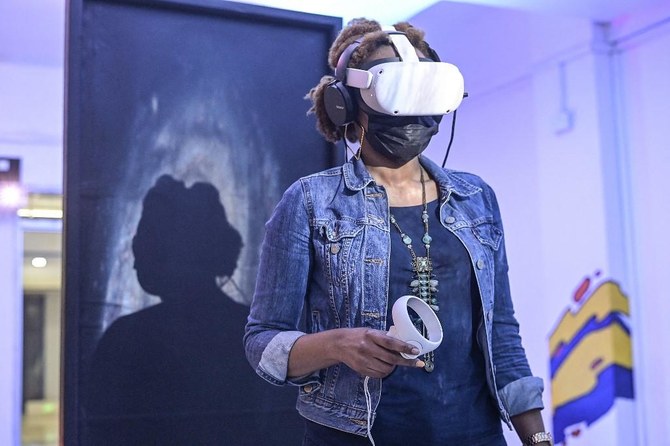
Facebook owner Meta adds tool to guard against harassment in metaverse

Its new “personal boundary” tool will make users feel like they have nearly four feet between their virtual avatar and others. (File/AFP)
Short Url
Updated 07 February 2022
Follow

Facebook owner Meta adds tool to guard against harassment in metaverse

  • Facebook adds tool to safeguard against harassment and maintain personal space boundaries in the metaverse

LONDON: Facebook’s parent Meta Platforms said on Friday it is launching a tool for people using its virtual reality social platforms to maintain personal space boundaries, as concerns have mounted about user safety and sexual harassment in the metaverse.
Its new “personal boundary” tool will make users feel like they have nearly four feet (1.2 meters) between their virtual avatar and others when they access the immersive Horizon Worlds and Horizon Venues apps through VR headsets.
The company said in a blog post that this new default setting would make it easier to avoid unwanted interactions. The change comes as users of VR platforms including Horizon Worlds have raised alarms about virtual groping and other abusive behavior.
Facebook Inc. changed its name to Meta, and has invested heavily in virtual and augmented reality to reflect its new bet on the metaverse, a futuristic idea of a network of virtual environments accessed via different devices where users can work, socialize and play.
Horizon Worlds, an expansive VR social platform, and Horizon Venues, which is focused on virtual events, are early iterations of metaverse-like spaces.
Shares of Meta, which is pouring billions of dollars into its metaverse ambitions, plummeted 26 percent on Thursday in the biggest single-day slide in market value for a US company, after the social media giant issued a dismal forecast, blaming Apple Inc’s privacy changes and increased competition.
The company has long been under scrutiny from global lawmakers and regulators over its handling of problematic content and abuses on its existing social media platforms such as Facebook and Instagram.
Meta said the new tool built on its current “hand harassment measures,” where an avatar’s hands would disappear if they invaded someone’s personal space. It also currently has a “Safe Zone” feature where people can activate a bubble around their avatar if they feel threatened.
Meta’s vice president of Horizon Vivek Sharma said in the blog that the company believed the new personal boundaries would help set “behavioral norms.”
“It’s an important step, and there’s still much more work to be done. We’ll continue to test and explore new ways to help people feel comfortable in VR,” said Sharma.
He said in the future, Meta would look at the possibility of adding in controls like letting people change the size of their personal boundary.
For now, the company noted users will have to “extend their arms to be able to high-five or fist bump other people’s avatars.”


Malaysia, Indonesia become first to block Musk’s Grok over AI deepfakes

Updated 12 January 2026
Follow

Malaysia, Indonesia become first to block Musk’s Grok over AI deepfakes

  • Authorities in both countries acted over the weekend, citing concerns about non-consensual and sexual deepfakes
  • Regulators say existing controls cannot prevent fake pornographic content, especially involving women and minors

KUALA LUMPUR: Malaysia and Indonesia have become the first countries to block Grok, the artificial intelligence chatbot developed by Elon Musk’s xAI, after authorities said it was being misused to generate sexually explicit and non-consensual images.
The moves reflect growing global concern over generative AI tools that can produce realistic images, sound and text, while existing safeguards fail to prevent their abuse. The Grok chatbot, which is accessed through Musk’s social media platform X, has been criticized for generating manipulated images, including depictions of women in bikinis or sexually explicit poses, as well as images involving children.
Regulators in the two Southeast Asian nations said existing controls were not preventing the creation and spread of fake pornographic content, particularly involving women and minors. Indonesia’s government temporarily blocked access to Grok on Saturday, followed by Malaysia on Sunday.
“The government sees non-consensual sexual deepfakes as a serious violation of human rights, dignity and the safety of citizens in the digital space,” Indonesia’s Communication and Digital Affairs Minister Meutya Hafid said in a statement Saturday.
The ministry said the measure was intended to protect women, children and the broader community from fake pornographic content generated using AI.
Initial findings showed that Grok lacks effective safeguards to stop users from creating and distributing pornographic content based on real photos of Indonesian residents, Alexander Sabar, director general of digital space supervision, said in a separate statement. He said such practices risk violating privacy and image rights when photos are manipulated or shared without consent, causing psychological, social and reputational harm.
In Kuala Lumpur, the Malaysian Communications and Multimedia Commission ordered a temporary restriction on Grok on Sunday after what it said was “repeated misuse” of the tool to generate obscene, sexually explicit and non-consensual manipulated images, including content involving women and minors.
The regulator said notices issued this month to X Corp. and xAI demanding stronger safeguards drew responses that relied mainly on user reporting mechanisms.
“The restriction is imposed as a preventive and proportionate measure while legal and regulatory processes are ongoing,” it said, adding that access will remain blocked until effective safeguards are put in place.
Launched in 2023, Grok is free to use on X. Users can ask it questions on the social media platform and tag posts they’ve directly created or replies to posts from other users. Last summer the company added an image generator feature, Grok Imagine, that included a so-called “spicy mode” that can generate adult content.
The Southeast Asian restrictions come amid mounting scrutiny of Grok elsewhere, including in the European Union, Britain, India and France. Grok last week limited image generation and editing to paying users following a global backlash over sexualized deepfakes of people, but critics say it did not fully address the problem.