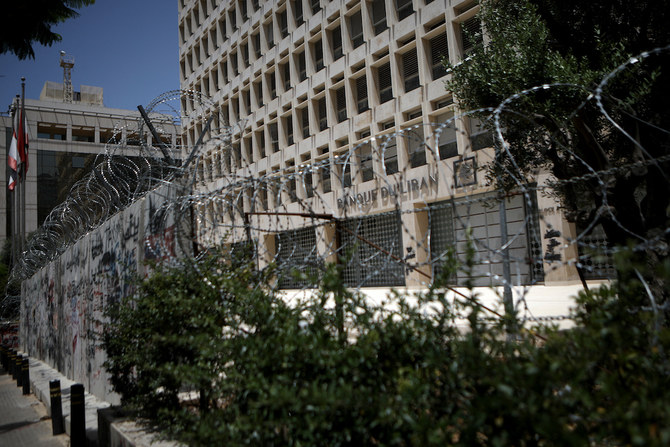
BEIRUT: Lebanon’s President Michel Aoun promised on Monday that an audit into the country’s central bank crucial for financial rescue would hold the organization accountable, despite efforts to limit the probe.
The audit is a condition for Lebanon to secure foreign aid to help it recover from a financial meltdown the World Bank described as one of the world’s sharpest ever economic depressions.
Earlier this month, the staff union of Lebanon’s central bank said it did not want personal data handed over to the restructuring consultancy Alvarez and Marsal (A&M), which could further hamper attempts to carry out the audit.
Aoun is monitoring attempts to overcome “artificial obstacles” discouraging the company from carrying out a forensic audit, his media office said in a statement.
The statement added the presidency hopes that there is not “something to hide in the accounts of the bank.”
Aoun criticized what he called the “deliberate procrastination” by the central bank in handing over the complete data required by A&M.
The central bank issued a statement on Monday responding to the president’s criticisms, saying it provided A&M with all the required data “in a manner that doesn’t conflict with the law and international standards.”
The central bank said it stresses A&M should start its work and make sure itself that the data provided is correct.
Central bank governor Riad Salameh, who denies any wrongdoing during almost three decades leading the central bank, is being probed in Lebanon and at least four European countries, with his role under close scrutiny since Lebanon’s economic collapse in 2019.
“The Lebanese people have the right to know how the gap in the central bank’s accounts arose and grew. Private banks stumbled, depositors’ money was wasted, and a lifetime was robbed,” the president added.
The gap refers to a portion of losses in Lebanon’s financial sector attributable to the central bank.
The governor has support from several top politicians and stayed in his post even as the economy has been crushed by huge debts, the currency has collapsed and many Lebanese have been driven into poverty.
Aoun “promises the people that accountability is coming,” the statement said.

Lebanon President Aoun promises central bank audit will provide accountability
https://arab.news/nsr25
Lebanon President Aoun promises central bank audit will provide accountability
- The central bank says audit company A&M must start its work and make sure the data provided is correct
Industry leaders highlight Riyadh’s Metro, infrastructure as investment catalysts
RIYADH: Saudi Arabia’s capital, Riyadh, is experiencing a transformative phase in its real estate sector, with the construction market projected to reach approximately $100 billion in 2025, accompanied by an anticipated annual growth rate of 5.4 percent through 2029.
The Kingdom is simultaneously advancing its data center capacity at an accelerated pace, with an impressive 2.7 GW currently in the pipeline. This expansion underscores the critical role of strategic land and power planning in establishing national infrastructure as a cornerstone of economic growth.
These insights were shared by leading industry experts during JLL’s recent client event in Riyadh, which focused on the city’s macroeconomic landscape and emerging trends across office, residential, retail, hospitality, and pioneering sectors, including AI infrastructure and Transit-Oriented Development.
Saud Al-Sulaimani, Country Lead and Head of Capital Markets at JLL Saudi Arabia, commented: “Riyadh is positioned at the forefront of Saudi Arabia’s Vision 2030, offering unparalleled opportunities for both investors and developers. National priorities are continuously recalibrated to ensure strategic alignment of projects and foster deeper collaboration with the private sector.”
He added: “Recent regulatory developments, including the introduction of the White Land Tax and the rent freeze, are designed to stabilize the market and are expected to drive renewed focus on delivering premium-quality assets. This dynamic environment, coupled with evolving construction cost considerations in select segments, is fundamentally reshaping the market landscape while accelerating progress toward our national objectives.”
The event further underscored the transformative impact of infrastructure initiatives. Mireille Azzam Vidjen, Head of Consulting for the Middle East and Africa at JLL, highlighted Riyadh’s transit revolution. She detailed the Riyadh Metro, a $22.5 billion investment encompassing 176 kilometers, six lines, and 84 stations, providing extensive geographic coverage, with a depth of 9.8 km per 100 sq. km. This strategic development generates significant TOD opportunities, with properties in proximity potentially commanding a 20-30 percent premium. JLL emphasized the importance of implementing climate-responsive last-mile solutions to enhance mobility and accessibility, particularly given Riyadh’s extreme temperatures.
Gaurav Mathur, Head of Data Centers at JLL, emphasized the rapid expansion of the Kingdom’s AI infrastructure, signaling a critical area for technological investment and innovation.
Focusing on the construction sector, Maroun Deeb, Head of Projects and Development Services, KSA at JLL, explained that the industry is actively navigating complexities such as skilled labor availability, material costs, and supply chain dynamics.
He highlighted the adoption of Building Information Modeling as a key driver for enhancing operational efficiency and project delivery.