

Pakistani artist’s unique Qur’anic installation attracts huge crowds at Dubai Expo

Pakistani-Canadian artist Shahid Rassam can be seen at the unveiling of the “world’s largest Quran” at the Pakistan Pavilion in Dubai, UAE, on January 24, 2022. (Photo courtesy: Pakistan Pavilion at Dubai Expo 2020)
Short Url
Updated 31 January 2022
Follow

Pakistani artist’s unique Qur’anic installation attracts huge crowds at Dubai Expo

  • Shahid Rassam has cast a portion of the Islamic scripture on a high-quality canvas with aluminum and gold-plated script
  • The 49-year-old artist says it will be a multimillion-dollar project to write the entire Qur’an using the same technique

DUBAI: People in large numbers have started visiting the Pakistan Pavilion at Dubai Expo 2020 to see what is said be the world’s largest Qur’an designed by a Pakistani-Canadian artist Shahid Rassam.
Surah Ar-Rahman, a chapter of the Islamic scripture which has been cast on a high-quality canvas with aluminum and gold-plated script, was unveiled at the pavilion on January 24 by Pakistan’s commerce chief Abdul Razak Dawood and its envoy to the United Arab Emirates (UAE) Afzaal Mahmood.
Speaking to Arab News on Sunday, the 49-year-old artist said the portion of the Qur’an will continue to be exhibited at the event until its end on March 31.
“I did not expect the Qur’an to become the highlight at the expo,” Rassam, who is currently visiting Dubai to promote the project, said.
He noted that writing the whole scripture in such a huge size was going to be a multimillion-dollar project since it would require 200 kilograms of gold and 2,000 kilograms of aluminum to cast around 80,000 words on 550 pages.

“This will be a gigantic multimillion-dollar project requiring the support of the governments of Pakistan and the UAE,” he continued.
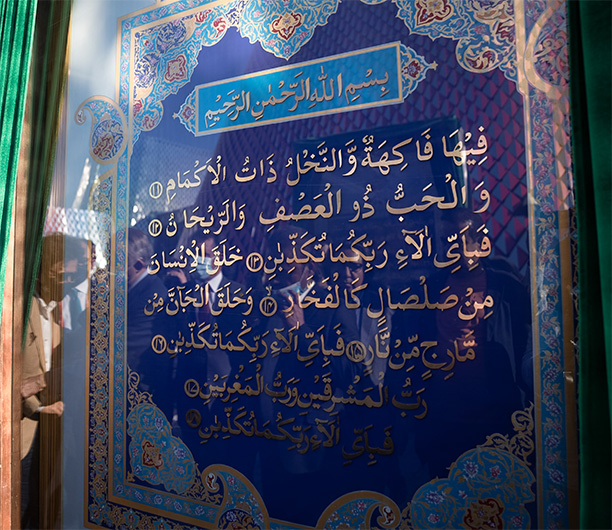


A chapter of the Quran is cast on a high-quality canvas with aluminum and gold-plated script by a Pakistani artist Shahid Rassam who put it on display at the Pakistan Pavilion in Dubai, UAE, on January 24, 2022. (Photo courtesy: Pakistan Pavilion at Dubai Expo 2020)

Rassam informed his financial team was working on assessing the exact amount required to cast the entire Qur’an in aluminum and gold.
He also maintained that the installation was unique and innovative in several ways, adding it had 1,585 letters, 352 words and 78 verses which were spread over six pages.
He informed the first two pages had only five lines while the rest of them had ten.
Rassam said the text required 15 kilograms of aluminum and more than one kilogram of gold on the special canvas.
“I have not written the Holy Qur’an with color or ink. Instead, it has been cast on the canvas with aluminum and gold-plated words for the first time in the Islamic history,” he said in a press release.
Speaking to Arab News in September 2021, he said he had created his own design with acrylic colors and used an Italian glazing technique.
The project had been completed in almost four months with the help of 200 artists, painters, calligraphers, designers, and sculptors.
Irfan Mustafa, a Dubai-based entrepreneur, played a significant role in making the project a reality: Not only did he sponsor it but also convinced Rassam to share it at the expo.
Mustafa told Arab News he decided to support the project since it was unique.
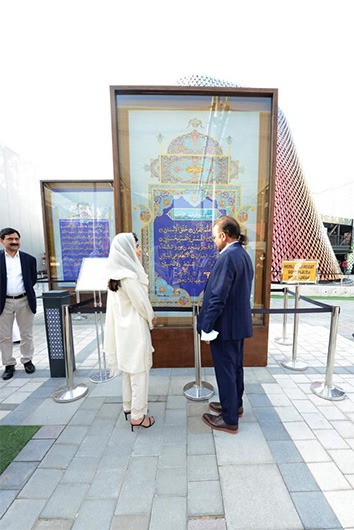


The world’s youngest Nobel laureate Malala Yousafzai visited the Pakistan Pavilion and met artist Shahid Rassam at the expo in Dubai, UAE, on January 29, 2022. (Photo courtesy: Shahid Rassam)

“This is a masterpiece which is being created and must be supported,” he said, adding the project would also strengthen Pakistan’s international image.
Farkhanda Jalil, a Dubai-based house wife who heard about the Qur’anic installation and decided to visit the pavilion, said she found it “completely amazing.”
“I have never seen anything like this and I think it is a great initiative,” she added.
Speaking to Arab News, Afroz Abro, director programming and marketing at the pavilion, said the team managing of the Pakistani venue was striving to highlight the potential fellow citizens and tell the international community that the people of Pakistan were capable of accomplishing big things when given the right opportunities.
“The Qur’anic installation by artist Shahid Rassam is a true example of that potential,” he maintained. “It adds a great value to the visitor’s experience. This is the true Pakistan that we all want to believe in.”


Pakistan’s OGDC ramps up unconventional gas plans

Updated 4 sec ago
Follow

Pakistan’s OGDC ramps up unconventional gas plans

  • Pakistan has long been viewed as having potential in tight and shale gas but commercial output has yet to be proved
  • OGDC says has tripled tight-gas study area to 4,500 square km after new seismic, reservoir analysis indicates potential

ISLAMABAD: Pakistan’s state-run Oil & Gas Development Company is planning a major expansion of unconventional gas developments from early next year, aiming to boost production and reduce reliance on imported liquefied natural gas.

Pakistan has long been viewed as having potential in both tight and shale gas, which are trapped in rock and can only be released with specialized drilling, but commercial output has yet to be proved.

Managing Director Ahmed Lak told Reuters that OGDC had tripled its tight-gas study area to 4,500 square kilometers (1,737 square miles) after new seismic and reservoir analysis indicated larger potential. Phase two of a technical evaluation will finish by end-January, followed by full development plans.

The renewed push comes after US President Donald Trump said Pakistan held “massive” oil reserves in July, a statement analysts said lacked credible geological evidence, but which prompted Islamabad to underscore that it is pursuing its own efforts to unlock unconventional resources.

“We started with 85 wells, but the footprint has expanded massively,” Lak said, adding that OGDC’s next five-year plan would look “drastically different.”

Early results point to a “significant” resource across parts of Sindh and Balochistan, where multiple reservoirs show tight-gas characteristics, he said.

SHALE PILOT RAMPS UP

OGDC is also fast-tracking its shale program, shifting from a single test well to a five- to six-well plan in 2026–27, with expected flows of 3–4 million standard cubic feet per day (mmcfd) per well.

If successful, the development could scale to hundreds or even more than 1,000 wells, Lak said.

He said shale alone could eventually add 600 mmcfd to 1 billion standard cubic feet per day of incremental supply, though partners would be needed if the pilot proves viable.

The company is open to partners “on a reciprocal basis,” potentially exchanging acreage abroad for participation in Pakistan, he said.

A 2015 US Energy Information Administration study estimated Pakistan had 9.1 billion barrels of technically recoverable shale oil, the largest such resource outside China and the United States.

A 2022 assessment found parts of the Indus Basin geologically comparable to North American shale plays, though analysts say commercial viability still hinges on better geomechanical data, expanded fracking capacity and water availability.

OGDC plans to begin drilling a deep-water offshore well in the Indus Basin, known as the Deepal prospect, in the fourth quarter of 2026, Lak said. In October, Turkiye’s TPAO with PPL and its consortium partners, including OGDC, were awarded a block for offshore exploration.

A combination of weak gas demand, rising solar uptake and a rigid LNG import schedule has created a surplus of gas that forced OGDC to curb output and pushed Pakistan to divert cargoes from Italy’s ENI and seek revised terms with Qatar.