

UK foreign office pledges to release Afghanistan cash after aid chief pleas

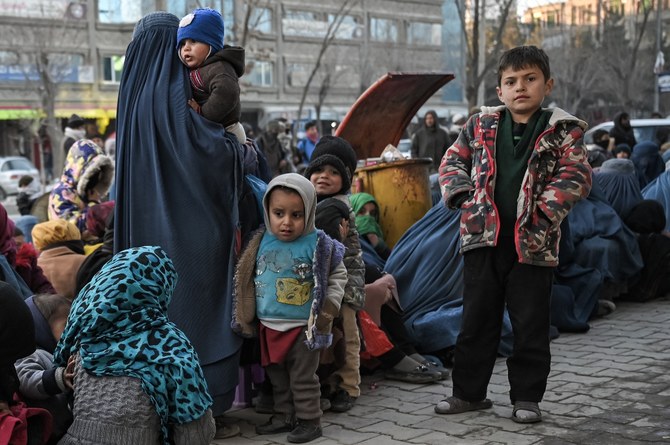
Experts say as many as 1 million children could die from acute malnutrition. (File/AFP)
Short Url
Updated 28 January 2022
Follow

UK foreign office pledges to release Afghanistan cash after aid chief pleas

  • London announces more than $130m in aid to ease Afghan humanitarian crisis
  • 1m children could die from acute malnutrition: Ex-UN official

LONDON: The UK’s Foreign and Commonwealth Office has pledged to release nearly £100m ($133m) in emergency funds to Afghanistan following impassioned pleas from two former aid chiefs, who warned that a million children could die from acute malnutrition.

Last August, the British government promised to double its aid spent in Afghanistan, but so far only £145 million out of £286 million has been disbursed, leaving roughly half the money unspent, just months before the end of the financial year in April. On Thursday Sir Mark Lowcock, a former UN under-secretary-general for humanitarian affairs, urged London to release the rest of the money.

He told Sky News: “It’s not at all appropriate to enforce a sort of collective punishment on the total population of the country because you don’t like the regime that those people haven’t chosen. Where is the rest of that money, what are they waiting for?”

Baroness Valerie Amos, also a former UN under-secretary-general for humanitarian affairs, also warned: “There will be 3 million children under 5 who will face acute malnutrition by March. Of those, a million children will die.”

Following those urgent pleas, the Foreign Office pledged to released £97m of emergency aid to Afghanistan for winter, which the department said would provide more than 2.7 million people with food, health services, and water.

Foreign Secretary Liz Truss said: “The UK continues to provide vital humanitarian assistance in Afghanistan. We have doubled UK aid this year to save lives, protect women and girls and support stability in the region.

“The funds announced today will mean essential food, shelter and health supplies will reach those who are most in need.”

Billions of dollars of Afghan money is currently frozen in assets by foreign governments as the US and its allies grapple with how they should deal with the Taliban regime.

Lowcock said Afghanistan’s own cash could be used to pay teachers and health workers directly. The UN is seeking $5.9 billion to help solve the humanitarian crisis.

“This is a significant requirement but the good news is quite a lot of it could be funded from Afghanistan’s own resources,” said Lowcock.

He added that while people “are right to be concerned” by the Taliban, the price is being paid by innocent children and women.

Reports have emerged that impoverished and desperate Afghans have resorted to selling their own organs, or in some cases their children, in order to feed themselves and their families.

Amos said: “We have to find a way of restoring the economy in Afghanistan without getting money into the hands of the Taliban, and we have plenty of experience of doing this.”


DR Congo city residents forced to adapt during year of M23 rule

Updated 58 min 29 sec ago
Follow

DR Congo city residents forced to adapt during year of M23 rule

  • Around one million Goma residents were holed up in their homes on Jan. 26, 2025, when the Congolese army and its allies were forced to pull out of the provincial capital

GOMA, DR Congo: They were caught under a barrage of fire and became trapped with “nowhere to go” after their city in the eastern Democratic Republic of Congo fell under the M23 armed group’s control a year ago.
Around one million Goma residents were holed up in their homes on January 26, 2025, when the Congolese army and its allies were forced to pull out of the provincial capital.
Hundreds of Rwandan soldiers had just poured across the border to fight alongside the M23 in a lightning offensive to seize the lakeside city.
Thousands of people were killed in the intense clashes.
Janvier Kamundu, whose name has been changed for security reasons, was sheltering from the fighting at home with his wife and children.
“Suddenly I heard my wife cry out. She fell, hit by a stray bullet,” he recalled.
Neighbors braved the gunfire to come and help, and a vehicle was found to transport his wife to hospital, ultimately saving her life.
Hospitals were overwhelmed with the wounded and bodies covered in white bags piled up at the morgues.
“She is slowly recovering, but it isn’t easy — she has a lot of wounds around her stomach,” Kamundu said.
Oppressive quiet
A year on, Goma residents endure “constant oppression” by the M23 group, government spokesman Patrick Muyaya said.
In the weeks that followed its capture, the streets emptied out at nightfall and the buzz evaporated from the bars that had once offered some respite in a region scarred by three decades of conflict.
Escaped prisoners, militia fighters and soldiers who had evaded capture roamed the city after dark, breaking into homes and threatening residents.
With the police and court system no longer functioning, the M23 eventually began to systematically cordon off neighborhoods in search of criminals.
By late May, several hundred men were sitting on the dark volcanic gravel covering the streets of Murambi village on Goma’s northern outskirts, watched over by members of the M23.
Local leaders and families are ordered to identify those they recognize as upstanding citizens. The others are detained.
Rough justice
But on the street, anyone deemed suspicious looking drew the M23’s ire.
People spoke of those who had been hauled off to the city sports stadium serving as an open-air prison for wearing dirty clothes or having an untidy beard.
An M23 spokesman invited reporters on several occasions to view the results of the operation — detainees separated into categories.
Desperate families crowded at the entrance, pleading to get their relatives released.
Those not cleared by testimony deemed reliable ended up at secret detention sites. NGO reports denounced torture and summary executions.
But, in time, residents and observers agreed that Goma’s streets were returning to relative safety.
With no independent justice system in place, opponents of the M23 faced repression, some accused of being in cahoots with the pro-government militia.
In October, the armed group — whose declared aim is to overthrow the government and end corruption — began appointing magistrates, but observers indicated there was little impartiality.
Despite parallel peace efforts backed by the United States and Qatar, the M23 launched a new offensive on the strategic town of Uvira near the Burundi border in December.
“These events have shown that the Rwandan president is not at all comfortable with peace processes,” Muyaya, the government spokesman, said.
‘Ideological training’
Most civil society representatives and rights campaigners had fled Goma before the M23 entered.
Civilians and former government combatants were forcibly recruited by the M23, which announced it had 7,000 new members in its ranks in September.
At the same time, the group began to impose taxes to finance its war effort but the city, already on its knees, has had no functioning banks for a year after the government ordered their closure to cut off the rebellion’s funding.
The airport remains inaccessible and trade between Goma and areas under government control has dwindled.
Civil servants were among the first to feel the blow of such cuts.
“There were about 200 agents here; around 20 left to work” in government-held areas, urban planning officer Claude Mumbere said.
“The others are here doing nothing,” added the officer, whose name has also been modified for security reasons.
Some had to undergo “ideological training” provided by the M23.
Mother-of-three Madeleine Mubuto’s husband lost his job.
“We had set aside a small amount of money at home that helped us at first, but after a year almost all of it is used up,” she said.
In the absence of cash, Rwanda’s currency is now used at Goma’s markets.
“Many are wondering how long this situation is going to last,” Kamundu said, adding: “We adapt because we have nowhere to go.”