

Standoff near Syrian prison holding Daesh militants continues

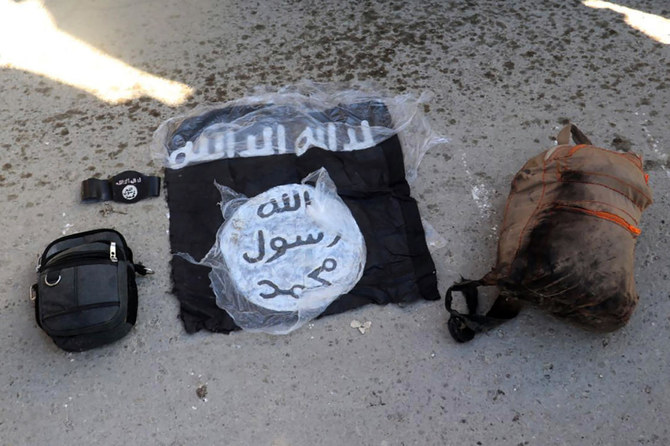
This photo shows the flag of Daesh and and bags taken from fighters who were arrested by the Kurdish-led Syrian Democratic Forces after militants attacked Gweiran Prison, in Hassakeh, northeast Syria. (File/AP)
Short Url
Updated 24 January 2022
Follow

Standoff near Syrian prison holding Daesh militants continues

  • Death toll rises to 136 from four days of fierce fighting after initial prison break
  • Civilians flee as terrorists mount biggest operation since defeat of their ‘caliphate’

JEDDAH: Daesh militants launched a new wave of attacks on a jail in northern Syria on Sunday as the death toll from four days of fighting rose to 136.

More than 100 terrorists first attacked the Kurdish-run Ghwayran jail in Hasakeh city on Thursday to free hundreds of Daesh members, including prominent leaders, in the most significant operation since its “caliphate” was defeated in Syria nearly three years ago

Amid intense fighting since then, the militants have freed prisoners and seized weapons stored at the jail, according to the Syrian Observatory for Human Rights, the monitoring group based in Britain.

“At least 84 Daesh members and 45 Kurdish fighters, including internal security forces, prison guards and counter-terrorism forces, have been killed,” the Observatory said. Seven civilians had also died in fighting in the city, the largest in northeastern Syria, it said.

The battles continued on Sunday as the Kurdish-led Syrian Democratic Forces, backed by US-led coalition airstrikes, closed in on Daesh targets inside and outside the jail.

Kurdish forces said the militants staged a new attack on the prison in an attempt to break the SDF security cordon and support prisoners who were still in control of some parts of the jail.

FASTFACT

The battles continued on Sunday as the Kurdish-led Syrian Democratic Forces, backed by US-led coalition airstrikes, closed in on Daesh targets inside and outside the jail.

The SDF said its forces had sealed off the area around the prison and “Daesh fighters located within the gates … can no longer escape.” The Observatory said the SDF had secured most of the area and much of the jail itself, apart from some cell blocks where militants had yet to surrender.

Hundreds of civilians fled the area. Daesh fighters were “entering homes and killing people,” said one man fleeing on foot carrying a child wrapped in a blanket. “It was a miracle we made it out. The situation is still very bad. After four days, violent clashes are still ongoing.”

Hamsha Sweidan, 80, who had been trapped in her home near the jail, said civilians were left without bread or water as the battle raged. “We have been dying of hunger and thirst,” she said as she crossed into SDF-held areas in Hasakeh city. “Now, we don’t know where to go.”

Ghwayran is the largest prison in Syria holding Daesh militants, housing up to 3,500, including over 600 under the age of 18. Daesh claimed their attack on Thursday had freed 800. The SDF said they had recaptured about 100 escaped prisoners, leaving hundreds still on the loose.

However, the anti-Daesh coalition insisted the prison attack would leave Daesh weaker because many militants involved in the fighting had been killed.

“The coalition is confident in its assessment that the recent Daesh escape attempt will not pose a significant threat,” it said. “While Daesh remains a threat, it is clearly no longer the force it once was.”


Libya brings in Western traders in blow to Russian fuel flows

Updated 6 sec ago
Follow

Libya brings in Western traders in blow to Russian fuel flows

  • The tenders will further reduce Russian product imports into Libya
  • Russian fuel exports to Libya have fallen to around 5,000 bpd in 2026 from 56,000 bpd in 2024–2025

LONDON: Global oil firms and traders including Vitol, Trafigura and TotalEnergies have won tenders to supply Libya with gasoline and diesel as the country grants large Western players wider access and reduces imports of Russian fuel, three trading sources told Reuters.
Libya is in the process of overhauling its oil sector 15 years after the fall of leader Muammar Qaddafi and years of civil wars.
The country produces some 1.4 million barrels a day of crude but lacks the infrastructure to refine it, leaving it reliant on fuel imports.
After issuing upstream licensing rounds for the first time in 20 years in an effort to grow crude output to 2 million bpd, Africa’s second-largest oil producer is now changing how it sells its oil ⁠and buys the ⁠fuel it requires.
Rather than swapping fuel imports for crude exports, it has instead awarded tenders to cover its fuel needs.
In the tenders in recent weeks, which have not previously been reported, Vitol won the rights to supply 5-10 gasoline cargoes a month and some diesel volumes, three traders familiar with the results said.
Trafigura and TotalEnergies also won the right to supply fuel, two of the three traders said. Reuters could not establish the exact volumes.
Vitol, Trafigura, and TotalEnergies declined to ⁠comment. Libya’s state-owned National Oil Corporation did not immediately respond to a request for comment on the tenders.

RUSSIAN IMPORTS DROPPING
The tenders will further reduce Russian product imports into Libya as Western firms source their volumes from refineries in the Mediterranean.
Russian fuel exports to Libya have fallen to around 5,000 bpd in 2026 from 56,000 bpd in 2024–2025, when it was the dominant supplier, according to live data from global analytics firm Kpler.
Italy has become Libya’s top fuel supplier this year with 59,000 bpd, mainly from the ISAB and Sarroch refineries run by Trafigura and Vitol, the Kpler data showed.
Moscow has relied heavily on Africa, Asia and South America for fuel sales after its refined products were banned from the West under sanctions linked to the war in Ukraine. The ⁠Kremlin has also seen ⁠its oil exports to India and Turkiye fall under US pressure, pushing more oil toward China.
Overall fuel exports into Libya from all sources have averaged around 186,000 bpd since the start of 2024.

FIRMS ALSO GAIN ACCESS TO CRUDE EXPORTS
Libya will also change the way it handles crude exports, the sources said.
Swiss-based trading firm BGN, previously a key exporter, will see crude liftings fall sharply, all three traders said, as big Western players will be allocated export rights.
Small Swiss-based trader Transmed Trading also picked up several crude cargoes in January and will keep lifting volumes in coming months, two of the three sources said.
Transmed and BGN did not immediately respond to requests for comment. Libya also signed a 25-year oil-development deal with TotalEnergies and ConocoPhillips in January, involving more than $20 billion in foreign-financed investment.