ISLAMABAD: A senior Pakistani minister on Tuesday criticized the opposition for making a legislation regarding the central bank’s autonomy controversial, saying the new law was not without checks and balances which were incorporated after “hard negotiations” with the International Monetary Fund.
The law was approved by the country’s national assembly last week and was enacted on the international financial institution’s insistence which had been demanding it to protect the State Bank of Pakistan (SBP) from any political interference.
The IMF executive board is scheduled to review Pakistan’s progress in terms of the implementation of structural reforms under a $6 billion loan program and may release another tranche of $1 billion later this month.
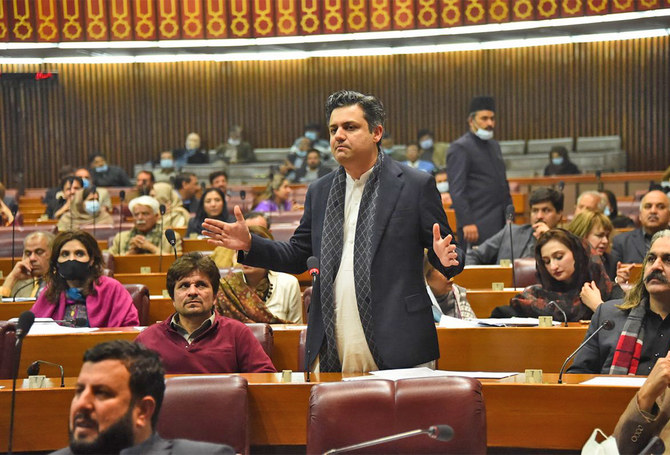
Pakistan’s energy minister Hammad Azhar told a news conference in Islamabad that central banks were always kept autonomous in the world since there was enough evidence that it allowed developed nations to bring down inflation and ensure economic growth.
“The federal government will appoint the central bank’s board of directors whose members can even remove the state bank governor,” he said, adding: “We managed to secure this concession of appointing the state bank board along with its governor and deputy governor from the IMF after hard negotiations.”
Azhar maintained previous administrations tried to influence central bank officials while dictating them how to manage the county’s monetary policy.
He added a similar bill was also suggested in 2015 by the opposition Pakistan Muslim League-Nawaz party wherein it was willing to surrender all its powers to the central bank board.
The minister noted the government had brought about a comprehensive reform in the area which was also “demanded by serious Pakistani economists for a substantially long period.”
Refuting the opposition’s criticism over the law, he said it was only going to strengthen the country’s economy and ensure sustained growth momentum.

Government says central bank autonomy not without checks and balances
https://arab.news/8v64j
Government says central bank autonomy not without checks and balances
- The IMF wanted Pakistan to grant maximum independence to the central bank to end any possible political interference
- A senior Pakistani minister says the oversight mechanism was built into the law after ‘hard negotiations’ with the lending agency
Pakistan, China to sign multiple MoUs at major agriculture investment conference today
- Hundreds of Chinese and Pakistani firms to attend Islamabad event
- Conference seen as part of expanding CPEC ties into agriculture, trade
KARACHI: Islamabad and Beijing are set to sign multiple memorandums of understanding (MoUs) to boost agricultural investment and cooperation at a major conference taking place in the capital tomorrow, Monday, with hundreds of Chinese and Pakistani companies expected to participate.
The conference is being billed by Pakistan’s Ministry of National Food Security and Research as a platform for deepening bilateral agricultural ties and supporting broader economic engagement between the two countries.
“Multiple memorandums of understanding will be signed at the Pakistan–China Agricultural Conference,” the Ministry of National Food Security said in a statement. “115 Chinese and 165 Pakistani companies will participate.”
The conference reflects a growing emphasis on expanding Pakistan-China economic cooperation beyond the transport and energy foundations of the flagship China-Pakistan Economic Corridor (CPEC) into agriculture, industry and technology.
Under its first phase launched in 2015, CPEC, a core component of China’s Belt and Road Initiative, focused primarily on transportation infrastructure, energy generation and connectivity projects linking western China to the Arabian Sea via Pakistan. That phase included motorways, power plants and the development of the Gwadar Port in the country's southwest, aimed at helping Pakistan address chronic power shortages and enhance transport connectivity.
In recent years, both governments have formally moved toward a “CPEC 2.0” phase aimed at diversifying the corridor’s impact into areas such as special economic zones, innovation, digital cooperation and agriculture. Second-phase discussions have highlighted Pakistan’s goal of modernizing its agricultural sector, attracting Chinese technology and investment, and boosting export potential, with high-level talks taking place between planning officials and investors in Beijing.
Agri-sector cooperation has also seen practical collaboration, with joint initiatives examining technology transfer, export protocols and value-chain development, including partnerships in livestock, mechanization and horticulture.
Organizers say the Islamabad conference will bring together government policymakers, private sector investors, industry associations and multinational agribusiness firms from both nations. Discussions will center on investment opportunities, technology adoption, export expansion and building linkages with global buyers within the framework of Pakistan-China economic cooperation.


