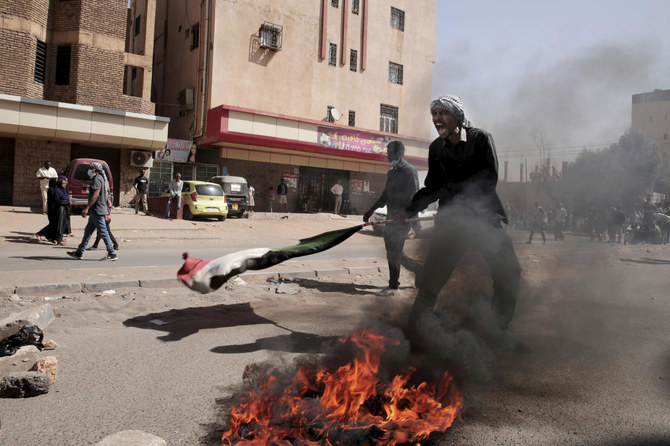

CAIRO/KHARTOUM: Sudanese security forces opened fire on protesters Monday, killing at least seven people and wounding around 100 others in the country’s capital in one of the deadliest days since an October military coup, activists said.
Earlier Monday, thousands had once again flooded the streets of Khartoum and elsewhere in Sudan to denounce the Oct. 25 military takeover that scuttled hopes of a peaceful transition to democracy. The coup came more than two years after a popular uprising forced the removal of longtime autocrat Omar Al-Bashir and his Islamist government in April 2019.
The turmoil has been amplified after Prime Minister Abdalla Hamdok stepped down earlier this month. Hamdok, the civilian face of Sudan’s transitional government, resigned after his efforts to bridge the gap between the generals and the country’s pro-democracy movement failed.
Monday’s deaths bring to at least 71 the number of people killed in near-daily demonstrations in Khartoum and other cities and towns in Sudan.
Footage circulating online shows protesters, mostly young people, marching in the streets of Khartoum and its twin city of Omdurman. There were also protests in Port Sudan, Wad Madani Obaid and the western Darfur region.
“I’m here today to resist the military coup,” said protester Hamed Al-Ser. “We hope our free revolution reaches the democratic civilian path.”
Activist Nazim Sirag said seven protesters were killed when security forces opened fire to break up several marches in the capital, including in the area around the presidential palace. He also said many people were wounded by gunshots.
The Sudan Doctors Committee, which is part of the pro-democracy movement, also reported the deaths and said around 100 protesters were wounded in Khartoum.
The pro-democracy movement condemned Monday’s deadly shootings and called for a two-day civil disobedience campaign over the security forces’ actions.
Faisal Saleh, a former information minister and Hamdok’s adviser, said the killings were “a full-fledged crime,” and urged the international community to act.
“The Sudanese people do not face an arbitrary government or authority, but rather a criminal gang that kills the youth of Sudan in cold blood, and the whole world is watching,” Saleh wrote on Twitter.
UN special representative Volker Perthes condemned the “continued use of live ammunition” to put down the protests, confirming at least seven people killed and “scores injured,” while the US embassy in Khartoum criticized “the violent tactics of Sudanese security forces.”
Continued use of live ammunition during today’s protests is unacceptable. At least 7 killed & scores injured. Violence must stop. We again call on authorities to cease using force against peaceful protesters & conduct credible investigations into such incidents. #ViolenceMustStop
— UN Integrated Transition Assistance Mission Sudan (@UNITAMS) January 17, 2022
Nine UN Security Council members including Britain and France urged all parties to “refrain from the use of violence,” stressing the importance of “peaceful assembly and freedom of expression.”
The UN condemned “the use of lethal force against demonstrators,” spokesman Stephane Dujarric also said later Monday.
“Whether it’s in Khartoum or other places, people have a right to demonstrate peacefully,” he added.
The fatalities will likely further complicate UN efforts to find a way out of the ongoing crisis. The UN mission in Sudan started holding separate consultations earlier this month with various Sudanese groups, including the military, to “prepare the ground for a process capable of securing agreement ... on the way forward for the democratic transition in Sudan.”
“It’s very important that we see an atmosphere that is conducive to the ongoing consultations, both in the streets and, obviously, inside the room,” Dujarric said.
Along with the UN, Western governments have also widely condemned the crackdown on protesters, and called for those responsible be held accountable.
US State Department spokesman Ned Price said on Twitter the United States was “concerned by reports of escalating violence.”
He added that Assistant Secretary of State Molly Phee and new Special Envoy David Satterfield “are headed to Khartoum and will reiterate our call for security forces to end violence and respect freedom of expression and peaceful assembly.”
We are concerned by reports of escalating violence against protesters in Sudan. @AsstSecStateAF Phee and Special Envoy Satterfield are headed to Khartoum and will reiterate our call for security forces to end violence and respect freedom of expression and peaceful assembly.
— Ned Price (@StateDeptSpox) January 17, 2022
Their visit is aimed to “facilitate a renewed civilian-led transition to democracy,” the State Department said.
“Their message will be clear: the United States is committed to freedom, peace, and justice for the Sudanese people,” the State Department added.
The demonstrations are organized by the Sudanese Professionals Association and the Resistance Committees, which were the backbone of the uprising against Al-Bashir. The two groups reject negotiations with the military, insisting it hand over power to a fully civilian government to lead the transition.
The generals, meanwhile, reject the protesters’ demands, saying that power will be handed over only to an elected government.
(With AP, AFP and Reuters)