

Indonesia to focus Afghan aid on women’s empowerment

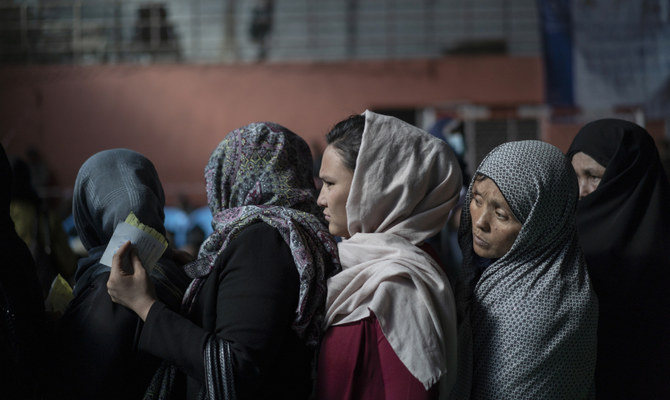
People wait in queues to receive cash at a money distribution organized by the World Food Program (WFP) in Kabul, Afghanistan. (AP/File)
Short Url
Updated 13 January 2022
Follow

Indonesia to focus Afghan aid on women’s empowerment

  • Indonesia has pledged $2.85 million in aid for Afghanistan
  • Taliban takeover rolled back advances in women’s rights in the war-torn country

JAKARTA: The Indonesian government pledged on Thursday to focus on women’s empowerment and education in Afghanistan, as part of its aid commitment made during last month’s extraordinary session of the Organization of Islamic Cooperation.

Afghanistan’s fragile economy has been on the brink of collapse, with rapid food price increases and widespread hunger, since the abrupt withdrawal and freezing of foreign aid after the Taliban takeover in August. The international community has been pressurizing the country;s new rulers to commit to upholding women’s rights as a condition for restoring aid.

Indonesia, the world’s largest Muslim majority country, pledged to support capacity-building and educational efforts for Afghan women during the 17th Extraordinary Session of the OIC’s Council of Foreign Ministers, hosted by Pakistan, on Dec. 19.

Abdul Kadir Jailani, the Indonesian foreign ministry’s director general for Asian, Pacific and African affairs, said during a press briefing in Jakarta that Indonesia’s $2.85 million aid package for Afghanistan will be directed predominantly at this purpose.

“All of those funds will be directed toward capacity building, especially for women, as well as scholarships,” Jailani told reporters, as he highlighted the Indonesian government’s commitment to “elevate women’s role.”

Women’s rights were severely curtailed during the Taliban’s previous stint in power from 1996 to 2001. The group banned women from leaving their houses without full face and head coverings and a male relative accompanying them, and barred girls from receiving an education.

The Taliban say they have changed, but many women and rights advocates remain skeptical. In the weeks after the group's takeover, the new government announced a steady stream of policies and regulations that rolled back the advances in women’s rights over the past two decades. 

The 2022 World Report by Human Rights Watch has raised concerns over opportunities for Afghan women under the new regime, as many secondary schools for girls remained closed by the end of the year, and women were prohibited from working in most government jobs and many other areas.


Modi ally proposes social media ban for India’s teens as global debate grows

Updated 31 January 2026
Follow

Modi ally proposes social media ban for India’s teens as global debate grows

  • India is the world’s second-biggest smartphone market with 750 million devices and a billion Internet users
  • South Asian nation is a key growth market for social media apps and does not set a minimum age for access

NEW DELHI: An ally of Indian Prime Minister Narendra Modi has proposed a bill to ban social media for children, as the world’s biggest market for Meta and YouTube joins a global debate on the impact of social media on young people’s health and safety.
“Not only are our children becoming addicted to social media, but India is also one of the world’s largest producers of data for foreign platforms,” lawmaker L.S.K. Devarayalu said on Friday.
“Based on this data, these companies are creating advanced AI systems, effectively turning Indian users into unpaid data providers, while the ‌strategic and economic ‌benefits are reaped elsewhere,” he said.
Australia last ‌month ⁠became the ‌first country to ban social media for children under 16, blocking access in a move welcomed by many parents and child advocates but criticized by major technology companies and free-speech advocates. France’s National Assembly this week backed legislation to ban children under 15 from social media, while Britain, Denmark and Greece are studying the issue.
Facebook operator Meta, YouTube-parent Alphabet and X did ⁠not respond on Saturday to emails seeking comment on the Indian legislation. Meta has ‌said it backs laws for parental oversight but ‍that “governments considering bans should be careful ‍not to push teens toward less safe, unregulated sites.”
India’s IT ministry ‍did not respond to a request for comment.
India, the world’s second-biggest smartphone market with 750 million devices and a billion Internet users, is a key growth market for social media apps and does not set a minimum age for access.
Devarayalu’s 15-page Social Media (Age Restrictions and Online Safety) Bill, which is not public but was seen by Reuters, says ⁠no one under 16 “shall be permitted to create, maintain, or hold” a social media account and those found to have one should have them disabled.
“We are asking that the entire onus of ensuring users’ age be placed on the social media platforms,” Devarayalu said.
The government’s chief economic adviser attracted attention on Thursday by saying India should draft policies on age-based access limits to tackle “digital addiction.”
Devarayalu’s legislation is a private member’s bill — not proposed to parliament by a federal minister — but such bills often trigger debates in parliament and influence lawmaking.
He is from the ‌Telugu Desam Party, which governs the southern state Andhra Pradesh and is vital to Modi’s coalition government.