

No new restrictions, Sindh province decides as COVID-19 positivity ratio crosses 28 percent

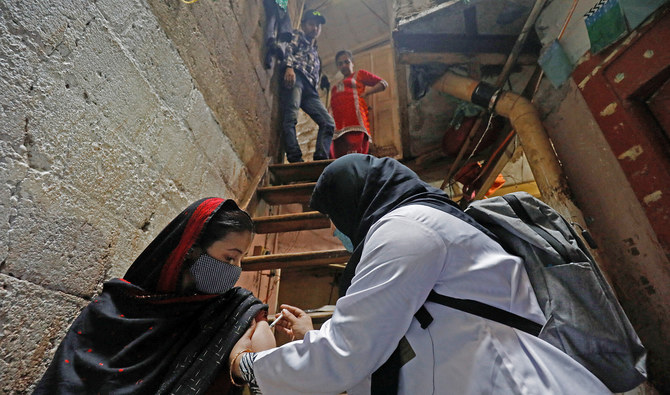
A healthcare worker administers a dose of COVID-19 vaccine during a door-to-door vaccination campaign in a slum in Karachi, Pakistan, on January 13, 2022. (REUTERS)
Short Url
Updated 13 January 2022
Follow

No new restrictions, Sindh province decides as COVID-19 positivity ratio crosses 28 percent

  • Positivity rate was 6.62 percent in Karachi on January 4, over 2,000 new cases reported in port city in last 24 hours
  • On account of low hospitalization rates and few people in critical care, authorities had decided not to impose new restrictions

KARACHI: On account of low hospitalization rates and few people in critical care, authorities in Pakistan’s southern Sindh province said on Thursday they were not considering imposing new restrictions and a major food festival would be held this week as per schedule despite a surge in coronavirus infections.

Karachi, the capital of Sindh province and the commercial capital of the country, reported 2,009 new cases of the coronavirus in the last 24 hours, recording an alarming positivity rate of 28.80 percent. A day earlier, the infection rate stood at 20.22 percent, and on Monday, it was 15.52 percent. On January 4, a 6.62 percent positivity rate had been recorded.

“This trend of growing infections will continue in the days to follow,” Qasim Soomro, parliamentary secretary for health in Sindh, told Arab News, adding that the current numbers were, however, not putting a burden on the health system.  “But God forbid if the numbers grow substantially and hospitalization may also increase, it will be something to worry about.”

He said only 18 patients were currently on ventilators in the province and 78 were in the ICU against 1,100 available beds.

“Taking this fact into account, a meeting has decided not to impose any restrictions,” Soomro added.

Karachi administrator, Murtaza Wahab, who is also the spokesperson for the Sindh government, said the decision to not impose new restrictions was due to a low number of critical patients.

“We have imposed strict measures in the past when pressure on hospitals was increasing,” Wahab said, urging people to wear masks and get vaccinated.

But experts worry authorities are not taking the latest surge seriously. A major event, the Karachi Eat festival, which attracts tens of thousands of people each year, is scheduled to start tomorrow, Friday, and go on until Sunday. Despite protestations by concerned citizens and experts, authorities have decided not to postpone the event.

Soomro said the local administration had given a list of instructions to the festival organizers which would be strictly implemented.

“There will be no entry for unvaccinated people,” he said. “Random PCR tests will be done at arrival. Only one family will be allowed to stay at a stall at a time and masks can be removed only while eating food.”


Pakistan finance chief calls for stronger emerging market voice during Saudi conference

Updated 6 sec ago
Follow

Pakistan finance chief calls for stronger emerging market voice during Saudi conference

  • Aurangzeb tells Saudi state media developing economies must assume larger global role
  • Minister says AlUla conference can strengthen coordination among emerging economies

KARACHI: Pakistan’s Finance Minister Muhammad Aurangzeb on Thursday called for developing economies to play a greater role in shaping global economic governance in an interview on the sidelines of the AlUla Conference for Emerging Market Economies in Saudi Arabia.

The conference, hosted by the Kingdom’s Finance Ministry, brings together top government functionaries, central bank governors and policymakers from emerging markets to discuss debt sustainability, macroeconomic coordination and structural reforms amid global economic uncertainty.

In a conversation with the Saudi Press Agency, Aurangzeb described the conference as a timely platform for dialogue at a moment of heightened geopolitical tensions, trade fragmentation and rapid technological change, including advances in artificial intelligence.

“It is not merely about discussions but about translating deliberations into concrete policy actions and execution over the course of the year,” he said, according to a statement circulated by the Finance Division in Islamabad.

The minister said emerging markets’ growing share of global output and growth should be matched by greater influence in international decision-making.

He noted these economies must strengthen collective dialogue and coordinated policy responses to address shared challenges, adding that the global landscape had evolved significantly since the inaugural edition of the conference.

Aurangzeb expressed confidence that the outcomes of the AlUla Conference would contribute to strengthening coordination among emerging economies and reinforcing their collective voice in shaping a more inclusive and resilient global economic order, the statement added.