

Egypt unveils plans for investments in its mining sector

Short Url
Updated 10 January 2022
Follow

Egypt unveils plans for investments in its mining sector

  • Oil Minister Tarek El Molla wants to increase mining’s contribution to Egypts GDP tenfold by 2026


CAIRO: Oil Minister Tarek El Molla is on the record as saying he wants to increase mining’s contribution to GDP tenfold by 2026, and in order to achieve this the ministry is to aid the sector’s transformation into a lucrative investment spot.

Part of the plan kicks off in March, with Egypt hosting a virtual global mining show bringing together international mining corporations, investors, solution providers and governments — all to help seal long-term strategic partnerships and tap potential opportunities in the sector.

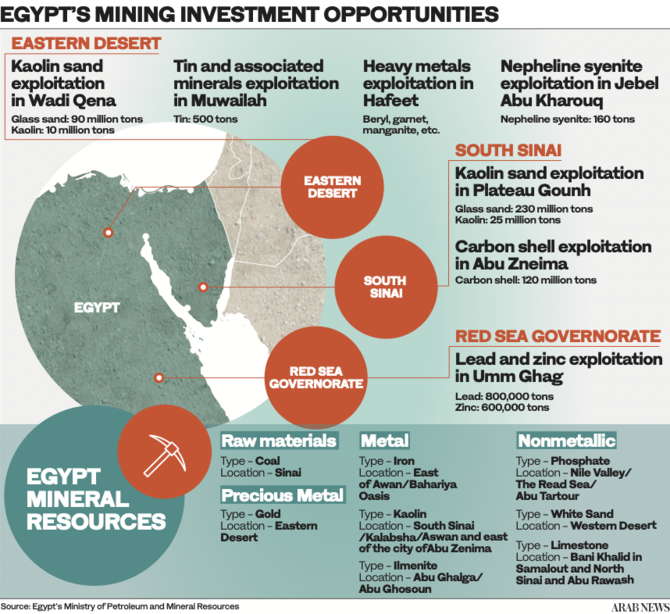
There is much to develop. Egypt is home to several mineral resources, including raw materials, metals, precious metals, or nonmetals. The mineral resources are dispersed across the country with the bulk concentrated in the Eastern Desert and the Sinai Peninsula.

With an average of 48 million tons of tantalite, 50 million tons of coal, and 6.7 million ounces of gold, Egypt has the potential to be one of the top mining locations in the world. The main producers in the country include Egypt Ministry of Petroleum, National Service Projects Organization, Egyptian Mineral Resources Authority (EMRA), Al Wadi Al Gadid for mineral resources & oil shale, Shalateen Mining Company, Hammash Misr for Gold Mines, Phosphate Misr Company, and Egyptian Black Sand company.
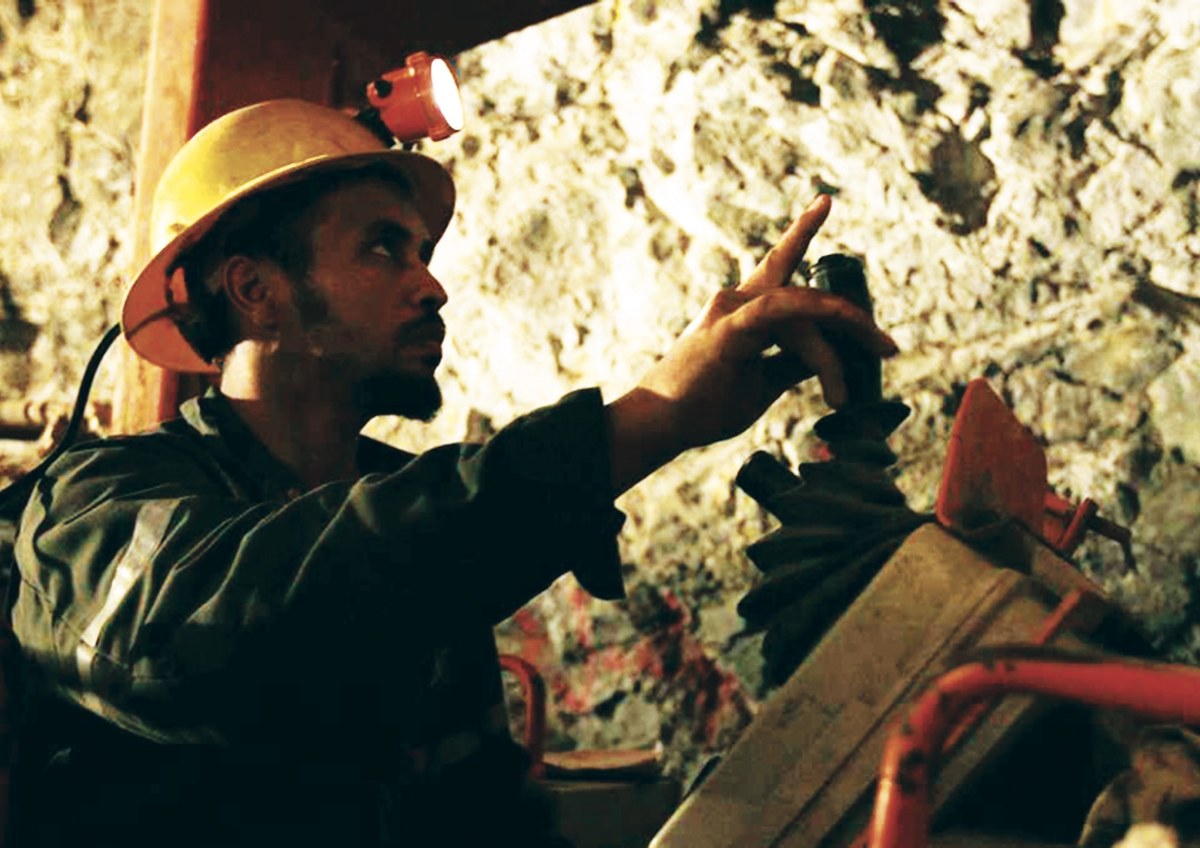


The Sukari gold mine, 700 kilometers from Egypt’s capital, Cairo. (Supplied)

With external aid from indepen- dent consultants such as UK’s Wood Mackenzie in 2018, the Egyptian government was able to set policies to lure global investments.

In 2020, the government intro- duced a new regulation shifting the system from production sharing agreements to its rent, royalty and tax systems.

The new system which tackles industry concerns while offering sector and investor-friendly terms and conditions attracted global investors and aided Egypt into becoming a captivating investment spot.

Snapshot of milestones and ongoing projects: 
- Egypt has recorded $550 million profits from Sukari Gold Mine located in the Eastern Desert over the past 10 years.
- This comes as a result of a collab- oration that dates back to 1994 between Australian gold mining 

company Centamin and the Mineral Wealth Authority.
- Under the terms of the agree- ment, the Australian company finances the project, paying the authority 55 percent of profits and 3 percent of revenues respectively in the process.

- 75 percent of the country’s mining minerals are attributed to a metallic and nonmetallic mineral


Egypt unveils $1bn Startup Charter to boost innovation, jobs

Updated 7 sec ago
Follow

Egypt unveils $1bn Startup Charter to boost innovation, jobs

JEDDAH: Egypt has launched its first-ever national Startup Charter, committing $1 billion in funding and new policies to stimulate innovation, create jobs, and drive economic growth.

The initiative follows over a year of consultations involving 15 national entities and more than 250 representatives from the startup ecosystem, entrepreneurs, and parliamentary bodies, according to an official statement from the Egyptian Cabinet.

The charter is designed to support up to 5,000 startups, generate an estimated 500,000 direct and indirect jobs, and accelerate international expansion, as outlined by the Ministerial Group for Entrepreneurship.

Egypt’s startup ecosystem has gained significant traction in recent years, with startups attracting $228 million in venture capital and debt financing during the first five months of 2025 alone, marking a notable increase from the previous year. Official figures indicate that total funding for the sector reached $614 million in 2025, a sign of growing investor confidence and a more diverse financing landscape.

The official launch took place on Feb. 7 at the Grand Egyptian Museum, attended by Prime Minister Mostafa Madbouly, Minister of Planning and Economic Development Rania Al-Mashat, key members of the entrepreneurial ministerial group, the governor of Giza, ambassadors, and various stakeholders from the startup ecosystem and venture capital funds.

“The Startup Charter represents a strategic framework to enhance the capabilities of startups and the entrepreneurial ecosystem, aiming for rapid, sustainable economic growth driven by competitiveness and innovation, while also contributing to job creation,” said the Cabinet’s statement.

The charter sets out several key objectives over the next five years, including accelerating startup expansion into international markets, developing local talent to combat brain drain, promoting venture capital, and attracting investments through a unified financing initiative. It also seeks to connect critical challenges in various sectors with innovative solutions from startups.

In her speech at the event, Al-Mashat emphasized that the charter is not just a theoretical document but a practical and adaptable tool that will evolve to meet technological advancements and market needs. She described it as the first step toward modernizing Egypt’s policies and legislation to better support startups.

Al-Mashat also highlighted that the priorities of the charter were determined after extensive consultations with key stakeholders, aiming to create a dynamic and sustainable business environment that fosters innovation and attracts investment.

One key feature of the Startup Charter is the introduction of a unified definition of startups — newly established companies with a focus on rapid growth, flexibility, and innovation. This definition will allow startups to access a range of incentives and benefits, including official classification certifications from small and medium enterprise authorities.

Additionally, it includes a unified financing initiative designed to coordinate available funding resources from government entities. The initiative aims to amplify the impact of these resources by up to four times, with the goal of mobilizing $1 billion over the next five years through government-backed guarantees, joint investments with venture capital funds, and collaboration with private-sector investors.

In 2024, Prime Minister Madbouly issued a decree forming a new ministerial group, led by the Minister of Planning and Economic Development, to further strengthen the startup ecosystem. The group's mission is to foster sustainable, knowledge-driven economic growth, enhance competitiveness, and create meaningful employment opportunities. It includes senior government officials, the CEO of the Small and Medium Enterprises Development Agency, and representatives from the Central Bank, the Financial Regulatory Authority, and other relevant bodies.