

Egypt unveils $1bn Startup Charter to boost innovation, jobs

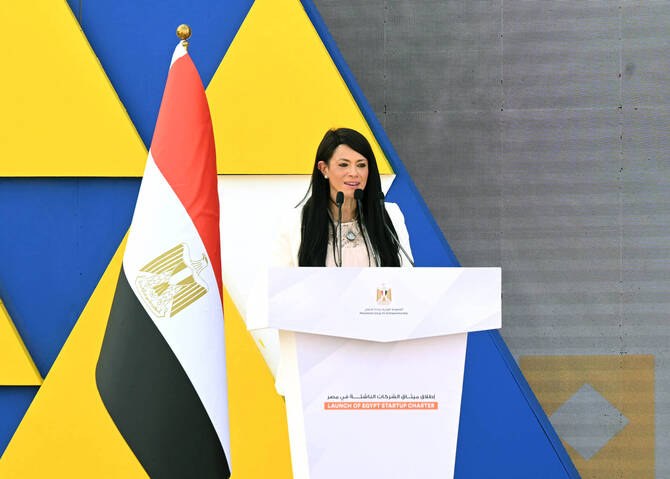
Egypt’s Minister of Planning, Economic Development, and International Cooperation Rania Al-Mashat speaks at an event organized to launch the country’s first national Startup Charter. Photo/Supplied
Short Url
Updated 08 February 2026
Follow

Egypt unveils $1bn Startup Charter to boost innovation, jobs

JEDDAH: Egypt has launched its first-ever national Startup Charter, committing $1 billion in funding and new policies to stimulate innovation, create jobs, and drive economic growth.

The initiative follows over a year of consultations involving 15 national entities and more than 250 representatives from the startup ecosystem, entrepreneurs, and parliamentary bodies, according to an official statement from the Egyptian Cabinet.

The charter is designed to support up to 5,000 startups, generate an estimated 500,000 direct and indirect jobs, and accelerate international expansion, as outlined by the Ministerial Group for Entrepreneurship.

Egypt’s startup ecosystem has gained significant traction in recent years, with startups attracting $228 million in venture capital and debt financing during the first five months of 2025 alone, marking a notable increase from the previous year. Official figures indicate that total funding for the sector reached $614 million in 2025, a sign of growing investor confidence and a more diverse financing landscape.

The official launch took place on Feb. 7 at the Grand Egyptian Museum, attended by Prime Minister Mostafa Madbouly, Minister of Planning and Economic Development Rania Al-Mashat, key members of the entrepreneurial ministerial group, the governor of Giza, ambassadors, and various stakeholders from the startup ecosystem and venture capital funds.

“The Startup Charter represents a strategic framework to enhance the capabilities of startups and the entrepreneurial ecosystem, aiming for rapid, sustainable economic growth driven by competitiveness and innovation, while also contributing to job creation,” said the Cabinet’s statement.

The charter sets out several key objectives over the next five years, including accelerating startup expansion into international markets, developing local talent to combat brain drain, promoting venture capital, and attracting investments through a unified financing initiative. It also seeks to connect critical challenges in various sectors with innovative solutions from startups.

In her speech at the event, Al-Mashat emphasized that the charter is not just a theoretical document but a practical and adaptable tool that will evolve to meet technological advancements and market needs. She described it as the first step toward modernizing Egypt’s policies and legislation to better support startups.

Al-Mashat also highlighted that the priorities of the charter were determined after extensive consultations with key stakeholders, aiming to create a dynamic and sustainable business environment that fosters innovation and attracts investment.

One key feature of the Startup Charter is the introduction of a unified definition of startups — newly established companies with a focus on rapid growth, flexibility, and innovation. This definition will allow startups to access a range of incentives and benefits, including official classification certifications from small and medium enterprise authorities.

Additionally, it includes a unified financing initiative designed to coordinate available funding resources from government entities. The initiative aims to amplify the impact of these resources by up to four times, with the goal of mobilizing $1 billion over the next five years through government-backed guarantees, joint investments with venture capital funds, and collaboration with private-sector investors.


Saudi investment pipeline active as reforms advance, says Pakistan minister

Updated 09 February 2026
Follow

Saudi investment pipeline active as reforms advance, says Pakistan minister

ALULA: Pakistan’s Finance Minister Mohammed Aurangzeb described Saudi Arabia as a “longstanding partner” and emphasized the importance of sustainable, mutually beneficial cooperation, particularly in key economic sectors.

Speaking to Arab News on the sidelines of the AlUla Conference for Emerging Market Economies, Aurangzeb said the relationship between Pakistan and Saudi Arabia remains resilient despite global geopolitical tensions.

“The Kingdom has been a longstanding partner of Pakistan for the longest time, and we are very grateful for how we have been supported through thick and thin, through rough patches and, even now that we have achieved macroeconomic stability, I think we are now well positioned for growth.”

Aurangzeb said the partnership has facilitated investment across several sectors, including minerals and mining, information technology, agriculture, and tourism. He cited an active pipeline of Saudi investments, including Wafi’s entry into Pakistan’s downstream oil and gas sector.

“The Kingdom has been very public about their appetite for the country, and the sectors are minerals and mining, IT, agriculture, tourism; and there are already investments which have come in. For example, Wafi came in (in terms of downstream oil and gas stations). There’s a very active pipeline.”

He said private sector activity is driving growth in these areas, while government-to-government cooperation is focused mainly on infrastructure development.

Acknowledging longstanding investor concerns related to bureaucracy and delays, Aurangzeb said Pakistan has made progress over the past two years through structural reforms and fiscal discipline, alongside efforts to improve the business environment.

“The last two years we have worked very hard in terms of structural reforms, in terms of what I call getting the basic hygiene right, in terms of the fiscal situation, the current economic situation (…) in terms of all those areas of getting the basic hygiene in a good place.”

Aurangzeb highlighted mining and refining as key areas of engagement, including discussions around the Reko Diq project, while stressing that talks with Saudi investors extend beyond individual ventures.

“From my perspective, it’s not just about one mine, the discussions will continue with the Saudi investors on a number of these areas.”

He also pointed to growing cooperation in the IT sector, particularly in artificial intelligence, noting that several Pakistani tech firms are already in discussions with Saudi counterparts or have established offices in the Kingdom.

Referring to recent talks with Saudi Minister of Economy and Planning Faisal Alibrahim, Aurangzeb said Pakistan’s large freelance workforce presents opportunities for deeper collaboration, provided skills development keeps pace with demand.

“I was just with (Saudi) minister of economy and planning, and he was specifically referring to the Pakistani tech talent, and he is absolutely right. We have the third-largest freelancer population in the world, and what we need to do is to ensure that we upscale, rescale, upgrade them.”

Aurangzeb also cited opportunities to benefit from Saudi Arabia’s experience in the energy sector and noted continued cooperation in defense production.

Looking ahead, he said Pakistan aims to recalibrate its relationship with Saudi Arabia toward trade and investment rather than reliance on aid.

“Our prime minister has been very clear that we want to move this entire discussion as we go forward from aid and support to trade and investment.”