

Relying on more home COVID-19 tests, Israel looks to lower costs

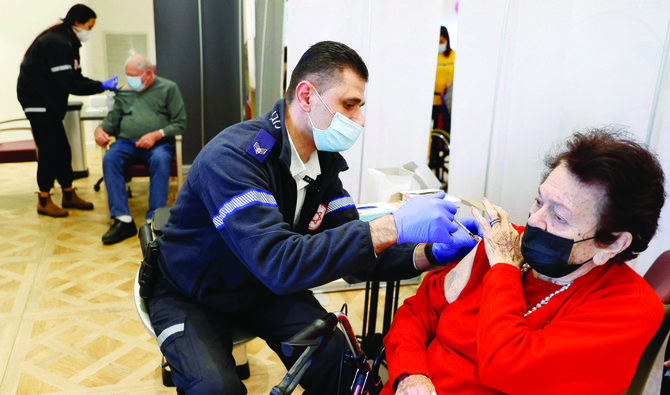
A resident of a private nursing home in the Israeli central coastal city of Netanya receives a fourth Pfizer-BioNTech vaccine against the coronavirus. (AP)
Short Url
Updated 11 January 2022
Follow

Relying on more home COVID-19 tests, Israel looks to lower costs

  • Israel last week said PCR and professionally administered antigen tests would only be required for people over the age of 60 or with weak immune systems

JERUSALEM: Israel sought on Sunday to ease access to home COVID-19 tests after a decision to allow most vaccinated people to use the kits to decide whether or not to quarantine led to shortages in shops and complaints about high prices.

“We are mindful of the public’s distress,” Prime Minister Naftali Bennett said at the weekly Cabinet meeting, announcing that every child in kindergarten or elementary school in Israel would be issued three free kits in the coming days.

The government was also negotiating price reductions with major pharmacy chains, Bennett said, adding: “In any event, costs will come down in the near future because the market will be flooded with millions of kits that will arrive in Israel.”

The kits cost around 25 shekels to 35 shekels ($8 and $11) in Israeli stores, many of which have reported running out.

Nachman Ash, director-general of the Health Ministry, told 103 FM radio that unit price should be no more than 10 shekels ($3).

With a surge in COVID-19 infections and hours-long queues at mandatory testing stations, Israel last week said PCR and professionally administered antigen tests would only be required for people over the age of 60 or with weak immune systems. Other vaccinated people could now rely on home tests. But there was some skepticism about efficacy.

Israel’s Channel 12 TV news reported that a Defense Ministry technology team had found that the kits missed 47 percent of confirmed COVID-19 carriers and had a false-positive rate of 37 percent. A ministry spokeswoman declined comment.

Salman Zarka, Israel’s pandemic-response coordinator, said self-testing and self-reporting would compromise efforts to track cases.

“We will not know the scale of morbidity with the home antigen kits,” he told Kan radio.

Israel hopes new antiviral COVID-19 medications will help keep hospital admissions and severe cases down, even as daily cases are expected to rise to record highs in the coming weeks.

About 60 percent of its 9.4 million population is fully vaccinated, according to the Health Ministry.


‘Not your war’: Omani FM on US and Israel undermining ‘active and serious negotiations’

Updated 5 sec ago
Follow

‘Not your war’: Omani FM on US and Israel undermining ‘active and serious negotiations’

  • On Friday, Albusaidi appeared on US news show “Face The Nation” and said a peace deal between Iran and the US was “within our reach”

LONDON: Oman’s Foreign Minister Badr Albusaidi, who was leading indirect negotiations between Iran and the US in Geneva this week, tweeted his dismay at the attacks on Tehran this morning by the US and Israel.

“I am dismayed. Active and serious negotiations have yet again been undermined. Neither the interests of the United States nor the cause of global peace are well served by this,” Albusaidi wrote. “And I pray for the innocents who will suffer. I urge the United States not to get sucked in further. This is not your war.”

On Friday, Albusaidi appeared on US news show “Face The Nation” and said a peace deal between Iran and the US was “within our reach.” He also said, “I don’t think any alternative to diplomacy is going to solve this problem.”

An agreement to irreversibly halt nuclear stockpiling and enrichment was reached, according to Abdusaidi — a feat never before achieved, and one of US President Donald Trump’s most important demands.

“Iran will never, ever have a nuclear material that will create a bomb. This is, I think, a big achievement. This is something that is not in the old deal that was negotiated during President Obama’s time,” the foreign minister said.

“They will not be able to actually accumulate the material that would enable them to create a bomb … So there would be zero accumulation, zero stockpiling and full verification.”

Early on Saturday, the US and Israel launched coordinated military strikes against multiple targets inside Iran, marking a dramatic escalation in Middle East tensions. The operation — described by US officials as “major combat operations” — involved air and missile strikes on key Iranian military and government infrastructure, including areas in and around Tehran.

Trump framed the action as an effort to degrade Iran’s missile and nuclear capabilities and to remove what he described as “an imminent threat” to regional and global security.