

Relying on more home COVID-19 tests, Israel looks to lower costs

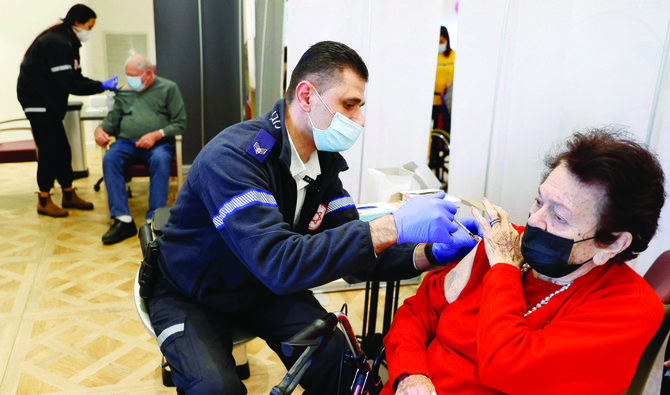
A resident of a private nursing home in the Israeli central coastal city of Netanya receives a fourth Pfizer-BioNTech vaccine against the coronavirus. (AP)
Short Url
Updated 11 January 2022
Follow

Relying on more home COVID-19 tests, Israel looks to lower costs

  • Israel last week said PCR and professionally administered antigen tests would only be required for people over the age of 60 or with weak immune systems

JERUSALEM: Israel sought on Sunday to ease access to home COVID-19 tests after a decision to allow most vaccinated people to use the kits to decide whether or not to quarantine led to shortages in shops and complaints about high prices.

“We are mindful of the public’s distress,” Prime Minister Naftali Bennett said at the weekly Cabinet meeting, announcing that every child in kindergarten or elementary school in Israel would be issued three free kits in the coming days.

The government was also negotiating price reductions with major pharmacy chains, Bennett said, adding: “In any event, costs will come down in the near future because the market will be flooded with millions of kits that will arrive in Israel.”

The kits cost around 25 shekels to 35 shekels ($8 and $11) in Israeli stores, many of which have reported running out.

Nachman Ash, director-general of the Health Ministry, told 103 FM radio that unit price should be no more than 10 shekels ($3).

With a surge in COVID-19 infections and hours-long queues at mandatory testing stations, Israel last week said PCR and professionally administered antigen tests would only be required for people over the age of 60 or with weak immune systems. Other vaccinated people could now rely on home tests. But there was some skepticism about efficacy.

Israel’s Channel 12 TV news reported that a Defense Ministry technology team had found that the kits missed 47 percent of confirmed COVID-19 carriers and had a false-positive rate of 37 percent. A ministry spokeswoman declined comment.

Salman Zarka, Israel’s pandemic-response coordinator, said self-testing and self-reporting would compromise efforts to track cases.

“We will not know the scale of morbidity with the home antigen kits,” he told Kan radio.

Israel hopes new antiviral COVID-19 medications will help keep hospital admissions and severe cases down, even as daily cases are expected to rise to record highs in the coming weeks.

About 60 percent of its 9.4 million population is fully vaccinated, according to the Health Ministry.


Israeli approval of West Bank land registration draws outrage

Updated 33 min 53 sec ago
Follow

Israeli approval of West Bank land registration draws outrage

  • Israel’s government has approved a process to register land in the West Bank, drawing condemnation

JERUSALEM: Israel’s government has approved a process to register land in the West Bank, drawing condemnation from Arab nations and critics who labelled it a “mega land grab” that would accelerate annexation of the Palestinian territory.
Israel’s foreign ministry said the measure would enable “transparent and thorough clarification of rights to resolve legal disputes” and was needed after unlawful land registration in areas controlled by the Palestinian Authority.
But Egypt, Qatar and Jordan criticized the move as illegal under international law.
In a statement, the Egyptian government called it a “dangerous escalation aimed at consolidating Israeli control over the occupied Palestinian territories.”
Qatar’s foreign ministry condemned the “decision to convert West Bank lands into so-called ‘state property’,” saying it would “deprive the Palestinian people of their rights.”
The Palestinian Authority called for international intervention to prevent the “de facto beginning of the annexation process and the undermining of the foundations of the Palestinian state.”
Israeli anti-settlement watchdog Peace Now called Sunday’s measure a “mega land grab.”
According to public broadcaster Kan, land registration will be reopened in the West Bank for the first time since 1967 — when Israel captured the territory in the Middle East war.
The Israeli media reported that the process will take place only in Area C, which constitutes some 60 percent of West Bank territory and is under Israeli security and administrative control.
Palestinians see the West Bank as foundational to any future Palestinian state, but many on Israel’s religious right want to take over the land.
Last week, Israel’s security cabinet approved a series of measures backed by far-right ministers to tighten control over areas of the West Bank administered by the Palestinian Authority under the Oslo accords in place since the 1990s.
Those measures, which also sparked international backlash, include allowing Jewish Israelis to buy West Bank land directly and allowing Israeli authorities to administer certain religious sites in areas under the Palestinian Authority’s control.
Excluding Israeli-annexed east Jerusalem, more than 500,000 Israelis live in West Bank settlements and outposts, which are illegal under international law.
Around three million Palestinians live in the territory.