

Arabic music institute to be established in Saudi Arabia

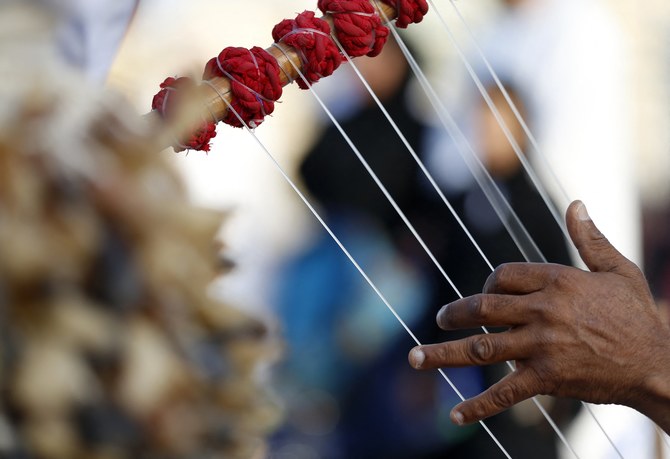
Musicians play traditional music on April 10, 2016, during the Sharjah Heritage Days festival at the Heritage Area in the United Arab Emirate. (AFP/ File)
Short Url
Updated 09 January 2022
Follow

Arabic music institute to be established in Saudi Arabia

  • The commission aims to develop the institute to be a globally recognized center
  • In recent decades, the Kingdom has become home to talented composers, singers, and oud players

JEDDAH: Saudi Arabia’s Music Commission is establishing an institute to train the country’s musical talent.

Bait Al-Oud seeks to be a learning center for musicians so they can get the required training in playing traditional Arabic instruments and be educated about the instruments’ role in developing the region’s music culture.

The oud, which dates back more than 3,000 years, is one of the oldest and most important stringed instruments in the Arab world’s musical heritage and it has played a significant role through history.

The commission aims to develop the institute to be a globally recognized center, spread awareness about Arabic musical instruments, specifically the oud, and preserve the heritage of Arabic music.

“The oud is one of the most important musical stringed instruments,” oud player Hasan Iskandrani told Arab News. “It has been called the ‘sultan of instruments’ and is usually used by composers in shaping their melodies.”
Traditional Arabic musical instruments such as the oud, duf, rebab, and mizmar, which are used in many different celebrations in the Kingdom, have played a major role in establishing the musical culture of the country and its different forms of musical expression.

There are different types of oud - including Iraqi, Syrian, Egyptian and Turkish — and it is played in different styles across the region.

In recent decades, the Kingdom has become home to talented composers, singers, and oud players.

Many people in the Kingdom enjoy the work of Abadi Al-Jowhar, who is known as the “Octopus of the Oud.”

Alongside Al-Jowhar are Talal Salamah and Aseel Abu Bakr Saleem who, to this day, are influencing an emerging new generation of Saudi oud players.

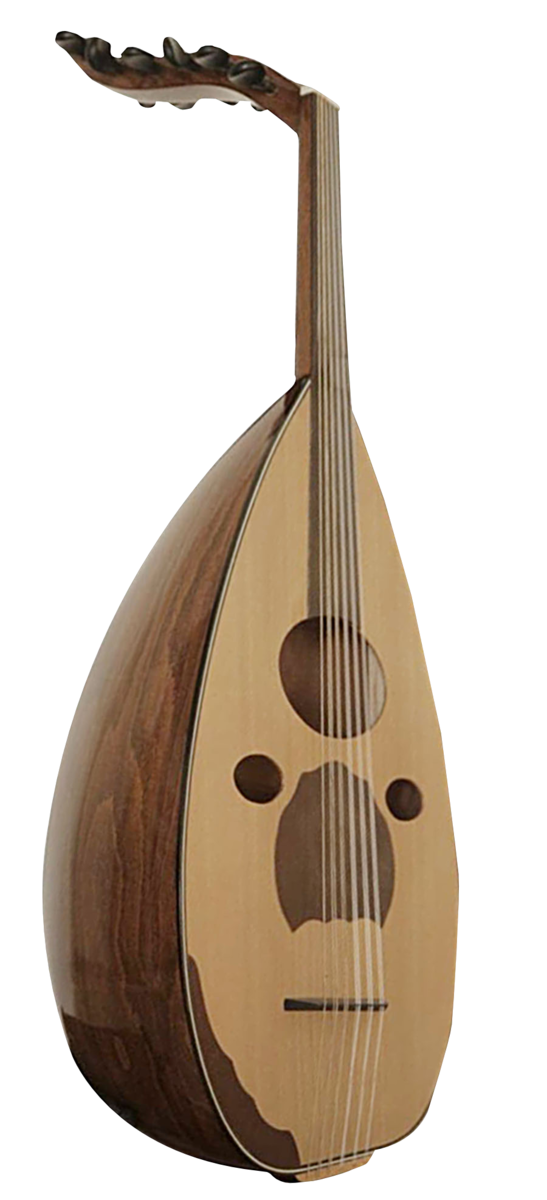
The oud is distinctive for being fretless and pear-shaped. It is traditionally made from lightwood, has a short neck, and is normally built with 11 strings.

Being fretless, the oud is considered a versatile instrument that gives musicians the freedom to produce more fluid notes without having to retune.

And, unlike other string instruments which typically have one large hole in the center, the oud can have up to three holes, which gives it its distinctive and mesmerizing tune.

This makes it ideally suited for musicians to play the maqam, a system of melodic structure used in traditional Arabic music.

And, like other ancient musical instruments, the oud has its own fans and admirers who enjoy listening to its tunes.

But, had it not been for some great musical maestros, the legacy of the oud would have probably been lost. One cannot talk about the instrument without mentioning the legends who made it what it is today.

The oud has passed through prominent musicians, from the “King of Oud” Fared Al-Atrache, to Marcel Khalifeh in Lebanon, Munir Bashir and Naseer Shamma in Iraq, and Mohamed Al-Qasabgi in Egypt.

There are many beliefs about where the instrument originated from. It is believed that it evolved from the Persian barbat and was used during the Kassite period and Babylon in Mesopotamia, which later made its way to Europe through North Africa.

The institute, which will be run by an elite group of musicians, also aims to be a regional hub for Saudis of all ages to learn and develop techniques to play Arabic musical instruments.

“The Bait Al-Oud Institute will contribute to the development of the various types of stringed instruments. In addition, it will encourage the development of young music talent,” said Iskandrani. “Through the institute, it will be a forum for great music legends and new emerging musicians to share ideas, experiences, and culture for continuous development.”

The institute will also act as a platform for musicians to share and perform their musical projects with audiences who enjoy listening to oud performances.


Saudi Arabia, Estonia strengthen cyber defense cooperation

Updated 09 February 2026
Follow

Saudi Arabia, Estonia strengthen cyber defense cooperation

  • Renowned for its leadership in digital governance, Estonia sees cybersecurity as central to its partnership potential with Saudi Arabia, building on years of regional engagement through its technology firms

RIYADH: Estonia aims to deepen defense, cybersecurity, and artificial intelligence cooperation with Saudi Arabia as both nations look to advance technology‑driven defense and cybersecurity capabilities.

Hanno Pevkur, Estonia’s minister of defense, told Arab News at the World Defense Show in Riyadh on Monday that Estonia’s defense industry is eager to contribute to the Kingdom’s fast‑growing defense ecosystem.

“In the modern world, cooperation built on trust and technology is the best defense,” he said. “It is important for us to be here because we clearly see there is a possibility to increase cooperation, not only bilaterally between Saudi Arabia and Estonia, but across the region.”

At Estonia’s pavilion, a cooperation agreement was signed between an Estonian company and a Saudi firm during the show, he noted.

Pevkur also said Estonia’s defense sector has expanded rapidly in recent years, driven by technological innovation and partnership.

“Our defense industry is growing very rapidly, and we continue to see strong momentum,” he said.

He said Estonia’s strengths lie in digital and smart‑system integration rather than large‑scale weapons production.

“We will not build airplanes or tanks, but what we can do is integrate robotics, automation and drones to make existing systems smarter,” he said.

The minister said effective defense collaboration must link businesses and governments to achieve meaningful results.

“When we want to have real cooperation, we need it on all levels,” he said. “The biggest client for any defense company is the government, so we must treat this as one ecosystem where the public and private sectors work hand in hand.”

Renowned for its leadership in digital governance, Estonia sees cybersecurity as central to its partnership potential with Saudi Arabia, building on years of regional engagement through its technology firms.

Pevkur said several Estonian companies, including Nortal, have already assisted Gulf governments in developing open IT and digital‑service systems.

“As the most digitalized nation in the world, almost every service in Estonia can be done online, except getting married,” he said. “But with such digitalization, we also need strong cyberdefense.”

He said data protection and digital resilience are treated as matters of national sovereignty in Tallinn, the capital of Estonia.

“Data is what we own. When someone steals that data, it becomes a serious threat,” he added. “That is why cyberdefense is not just about technology, it is about trust, sovereignty and protection.”

Pevkur said Saudi Arabia’s advances in AI offer promising opportunities for collaboration.

“I know that Saudi Arabia is doing great work when it comes to AI,” he said. “For us, as a small country with limited human resources, AI is essential not just for defense but for everyday life.”

Pevkur added that Estonia has launched a national AI strategy to promote responsible development and closer coordination between government and industry. One Estonian company, he said, has developed a system that allows a single operator to control hundreds of drones through AI.

“It is quite easy to put a weapon into the hands of a robot, but we also need to define who is accountable for its actions,” he said.

“The big question for the future is whether we can allow a war to be fought entirely by AI, or if humans must always make the final ethical decisions.”

He said in his conclusion that governments must reach a common understanding on how AI will be used and regulated on the battlefield.