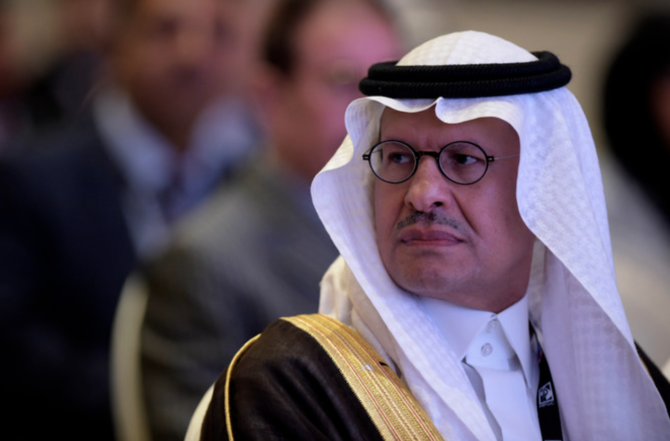
RIYADH: Energy security does not need to be sacrificed to deal with climate concerns, one of Saudi Arabia’s top ministers has insisted.
The Kingdom’s Energy Minister Prince Abdulaziz bin Salman flagged made the comments at a dialogue session titled “Energy Security, Future of Energy, and Sustainable Development” during the 2024 IsDB Group Annual Meetings in Riyadh.
His warning come as climate change discussions now include a focus on innovative solutions such as renewables and advanced technologies while ensuring energy security and economic growth.
Prince Abdulaziz stated: “We believe in the reality of the climate crisis, but we support dealing with it according to the priorities of each country.”
He added: “Our issue is not recognizing the existence of the problem of climate change, but rather how to deal with it in a fair and direct manner, taking into account the differences in the national circumstances of countries.”
The minister stressed the importance of collaboration and collective action, noting Saudi Arabia’s proactive engagement on global warming.
“The Kingdom has the second lowest intensity of carbon dioxide and methane emissions in the world, and countries that occupy lagging positions must follow our approach,” he emphasized, urging nations to unite and work together toward effective solutions.
“The discussion on the issue of climate change must be realistic and logical to enable all parties to cooperate in confronting this global issue,” the minister added.
The energy minister joined a growing chorus of high-profile figures discussing the trade-offs between energy security and climate concerns.
In March, President and CEO of Aramco Amin Nasser called for a new approach to the energy transition that incorporates oil and gas, saying the current strategy “is visibly failing on most fronts.”
Speaking at the same meeting as Prince Abdulaziz in Riyadh, Muhammad Al-Jasser, president of the Islamic Development Bank, highlighted the institution’s commitment to green projects through innovative financing mechanisms.
“Anytime you have a green project, you can issue sukuk against it. Once you have those green sukuks, you can create green assets against it and then you have a virtual cycle triggered into the process and we’re already there,” he explained.
Al-Jasser emphasized the bank’s proactive approach to catalyzing change rather than waiting for it.
“This year is going to be a bumper year for us, we’re going to be issuing $6 billion of sukuk; some of it will be green. This is our way of helping and not waiting too long to bring about that change,” he said.
Addressing the financing challenges associated with the energy transition, he emphasized the progress made by IsDB in increasing funding for sustainable projects.
“We will provide financing within our abilities and we do it with also all of the other Arab lending institutions,” he explained.
He continued: “There’s the Arab Coordination Group, we compare notes and we go out and we finance some of these projects like the hydro dams that we have financed together and that helps a lot with the transition and with the creation of sufficient energy to fuel these economies.”
However, he acknowledged the financial constraints and emphasized that the transition must be realistic and inclusive, stating: “We will never have enough money, and therefore the transition has to take that into account.”