

From roads to Nike sneakers: Pakistani truck art makes new unlikely entry

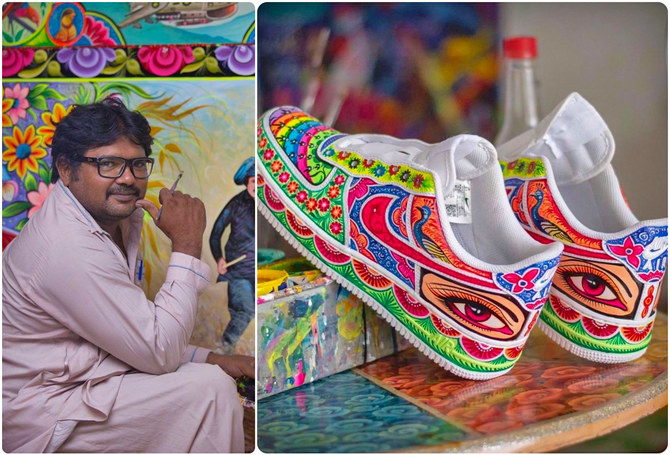
The collage of undated photos shows Pakistani truck-art painter Haider Ali (left) and Nike sports shoes custom painted by him. (Photo courtesy: Haider Ali)
Short Url
Updated 09 January 2022
Follow

From roads to Nike sneakers: Pakistani truck art makes new unlikely entry

  • Photos of Nike shoes custom painted by Pakistani artist Haider Ali have gone viral on social media
  • Ali first made international headlines in 2020 when he painted a mural portraying George Floyd

KARACHI: Traditional truck art, which brings color and humor to the landscape of Pakistani roads, is making a new entry into the international pop culture scene through an unexpected medium: Nike sneakers.

Photos of the Nike sports shoes decorated with floral ornaments, peacocks, and mascara-rimmed eyes have gone viral on social media last week, putting Karachi-based artist Haider Ali in the spotlight. 

“A client came with sneakers and asked me to paint them,” the 41-year-old artist told Arab News. “I made these designs in a week’s time.”

A third generation of truck artists, he started painting at the age of seven and has since brought the colorful South Asian technique also to rickshaws, cars, aircraft, buildings, apparel and items of daily use. He made international headlines in 2020 when he painted a mural portraying George Floyd, an African-American who was killed by the US police that year, becoming a symbol of resistance against racial discrimination.
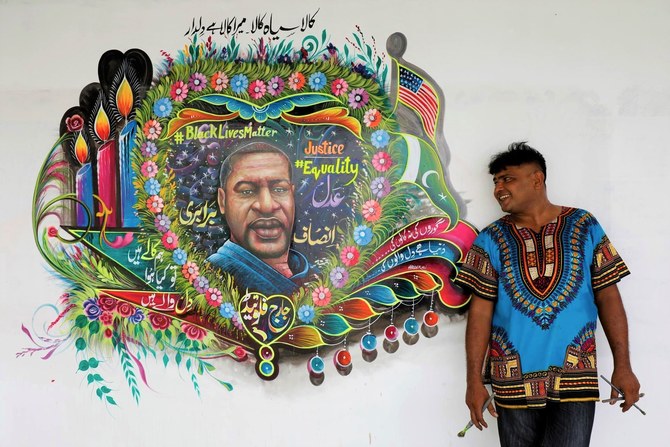


Pakistani truck-art painter Haider Ali, 40, poses next to a mural, depicting George Floyd, who died in Minneapolis police custody in US., in Karachi, Pakistan, June 12, 2020. (Reuters)

A former lecturer at the prestigious Indus Valley School of Art and Architecture, Ali also runs a truck art design school and studio at his residence in Karachi’s Hawke’s Bay, and has been training his children to follow in his footsteps.

“I have spent my life with these colors and trucks,” he said. “I am now training my own children, to carry the family legacy forward as well as to keep this beautiful art form alive.”

Besides the trucks that ply the roads of the seaside metropolis with both traditional motifs and portraits ranging from Pakistani greats to Princess Diana, Ali’s art is visible across Karachi, decorating its walls, bridges and pillars with vivid designs and hues. 
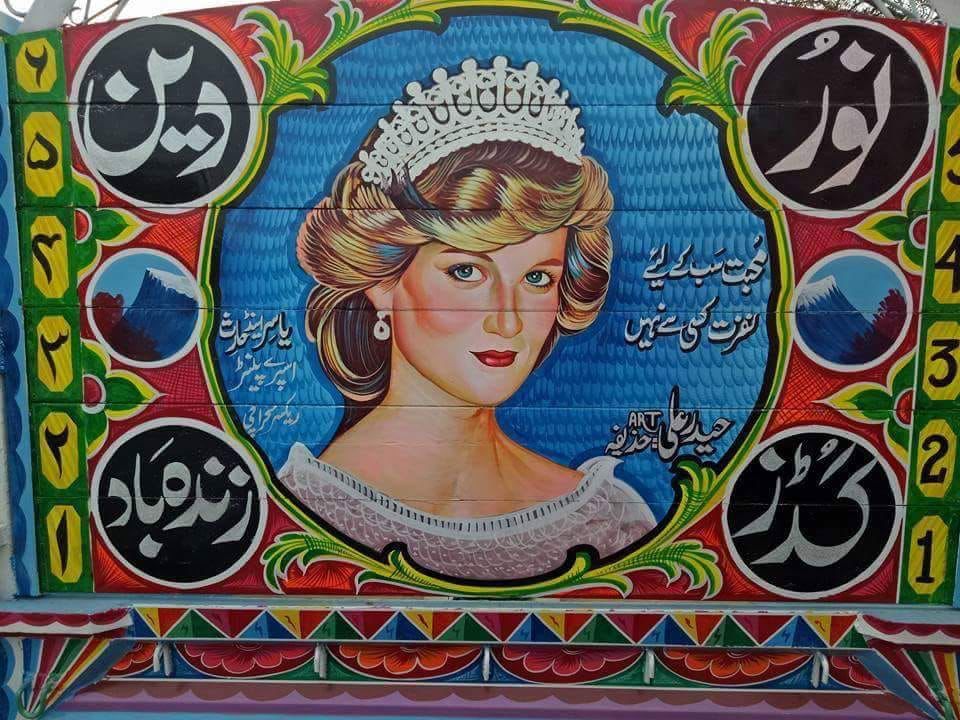


The undated photo shows Princess Diana painted on a truck by Pakistani truck-art painter Haider Ali. (Photo courtesy: Haider Ali)

Like the George Floyd painting on his house, some of Ali’s other murals have also been dedicated to those who became the symbols of their time. His two portraits on the walls of the Karachi Press Club show Pakistani social activists Sabin Mehmood and Parveen Rehman, both of whom were assassinated in relation to their work.

Truck art is for Ali a way to express all “colors of Pakistan.”
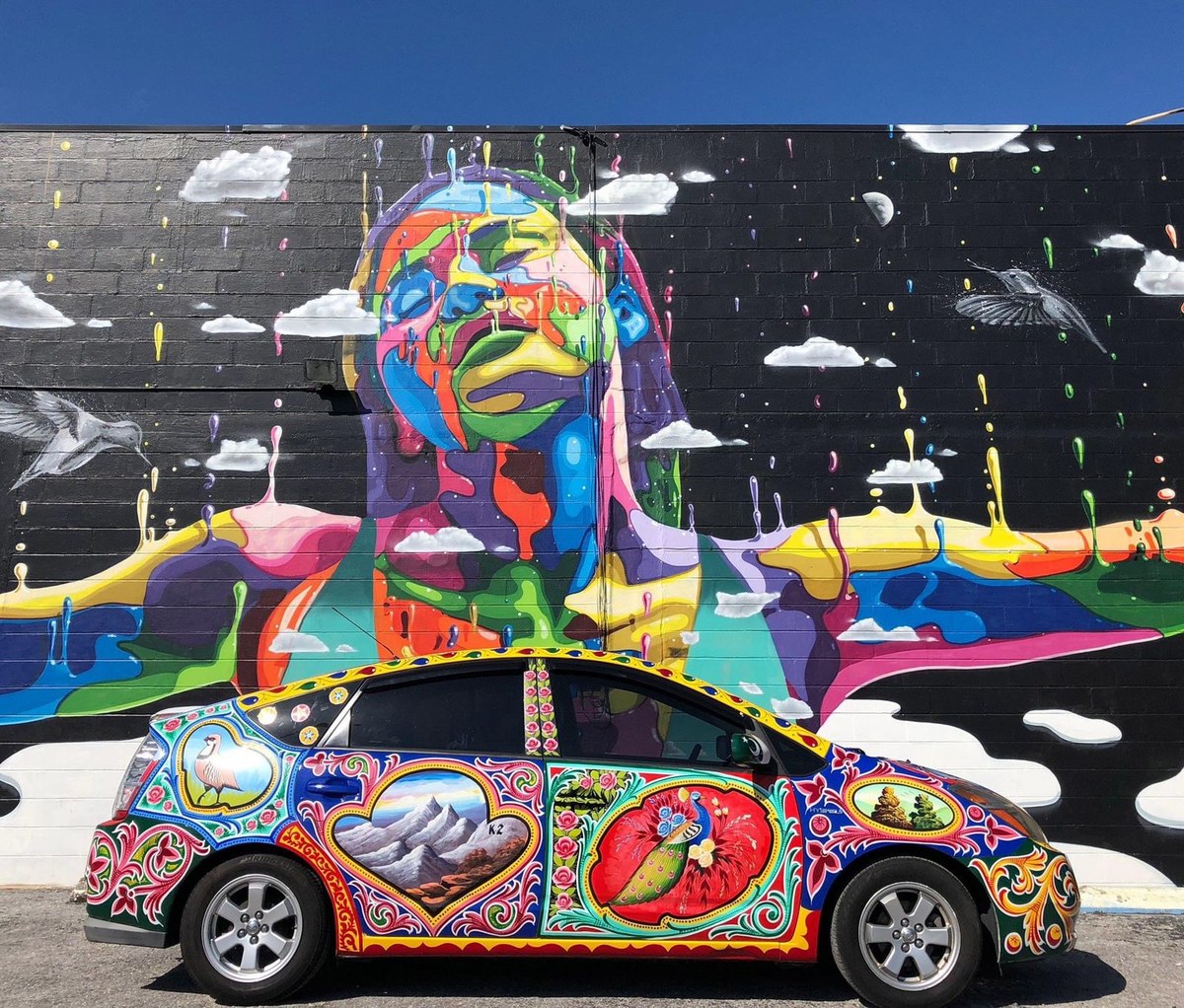


The undated photo shows truck-art themed car painted by Pakistani truck-art painter Haider Ali. (Photo courtesy: Haider Ali)

Already present abroad, especially in the UK and in the US, where he painted a truck for the Smithsonian Institute, he wishes his work could also reach the Middle East.

“I wish to get commissioned work from Saudi Arabia and UAE,” he said, expressing hope “the people of these nations could also see how beautiful Pakistan’s truck art is.”


IMF warns against policy slippage amid weak recovery as it clears $1.2 billion for Pakistan

Updated 11 December 2025
Follow

IMF warns against policy slippage amid weak recovery as it clears $1.2 billion for Pakistan

  • Pakistan rebuilt reserves, cut its deficit and slowed inflation sharply over the past one year
  • Fund says climate shocks, energy debt, stalled reforms threaten stability despite recent gains

ISLAMABAD: Pakistan’s economic recovery remains fragile despite a year of painful stabilization measures that helped pull the country back from the brink of default, the International Monetary Fund (IMF) warned on Thursday, after it approved a fresh $1.2 billion disbursement under its ongoing loan program.

The approval covers the second review of Pakistan’s Extended Fund Facility (EFF) and the first review of its climate-focused Resilience and Sustainability Facility (RSF), bringing total disbursements since last year to about $3.3 billion.

Pakistan entered the IMF program in September 2024 after years of weak revenues, soaring fiscal deficits, import controls, currency depletion and repeated climate shocks left the economy close to external default. A smaller stopgap arrangement earlier that year helped avert immediate default, but the current 37-month program was designed to restore macroeconomic stability through strict monetary tightening, currency adjustments, subsidy rationalization and aggressive revenue measures.

The IMF’s new review shows that Pakistan has delivered significant gains since then. Growth recovered to 3 percent last year after shrinking the year before. Inflation fell from over 23 percent to low single digits before rising again after this year’s floods. The current account posted its first surplus in 14 years, helped by stronger remittances and a sharp reduction in imports. And the government delivered a primary budget surplus of 1.3 percent of GDP, a key program requirement. Foreign exchange reserves, which had dropped dangerously low in 2023, rose from US$9.4 billion to US$14.5 billion by June.

“Pakistan’s reform implementation under the EFF arrangement has helped preserve macroeconomic stability in the face of several recent shocks,” IMF Deputy Managing Director Nigel Clarke said in a statement after the Board meeting.

But he warned that Islamabad must “maintain prudent policies” and accelerate reforms needed for private-sector-led and sustainable growth.

The Fund noted that the 2025 monsoon floods, affecting nearly seven million people, damaging housing, livestock and key crops, and displacing more than four million, have set back the recovery. The IMF now expects GDP growth in FY26 to be slightly lower and forecasts inflation to rise to 8–10 percent in the coming months as food prices adjust.

The review warns Pakistan against relaxing monetary or fiscal discipline prematurely. It urges the State Bank to keep policy “appropriately tight,” allow exchange-rate flexibility and improve communication. Islamabad must also continue raising revenues, broadening the tax base and protecting social spending, the Fund said.

Despite the progress, Pakistan’s structural weaknesses remain severe.

Power-sector circular debt stands at about $5.7 billion, and gas-sector arrears have climbed to $11.3 billion despite tariff adjustments. Reform of state-owned enterprises has slowed, including delays in privatizing loss-making electricity distributors and Pakistan International Airlines. Key governance and anti-corruption reforms have also been pushed back.

The IMF welcomed Pakistan’s expansion of its flagship Benazir Income Support Program, which raises cash transfers for low-income families and expands coverage, saying social protection is essential as climate shocks intensify. But it warned that high public debt, about 72 percent of GDP, thin external buffers and climate exposure leave the country vulnerable if reform momentum weakens.

The Fund said Pakistan’s challenge now is to convert short-term stabilization into sustained recovery after years of economic volatility, with its ability to maintain discipline, rather than the size of external financing alone, determining the durability of its gains.