

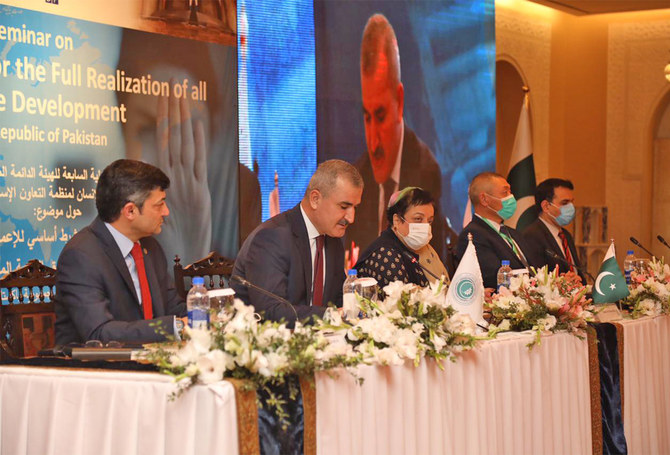
OIC rights commission in Pakistan urges member states to establish anti-corruption institutions

Chairperson of the OIC-IPHRC, Dr. Haci Ali Acikgul (2L) speaks to the participants of a seminar on ‘Combating Corruption – A Prerequisite for the Full Enjoyment of all Human Rights and Sustainable Development’ in Islamabad on January 7, 2022. (UNDP)
Short Url
Updated 07 January 2022
Follow

OIC rights commission in Pakistan urges member states to establish anti-corruption institutions

  • Pakistan and OIC’s human rights commission hosted a seminar in Islamabad on preventing graft
  • Islamabad Declaration urges member states to establish accessible and independent channels for reporting corruption

ISLAMABAD: The Organization of Islamic Cooperation (OIC) Independent Permanent Human Rights Commission (IPHRC) on Friday urged member states to strengthen institutional mechanisms by establishing fully equipped, empowered and independent accountability institutions, enhancing the capacity of the judiciary, prosecution services and law enforcement agencies to combat corruption across the Muslim world. 
OIC-IPHRC and the Pakistani government organized a two-day seminar on ‘Combating Corruption – A Prerequisite for the Full Enjoyment of all Human Rights and Sustainable Development’. Over 200 representatives of international organizations, including the Office of the High Commissioner for Human Rights (OHCHR), the United Nations Office on Drugs and Crime (UNODC) and the United Nations Development Program (UNDP) attended the seminar. 
“This declaration encouraged all OIC member states to establish fully equipped, empowered and independent accountability institutions, which are capable to investigate crimes of corruption, including sophisticated transnational crimes, in an independent and impartial manner,” the Islamabad Declaration’s statement read at the end seminar’s conclusion. 
The seminar laid stress on providing training, with adequate resources, to personnel to ensure the implementation of various laws relation to anti-corruption. 
“The Islamabad Declaration urged all OIC States to undertake accelerated actions to combat corruption in a comprehensive manner through strengthening the legal frameworks, with human dignity at the heart of policies, to address existing structural disadvantages and inequalities which reflect both causes and consequences of various forms of corruption in respective societies and systems,” Dr. Haci Ali Acikgul, chairperson of the OIC-IPHRC, told Arab News. 
“No country alone can combat corruption, it requires cooperation at the national, regional and international level,” he said, adding that during the seminar inputs were obtained from UN agencies, OIC member states and other international experts.
All of these inputs, he said, combined to make up the Islamabad Declaration against corruption. 
“It is a very important document. I hope these efforts will raise awareness among member states and the international community, especially through civil society and media,” Acikgul said and emphasized that “corruption is the main epidemic in full realization of human rights.” 
Islamabad Declaration called for the mobilization of all relevant national mechanisms to fight corruption in close cooperation with media, religious institutions and civil societies while ensuring that victims and all those involved in reporting, investigating and prosecuting corruption are protected from intimidation and harm. 
It stressed on establishing accessible, visible and independent channels to report corruption and introducing procedures that enable all individuals and groups to demand action when their rights are suppressed due to corruption. 
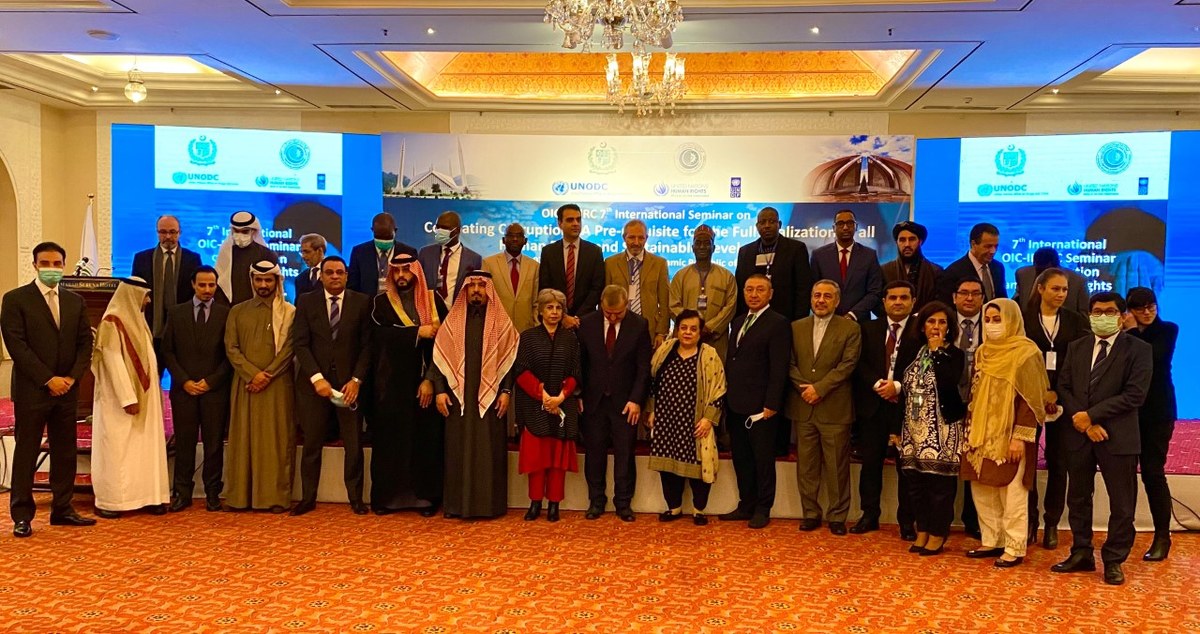


A group photo of the participants of the two-day seminar “Combating Corruption – A Prerequisite for the Full Enjoyment of all Human Rights and Sustainable Development,” organized by organized by OIC-IPHRC and Pakistani government, in Islamabad, Pakistan, on January 7, 2022. (AN Photo)

The Islamabad Declaration called upon the international community to translate the global focus on human rights protection and Sustainable Development Goals (SDGs), which has been a central issue for international cooperation, into concrete, measurable actions on the ground to effectively address transnational corruption. 
“Recovering and returning confiscated assets and illicit financial flows, in accordance with UNCAC, can contribute to effective resource mobilization, poverty eradication, sustainable development and the enjoyment of all human rights, particularly for developing countries,” the declaration statement added. 
It also encouraged member states to cooperate with international partners to reinforce efforts and resources to assist in implementing integral measures that end corruption, enhance accountability and contribute to the promotion and protection of human rights. 
Pakistan’s ministry for human rights Dr. Shireen Mazari said OIC has immense power to mobilize collective efforts to combat corruption. 
“OIC can play a very strong role internationally to stop corruption, illegal flow of money and money laundering,” she told Arab News. 
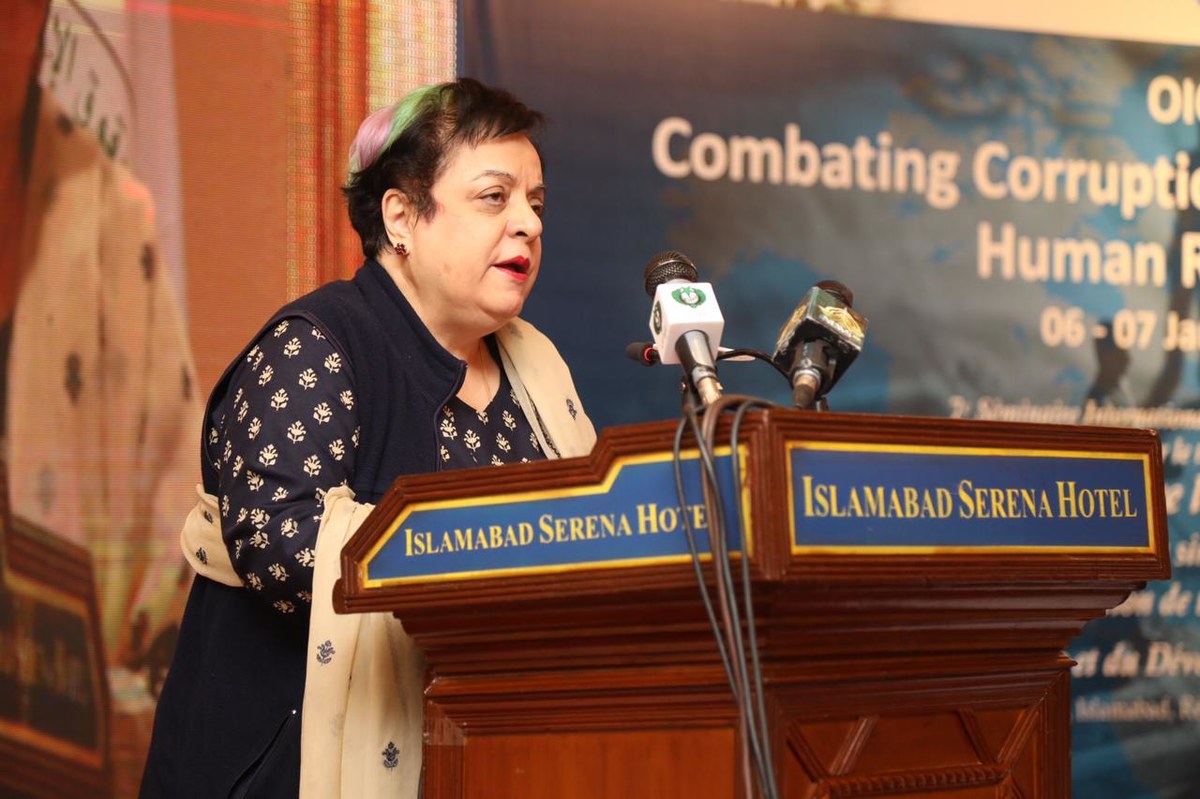


Pakistan's minister for human rights, Dr. Shireen Mazari, address the seminar on ‘Combating Corruption – A Prerequisite for the Full Enjoyment of all Human Rights and Sustainable Development’ in Islamabad, Pakistan, on January 7, 2022. (UNDP)

She commended OIC-IPHRC for gathering experts from across the world. 
“It has been informative for all participants and helpful in combating the menace of corruption in the Muslim world through an effective anti-corruption framework and methodology,” she said. 


Multi-party summit pushes for talks between Pakistan government, opposition to ease tensions

Updated 5 sec ago
Follow

Multi-party summit pushes for talks between Pakistan government, opposition to ease tensions

  • National Dialogue Committee group organizes summit attended by prominent lawyers, politicians and journalists in Islamabad
  • Participants urge government to lift alleged ban on political activities, end politically motivated cases and release women prisoners

ISLAMABAD: Participants of a meeting featuring prominent politicians, lawyers and civil society members on Wednesday urged the government to initiate talks with former prime minister Imran Khan’s Pakistan Tehreek-e-Insaf (PTI) party, lift alleged bans on political activities and release jailed leaders of the PTI to foster reconciliation and pave the way for economic prosperity.

The summit was organized by the National Dialogue Committee (NDC), a political group formed last month by former PTI members Chaudhry Fawad Husain, ex-Sindh governor Imran Ismail and Mehmood Moulvi. The NDC has called for efforts to ease political tensions in the country and facilitate dialogue between the government and Khan’s party. 

The development takes place amid rising tensions between the PTI and Pakistan’s military and government. Khan, who remains in jail on a slew of charges he says are politically motivated, blames the military and the government for colluding to keep him away from power by rigging the 2024 general election and implicating him in false cases. Both deny his allegations. 

Since Khan was ousted in a parliamentary vote in April 2022, the PTI has complained of a widespread state crackdown, while Khan and his senior party colleagues have been embroiled in dozens of legal cases. Prime Minister Shehbaz Sharif last month reiterated his openness to talks with the PTI.

“The prime objective of the dialogue is that we want to bring the political temperatures down,” Ismail told Arab News after the conference concluded. 

“At the moment, the heat is so much that people— especially in politics— they do not want to sit across the table and discuss the pertaining issues of Pakistan which is blocking the way for investment.”

Former prime minister Shahid Khaqan Abbasi, who heads the Awaam Pakistan political party, attended the summit along with Jamaat-e-Islami senior leader Liaquat Baloch, Muttahida Quami Movement-Pakistan’s Waseem Akhtar and Haroon

Rasheed, president of the Supreme Court Bar Association. Journalists Asma Shirazi and Fahd Husain also attended the meeting. 

Members of the Pakistan Peoples Party, the ruling Pakistan Muslim League-Nawaz (PML-N) and the PTI did not attend the gathering. 

Muhammad Ali Saif, a former adviser to the Khyber Pakhtunkhwa chief minister, told participants of the meeting that Pakistan was currently in a “dysfunctional state” due to extreme political polarization.

“The tension between the PTI and the institutions, particularly the army, at the moment is the most fundamental, the most prominent and the most crucial issue,” Saif noted. 

‘CHANGED FACES’

The summit issued a joint communiqué after the meeting, proposing six specific confidence-building measures. These included lifting an alleged ban on political activities and the appointment of the leaders of opposition in Pakistan’s Senate and National Assembly. 

It also called for the immediate release of women political prisoners, such as Khan’s wife Bushra Bibi and PTI leader Yasmin Rashid, and the withdrawal of cases against supporters of political parties.

The communiqué also called for an end to media censorship and proposed that the government and opposition should “neither use the Pakistan Armed Forces for their politics nor engage in negative propaganda against them.”

Amir Khan, an overseas Pakistani businessperson, complained that frequent political changes in the country had undermined investors’ confidence.

“I came here with investment ideas, I came to know that faces have changed after a year,” Amir Khan said, referring to the frequent change in government personnel. 

The NDC plans to consult senior opposition leaders currently in prison to finalize a representative committee for talks once the government announces its own team.

“Let us create some environment. Let us bring some temperatures down and then we will do it,” Ismail said regarding a potential meeting with the jailed Khan. 

Khan’s party, on the other hand, has been calling for a “meaningful” political dialogue with the government. 

However, it has accused the government of denying PTI members meetings with Khan in the Rawalpindi prison where he remains incarcerated. 

“For dialogue to be meaningful, it is essential that these authorized representatives are allowed regular and unhindered access to Imran Khan so that any engagement accurately reflects his views and PTI’s collective position,” PTI leader Azhar Leghari told Arab News last week.