
ALMATY: Security forces in Kazakhstan killed dozens of protesters trying to storm government buildings overnight, police said Thursday, after a Moscow-led military alliance agreed to send forces to help quell mounting unrest.
The country’s state TV also confirmed the death of 12 policemen during clashes with the demonstrators, adding that one of the bodies was found with its head cut off.
Long seen as one the most stable of the ex-Soviet republics of Central Asia, energy-rich Kazakhstan is facing its biggest crisis in decades after days of protests over rising fuel prices escalated into widespread unrest.
In the worst reported violence so far, police said dozens of people were killed in battles with security forces at government buildings in the country’s largest city Almaty.
“Last night, extremist forces tried to assault administrative buildings, the Almaty city police department, as well as local police commissariats. Dozens of assailants were eliminated,” police spokesman Saltanat Azirbek was quoted as saying by the Interfax-Kazakhstan, TASS and Ria Novosti news agencies.
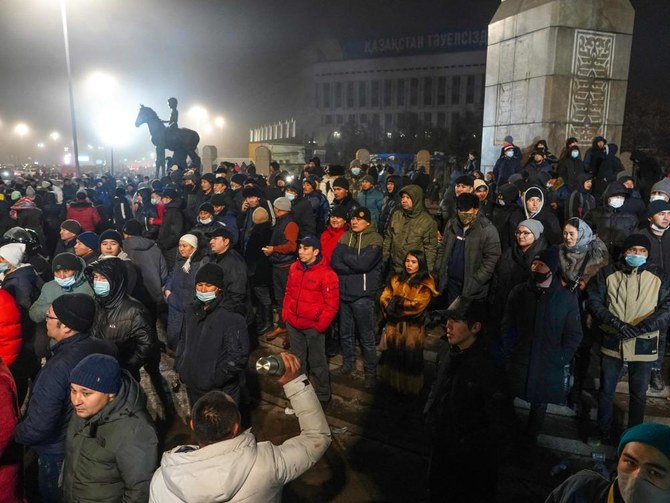
Videos on social media on Thursday showed pillaged shops and burned buildings in Almaty, automatic gunfire in the streets and residents screaming in fear.
The growing unrest is presenting a major challenge to the authoritarian regime of President Kassym-Jomart Tokayev and has raised international concern, especially with key ally Moscow.
With his repeated calls for calm ignored, Tokayev in an address to the nation early Thursday said he had appealed to the Russia-led Collective Security Treaty Organization (CSTO), which includes five other ex-Soviet states, to combat what he called “terrorist groups” that had “received extensive training abroad.”
The CSTO’s chairman, Armenian Prime Minister Nikol Pashinyan, said the alliance would send “collective peacekeeping forces... for a limited period of time in order to stabilize and normalize the situation in this country” that was caused by “outside interference.”
There were no immediate further details nor comment from Moscow, which dominates the alliance.
Tokayev said “terrorists” were seizing buildings, infrastructure and small arms, and fighting battles with security forces.
The Organization of Islamic Cooperation affirmed its full solidarity with the government of Kazakhstan in preserving the national unity of the country and its sovereignty, security, stability, and territorial integrity.
The organization called for maximum restraint and calm, and the safeguarding of the national interest and placing it above all other considerations to overcome the current crisis.
Protests spread across the nation of 19 million this week in outrage over a New Year increase in prices for liquid petroleum gas (LPG), which is widely used to fuel cars in the west of the country.
Thousands took to the streets in Almaty and in the western province of Mangystau, saying the price rise was unfair given oil and gas exporter Kazakhstan’s vast energy reserves.
Protesters were reported to have stormed several government buildings on Wednesday, including the Almaty mayor’s office and the presidential residence, with both said to be on fire.
As of late Wednesday, at least eight law enforcement officers had been killed and 317 wounded in the violence, according to the interior ministry quoted by local media.
The full picture of the chaos was unclear, with widespread disruptions to communications including mobile phone signals, the blocking of online messengers and hours-long Internet shutdowns.
The protests are the biggest threat so far to the regime established by Kazakhstan’s founding president Nursultan Nazarbayev, who stepped down in 2019 and hand-picked Tokayev as his successor.
Tokayev tried to head off further unrest by announcing the resignation of the government headed by Prime Minister Askar Mamin early on Wednesday, but protests continued.
Tokayev also announced he was taking over from Nazarbayev as head of the powerful security council, a surprise move given the ex-president’s continued influence.
With protests escalating, the government late on Wednesday said a state of emergency declared in protest-hit areas would be extended nationwide and in effect until January 19.
It imposes an overnight curfew, restricts movements and bans mass gatherings.
Much of the anger appeared directed at Nazarbayev, who is 81 and had ruled Kazakhstan since 1989 before handing power to Tokayev.
Many protesters shouted “Old Man Out!” in reference to Nazarbayev and images posted on social media showed a statue of the ex-president being torn down.
The EU and the UN called for “restraint” on all sides, while Washington urged authorities to allow protesters to “express themselves peacefully.”
Kazakhstan’s government tolerates little real opposition and has been accused of silencing independent voices.
Spontaneous, unsanctioned protests are illegal despite a 2020 law that eased some restrictions on freedom of assembly.