



LONDON: Moroccan artist Nabil El-Makhloufi has a particular talent for conveying mixed emotions in his work. Take his images of crowd scenes, which can seem both harmonious and dissonant. It’s not quite clear what is happening, nor whether it is good, bad, or somewhere in between.
This sense of ambivalence is deliberate, El-Makhloufi admits, but not contrived.
“I’m facing the same puzzle as the viewer,” he says. “Enigmatic or threatening situations that attract curiosity and ominous feelings are an important part of my work.”
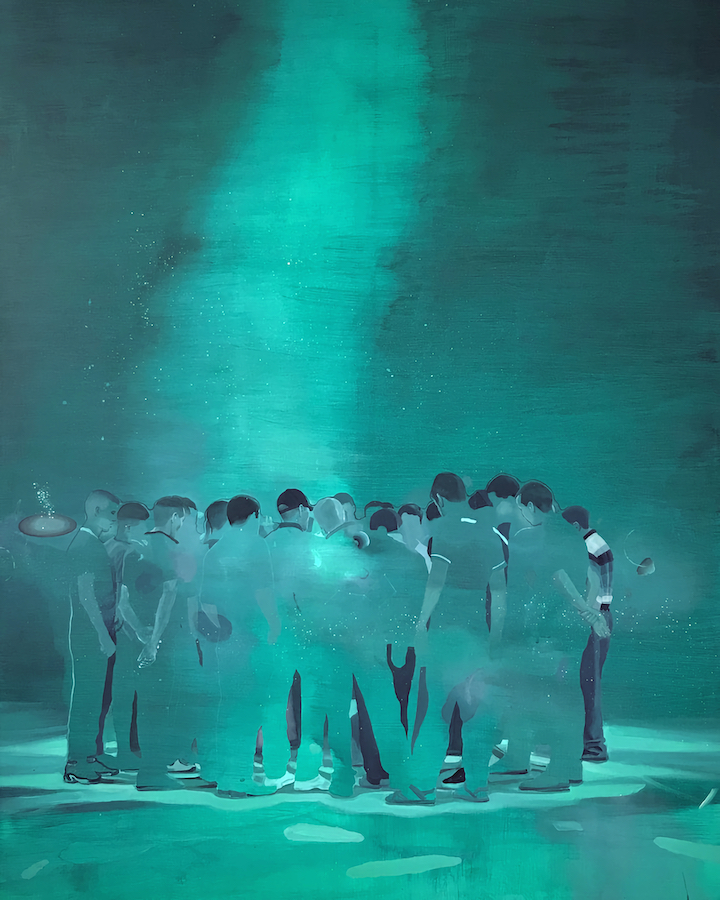
Nabil El-Makhloufi Milky Way II. (Supplied)
Perhaps this ability to stand apart and observe the dynamics and non-verbal interactions of groups is more acute in El-Makhloufi because he has lived much of his life as an outsider in his adopted homeland of Germany. This experience, he said, has given him the opportunity to contemplate and contrast his ‘Arabness’ with German culture.
“I like the openness of the way people think in Germany. You can speak directly and talk about everything,” he tells Arab News. “That’s a big difference compared to Arab culture, which has lots of taboos. I have an unconditional love for Morocco, but Germany has opened my eyes.
“The good thing about living here is that it gives me a distance to reflect on all these questions about my Arab identity,” he continues. “So, for me, to a certain extent, it’s important not to be integrated or else that feeling is lost.” He smiles, suggesting he is joking.

Nabil El-Makhloufi has a particular talent for conveying mixed emotions in his work. (Supplied)
El-Makhloufi moved to Leipzig after visiting the former East German city during a trip to Europe in his early twenties. He was immediately attracted to the city’s rich cultural scene. When he visited its School of Visual Arts he loved the buzz of the place and “the way it smelled of paint.” It was here he would continue his artistic education, building on the degree he earned at the Art School of Rabat.
His decision to study in Leipzig was also based on a desire to forge his own path. The close ties between Morocco and France meant many Moroccan artists had headed to Paris to study. Germany, El-Makhloufi felt, would offer a new challenge — including learning a new language — and add another dimension to his development as an artist.
As a child growing up in Fez, he had displayed an early talent for drawing, but art was not taught in his primary school, so there was no formal structure to his early artistic learning. His main inspiration was an uncle who “drew everything around him.”

Nabil El-Makhloufi, The Consideration. (Supplied)
When he moved on to high school, art was part of the curriculum, and that gave him some solid technical training. From there, it was a natural progression to study art in Rabat, which had a far more vibrant cultural scene than his relatively conservative hometown.
Those formative years in Morocco remain a major influence on El-Makhloufi’s work today. “All my pictures always have a direct reference to Arab culture,” he says.
Naturally, though, his life as an outsider also plays a significant part in his art. Migration is an issue that he has thought about deeply — not just the recent, widely reported struggles of refugees, but older patterns going back generations. However, even though some of his paintings seem to make this connection obvious — such as “The Consideration,” in which a man gazes intently at a model of a wooden boat — his work is always open to many interpretations, the artist insists.
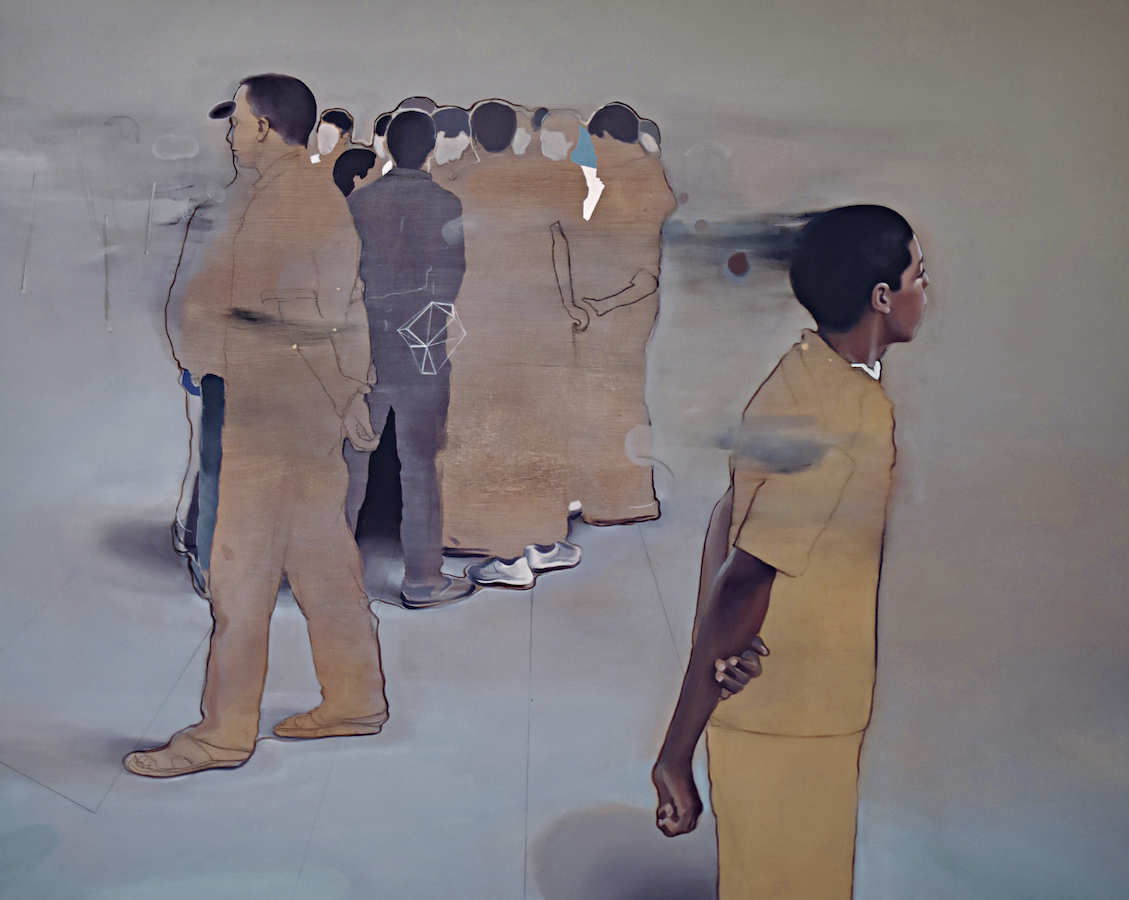
Nabil El-Makhloufi, La Foule. (Supplied)
“In this picture I try to express being alone with a decision — not necessarily to do with boats and migration, but an existential decision that you could have to take at any time,” he explains.
Similarly, while “Passage” shows people packed into boats, immediately bringing to mind stories of refugees attempting to cross the Mediterranean Sea or the English Channel on overcrowded vessels, El-Makhloufi says he sees a wider universal story of the human longing for self-realization.
“This boat with refugees that I have painted is like a process that every human being goes through,” he explains. “There is always a transition from one situation to another situation. There is always a development in your own personality. It’s a universal human situation. I’m trying to express the fragility of this transition.”
Like ambivalence, fragility is something he is adept at capturing in his work. Particularly in “The Leap,” his image of a young man in mid-air — perhaps executing a dive into water, but perhaps not. His destination is unclear.
“That’s a celebration of youth. This picture is about Arab youth, but it also has a tragic side,” El-Makhloufi says. “Young people want to fly, but, at the same time, their circumstances are very uncertain.”


