Pakistan revises guidelines for UK travellers amid omicron rise 

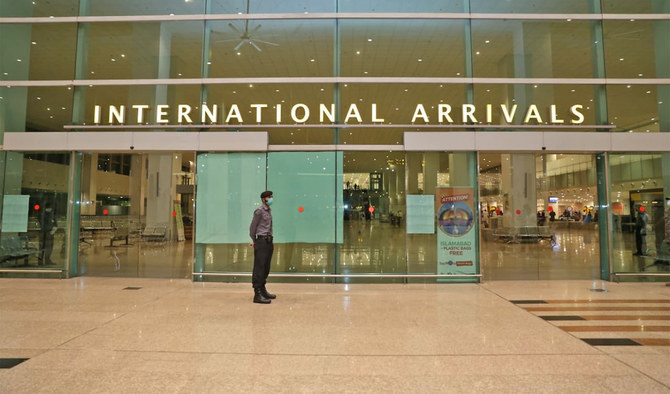
An airport security personnel wearing mask stands guard at Islamabad International Airport on May 5, 2020. (Photo courtesy: @mophrd/Twitter)
Short Url
Updated 21 December 2021
Follow

Pakistan revises guidelines for UK travellers amid omicron rise 

  • Makes its mandatory for passengers to undergo rapid antigen COVID-19 test upon arrival from UK
  • Decision comes as Britain has reported record levels of COVID-19 cases over the past week

ISLAMABAD: Pakistan’s federal pandemic response body, the National Command and Operation Centre, has revised its travel policy for people returning to Pakistan from the United Kingdom via direct and indirect flights, local media reported, mandating a rapid antigen COVID-19 test upon arrival in Pakistan.
The decision comes as Britain has reported record levels of COVID-19 cases over the past week, with officials and ministers warning that hospitalisations are also rising.
Fears are also rising over omicron infections, which are multiplying rapidly across Europe and the United States, doubling every two or three days in London and elsewhere and taking a heavy toll on financial markets.
The omicron variant was first detected last month in southern Africa and Hong Kong and so far has been reported in at least 89 countries. The severity of illness it causes remains unclear.
Under its new guidelines, the NCOC has made it mandatory for passengers to undergo a rapid antigen COVID-19 test upon arrival from the UK. Travelers will also have to carry a vaccination certificate and negative coronavirus test results from 48 hours before boarding the flight.
The NCOC has also instructed the Pakistan Civil Aviation Authority "to adjust direct flights from the UK to provide passengers time to conduct rapid COVID tests at the airport," Samaa reported.
Around 270 people tested positive for the coronavirus in Pakistan in the last 24 hours, with four deaths. More than 61 million people in a population of 220 million have so far been fully vaccinated in Pakistan.


Sindh cabinet approves compensation for Gul Plaza victims after deadly Karachi fire

Updated 27 January 2026
Follow

Sindh cabinet approves compensation for Gul Plaza victims after deadly Karachi fire

  • Over 70 people were killed in one of Karachi’s worst fires, which took three days to extinguish
  • Deadly blazes have become frequent in the city amid weak fire safety, limited response capacity

ISLAMABAD: The Sindh cabinet on Tuesday approved a major relief and rehabilitation package for victims of the Gul Plaza fire, one of Karachi’s deadliest blazes, which killed more than 70 people and took three days to bring under control earlier this month.

The decision comes weeks after the fire ripped through the multi-story commercial building in the city’s Saddar area, trapping workers and traders as flames spread rapidly through the structure, exposing severe gaps in fire safety enforcement and emergency response.

Under the cabinet-approved package, families of those who died will receive Rs10 million ($35,800) each in compensation, while affected shopkeepers will be provided interest-free loans of Rs10 million per unit, with the provincial government bearing the cost of interest.

An additional Rs500,000 ($1,790) per shopkeeper has been approved as immediate subsistence support.

“There can be no compromise on human life,” Chief Minister Syed Murad Ali Shah said during the cabinet meeting, adding that the government’s priority was to support affected families while ensuring accountability.

“Relief, justice and prevention must go hand in hand,” he added.

The cabinet also constituted a high-level subcommittee, headed by the chief minister, to review the findings of an inquiry committee tasked with determining responsibility for the incident and recommending further action.

Fires have become an increasingly frequent occurrence in Karachi, a megacity of more than 20 million people, where fire services remain severely overstretched and under-resourced relative to population density and the scale of commercial activity.

Successive deadly incidents have drawn criticism of the Sindh administration over lax enforcement of building codes, inadequate inspections and limited emergency response capacity.