

Saudi FM calls on Pakistani PM, army chief after OIC summit on Afghanistan

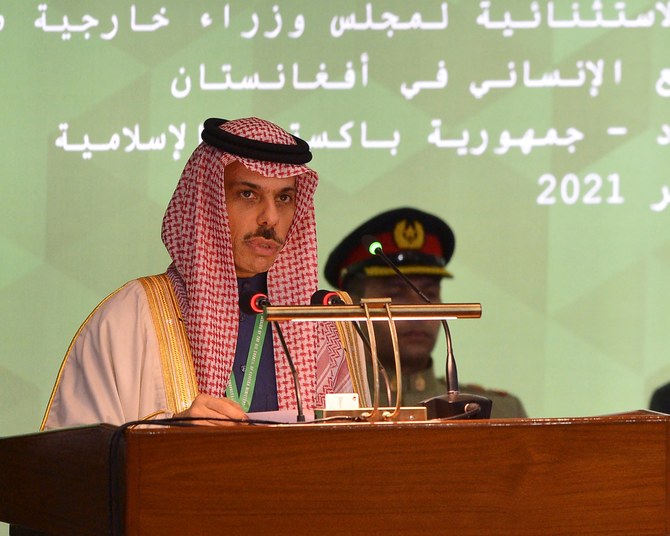
Saudi Arabia's Minister of Foreign Affairs Prince Faisal bin Farhan Al Saud, addresses the opening of a special meeting of the 57-member Organisation of Islamic Cooperation (OIC) in Islamabad, Pakistan, on December 19, 2021. (AFP)
Short Url
Updated 19 December 2021
Follow

Saudi FM calls on Pakistani PM, army chief after OIC summit on Afghanistan

  • Tells PM Khan he hopes OIC summit will ‘mobilize’ international community to help Afghanistan 
  • Pakistani PM expresses hope the world will not repeat mistake of disengaging with Afghanistan

ISLAMABAD: The Foreign Minister of Saudi Arabia, Prince Faisal Bin Farhan Al Saud, called on Pakistani Prime Minister Imran Khan on Sunday and told him he hoped an ongoing summit of the Organization of Islamic Cooperation (OIC) in Islamabad would help "mobilize" the international community to come to the aid of Afghanistan, which is facing an acute humanitarian crisis.

Pakistan is hosting the 17th Extraordinary Session of the OIC’s Council of Foreign Ministers, called by Saudi Arabia, at the Parliament House in Islamabad. The purpose of the summit is to rally Muslim and other countries to seek solutions for a growing economic and humanitarian crisis in Afghanistan.

“Thanking the Prime Minister for hosting the Extraordinary Session of the OIC Council of Foreign Ministers on the humanitarian situation in Afghanistan, Prince Faisal expressed hope that the Session would be instrumental in mobilizing the international community to support the people of Afghanistan on humanitarian grounds,” the Pakistani foreign office said in a statement. 

“He also underscored the importance that Saudi Arabia attaches to its strong relationship with Pakistan, based on bonds of brotherhood.”

The Pakistani PM appreciated the Saudi initiative to convene the special OIC summit and expressed the hope that the world would not repeat the mistake of disengaging with Afghanistan. 

“He urged the international community to support the vulnerable people of Afghanistan,” the statement said. “The Prime Minister highlighted that Pakistan has already committed to immediate relief of in-kind humanitarian assistance worth Rs. 5 billion, which comprises of food commodities including 50,000 MT of wheat, emergency medical supplies, winter shelters and other supplies.”

The Saudi foreign minister also met Pakistani chief of army staff (COAS) General Qamar Javed Bajwa. 

“COAS said that this extraordinary session of OIC is extremely important to channelise international efforts & save Afghanistan from looming security & humanitarian crises,” a statement from the Pakistan army said. 

The visiting dignitary appreciated Pakistan’s role in the “Afghan situation, special efforts for border management, role in regional stability and pledged to play his part for further improvement in diplomatic cooperation with Pakistan at all levels.”

Senior Taliban officials appealed this week for international help to combat a deepening economic crisis that has fueled fears of another refugee exodus from Afghanistan.

The comments, at a special meeting to mark the UN's international migrants day, underlined the new Taliban government's push to engage with the world community, four months after they seized power in Kabul.

The movement's deputy foreign minister, Sher Mohammad Abbas Stanikzai, said it was the responsibility of countries like the United States, which have blocked billions of dollars of central bank reserves, to help Afghanistan recover after decades of war.


Pakistan highlights economic reforms at Davos, eyes cooperation in AI, IT and minerals

Updated 30 min 5 sec ago
Follow

Pakistan highlights economic reforms at Davos, eyes cooperation in AI, IT and minerals

  • Prime Minister Shehbaz Sharif speaks at breakfast event in Davos at sidelines of World Economic Forum summit
  • Pakistan, rich in gold, copper reserves, has sought cooperation with China, US, Gulf countries in its mineral sector

ISLAMABAD: Prime Minister Shehbaz Sharif highlighted Pakistan’s recent economic reforms during the sidelines of the ongoing World Economic Forum (WEF) summit in Davos on Wednesday, saying that his country was eyeing greater cooperation in mines and minerals, information technology, cryptocurrency and artificial intelligence with other states. 

The Pakistani prime minister was speaking at the Pakistan Pavilion in Davos on the sidelines of the WEF summit at a breakfast event. Sharif arrived in Switzerland on Tuesday to attend the 56th annual meeting of the WEF, which brings together global business leaders, policymakers and politicians to speak on social, economic and political challenges. 

Pakistan has recently undertaken several economic reforms, which include removing subsidies on energy and food, privatization of loss-making state-owned enterprises and expanding its tax base. Islamabad took the measures as part of reforms it agreed with the International Monetary Fund (IMF) in exchange for a financial bailout package. 

“We are now into mines and minerals business in a big way,” Sharif said at the event. “We have signed agreements with American companies and Chinese companies.”

Islamabad has sought to attract foreign investment in its critical minerals sector in recent months. In April 2025, Pakistan hosted an international minerals summit where top companies and government officials from the US, Saudi Arabia, China, Türkiye, the UK, Azerbaijan, and other nations attended.

Pakistan is rich in gold, copper and lithium reserves as well as other minerals, yet its mineral sector contributes only 3.2 percent to the countrys GDP and 0.1 percent to global exports, according to official figures.

Sharif said Pakistan has been blessed with infinite natural resources which are buried in its mountains in the northern Gilgit-Baltistan, Khyber Pakhtunkhwa, Azad Kashmir and southwestern Balochistan regions. 

“But we have now decided to go forward at lightning speed,” he said. “And we are also moving speedily in the field of crypto, AI, IT.”

He said the government’s fiscal and economic measures have reduced inflation from nearly 30 percent a few years ago to single-digit figures, adding that its tax-to-GDP ratio had also increased from 9 to 10.5 percent. 

The prime minister admitted Pakistan’s exports face different kinds of challenges collectively, saying the country’s social indicators needed to improve. 

“But the way forward is very clear: that Pakistan has to have an export-led growth,” he said. 

SHARIF MEETS IMF MANAGING DIRECTOR

Separately, Sharif met IMF Managing Director Kristalina Georgieva on improvements in Pakistan’s macroeconomic indicators, efforts toward stability and progress on institutional reforms, a statement from Sharif’s office said.

He emphasized Pakistan’s commitment to fiscal discipline, revenue mobilization and sustainable development, it added. 

The IMF managing director acknowledged and appreciated Pakistan’s reform efforts, the Prime Minister’s Office (PMO) said.

“Both sides exchanged views on the global economic outlook, challenges facing emerging economies, and the importance of multilateral cooperation in safeguarding economic stability,” the PMO said.