
ISLAMABAD: The Organization of Islamic Cooperation (OIC) announced on Saturday its humanitarian office in Kabul would work with other international agencies to help the people of Afghanistan since their country is facing a major economic meltdown.
The OIC statement was issued only a day before the 17th Extraordinary Session of its Council of Foreign Ministers in Islamabad.
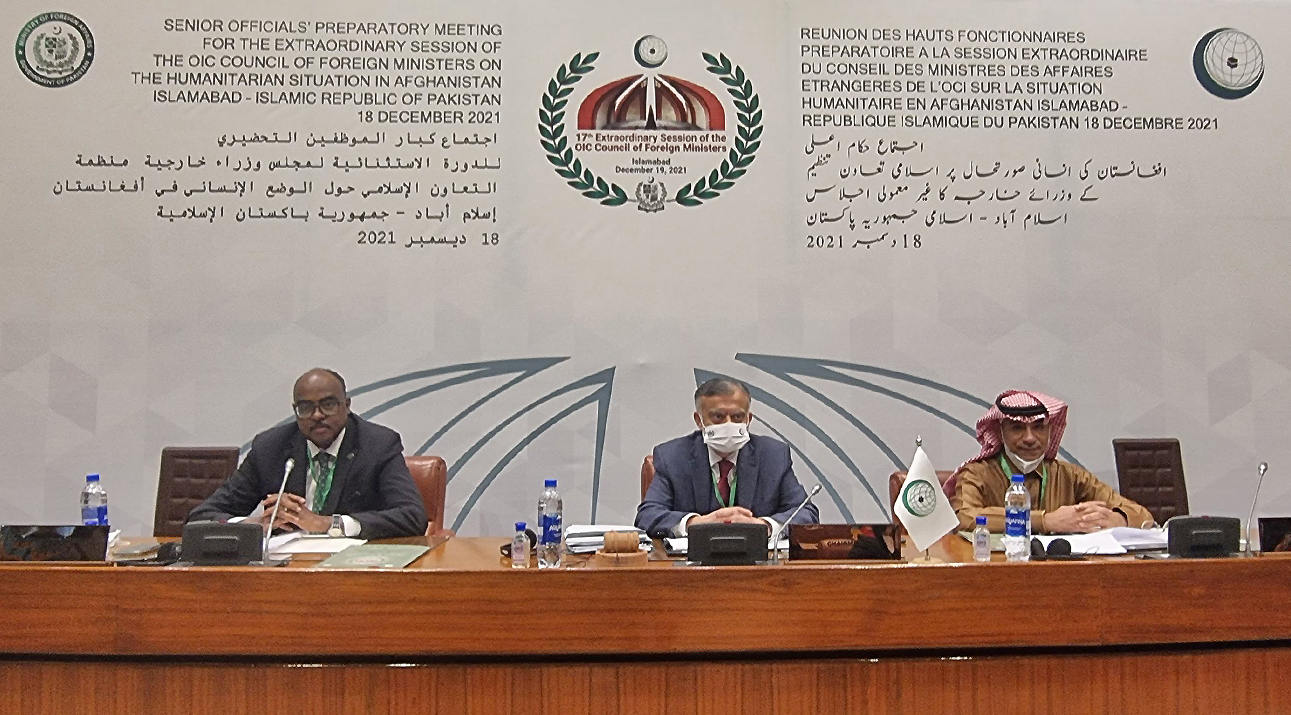
The Organization of Islamic Cooperation's officials chair opening session of the 17th Extraordinary Session of its Council of Foreign Ministers in Islamabad, Pakistan, on December 18, 2021. (Photo courtesy: OIC)
The session, which has brought together foreign ministers from Islamic countries along with delegations from the European Union, the United States, Britain, France, Russia, China and Germany, will focus on the humanitarian situation in Afghanistan.
The United Nations has already warned that nearly 23 million people of Afghanistan — or about 55 percent of its population — face extreme levels of hunger with nearly nine million at risk of famine as winter takes hold in the impoverished, landlocked country.
“The OIC humanitarian Office in #Kabul will assume its responsibility in coordination with the various international agencies in delivering the required assistance to the millions of people in need,” the organization quoted its assistant secretary general for humanitarian affairs Ambassador Tarig Bakheet in a Twitter post.
“It is crucial for the international community to take swift action to ensure that the people of #Afghanistan have unimpeded access to life-saving assistance, and the humanitarian support need to be scaled up,” he added.
“I am confident that the OIC fraternity, the United Nations, & regional partners would take all necessary steps to bring sustainable solutions to the catastrophic #humanitarian situation in #Afghanistan in which millions of lives are at stake,” Bakheet continued.
Prime Minister Imran Khan also welcomed the OIC delegates along with diplomats from other countries in a Twitter post, saying the upcoming conference was “an expression of solidarity with the Afghan people” who were facing a dire humanitarian situation.
The OIC meeting will be held on Sunday, December 19, at the Parliament House in Islamabad.
The Pakistani prime minister will deliver the keynote speech at the inaugural session of the gathering, and foreign minister Qureshi will jointly address a news conference with OIC Secretary General Hissein Brahim Taha in the evening.
Saudi foreign minister Prince Faisal bin Farhan Al Saud, who is also chair of the OIC summit, arrived Islamabad on Saturday night and was received by prime minister’s adviser on the Middle East Hafiz Tahir Mahmood Ashrafi and Saudi envoy to Pakistan Nawaf bin Said Al-Malki at the airport.
Foreign ministers of Kuwait, Bahrain, Malaysia, Indonesia, Azerbaijan, Turkmanistan, Bosnia, have also arrived in Islamabad. Special representatives of the United States and Germany for Afghanistan have also reached Pakistan to attend the session. The secretary generals of OIC and Gulf Cooperation Council (GCC) are also present in the Pakistani capital.
The foreign ministers of Jordan, Turkey, Palestine, Iran, Bangladesh, and other important Islamic countries will also participate in the meeting.
There have been growing warnings of the humanitarian crisis facing Afghanistan since international aid was abruptly cut following the Taliban takeover on August 15 and fears of disaster if the situation is not brought under control.
However, getting help in has been hindered by sanctions on dealing with the Taliban, the US decision to freeze billions of dollars of central bank reserves held outside Afghanistan and the collapse of much of the country’s banking system.
Sunday’s session will be kicked off with a statement from Qureshi who will chair the extraordinary session, followed by a statement by the foreign minister for Saudi Arabia, Prince Faisal Bin Farhan Al-Saud, who is the OIC summit chair.
There will also be statements by Hissein Brahim Taha, Secretary General of the OIC, the President of the Islamic Development Bank, Dr. Muhammad Al-Jasser and statements on behalf of the OIC Regional Groups for Asia, Africa, and Arab states.