

France seeks to ban ‘ultra-right’ group behind violent attacks

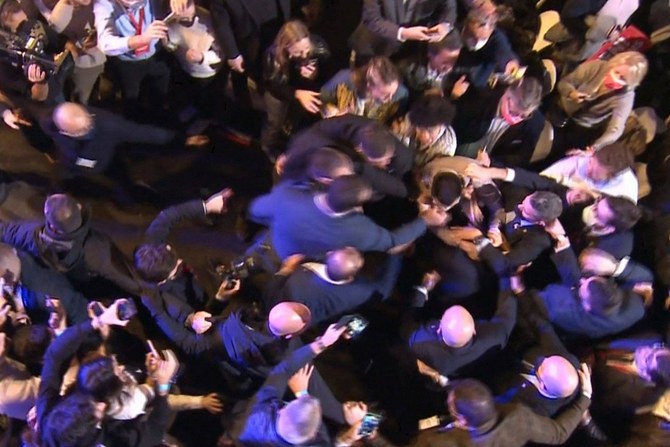
A rally in early December for Presidential candidate Eric Zemmour descended into violence. (AFP)
Short Url
Updated 13 December 2021
Follow

France seeks to ban ‘ultra-right’ group behind violent attacks

  • Zouaves assaulted anti-racism campaigners protesting at rally for presidential hopeful Eric Zemmour

LONDON: French Interior Minister Gerald Darmanin has said he is seeking to dissolve an “ultra-right” group believed to be responsible for attacks on anti-racism campaigners who protested at a rally for presidential hopeful Eric Zemmour.

The Zouaves, who support Zemmour’s anti-immigration and anti-Islam ideology, are believed to have attacked members of SOS Racisme.

The anti-racism campaigners said they had hoped to protest peacefully, but five of their members were injured when people attacked them. Dozens were reportedly arrested following the incident, including members of SOS Racisme.

In footage of that night eight days ago, a man is seen violently punching the head of a young woman wearing a “No to racism” T-shirt. 

Other assailants kicked and threw chairs at protesters. After the meeting, police said they had identified about 50 people linked to the Zouaves who posed for a picture and chanted: “On est chez nous (this is our home),” AFP reported.

Darmanin on Monday said: “I have initiated the procedure to dissolve this de facto grouping that are the Zouaves, which is a group of people who come from either the GUD (a former far-right student union) or Action Française, that is to say, well-known ultra-right movements.”

Jean-Yves Camus, a political analyst from the Jean-Jaurès Foundation think tank, said the Zouaves “have by far one of the most violent pedigrees of all far-right groups.”

They have been linked to a series of violent attacks, including an assault on football supporters waving an Algerian flag in Paris during the 2018 World Cup, and during France’s yellow vest demonstrations.

The public prosecutor has opened an investigation into the violence at Zemmour’s meeting.

Dominique Sopo, president of SOS Racisme, said: “You either have to be drunk with racism or be certain of your omnipotence to be able to act like that in front of cameras.

“It’s absolutely astonishing, and it shows what this candidate is, and what the public he draws is, and who the militants who gathered there are.”

Zemmour is a controversial figure and TV personality whose history of anti-immigrant and anti-Muslim rhetoric has landed him in hot water with French authorities.

In 2011, he was fined €10,000 ($11,281) for claiming on TV that “most drug dealers are black and Arab,” and in 2018 he was ordered to pay €3,000 for comments about a Muslim “invasion” of France.
France will vote on its next president in April.


NATO wants ‘automated’ defenses along borders with Russia: German general

Updated 24 January 2026
Follow

NATO wants ‘automated’ defenses along borders with Russia: German general

  • That zone would act as a defensive buffer before any enemy forces advanced into “a sort of hot zone,” said Lowin
  • The AI-guided system would reinforce existing NATO weapons and deployed forces, the general said

FRANKFURT: NATO is moving to boost its defenses along European borders with Russia by creating an AI-assisted “automated zone” not reliant on human ground forces, a German general said in comments published Saturday.
That zone would act as a defensive buffer before any enemy forces advanced into “a sort of hot zone” where traditional combat could happen, said General Thomas Lowin, NATO’s deputy chief of staff for operations.
He was speaking to the German Sunday newspaper Welt am Sonntag.
The automated area would have sensors to detect enemy forces and activate defenses such as drones, semi-autonomous combat vehicles, land-based robots, as well as automatic air defenses and anti-missile systems, Lowin said.
He added, however, that any decision to use lethal weapons would “always be under human responsibility.”
The sensors — located “on the ground, in space, in cyberspace and in the air” — would cover an area of several thousand kilometers (miles) and detect enemy movements or deployment of weapons, and inform “all NATO countries in real time,” he said.
The AI-guided system would reinforce existing NATO weapons and deployed forces, the general said.
The German newspaper reported that there were test programs in Poland and Romania trying out the proposed capabilities, and all of NATO should be working to make the system operational by the end of 2027.
NATO’s European members are stepping up preparedness out of concern that Russia — whose economy is on a war footing because of its conflict in Ukraine — could seek to further expand, into EU territory.
Poland is about to sign a contract for “the biggest anti-drone system in Europe,” its defense minister, Wladyslaw Kosiniak-Kamysz, told the Gazeta Wyborcza daily.
Kosiniak-Kamysz did not say how much the deal, involving “different types of weaponry,” would cost, nor which consortium would ink the contract at the end of January.
He said it was being made to respond to “an urgent operational demand.”