UN ‘cautiously welcomes’ Sudan accord amid post-coup erosion of trust

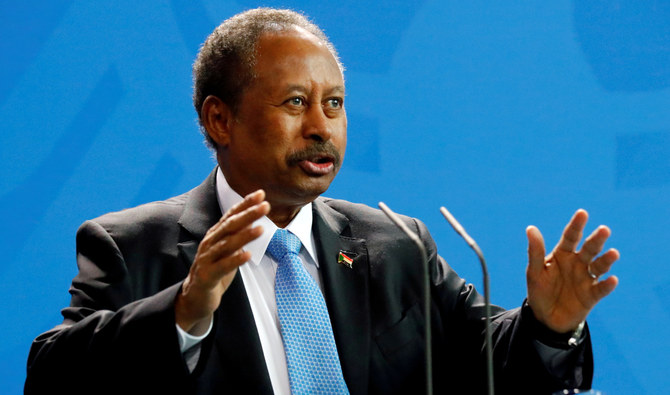
The military takeover on Oct. 25, during which Hamdok and other senior officials and activists were arrested, sparked protests across the country. (AFP/File)
Short Url
Updated 11 December 2021
Follow

UN ‘cautiously welcomes’ Sudan accord amid post-coup erosion of trust

  • While acknowledging the Nov. 21 agreement is ‘far from perfect’ envoy Volker Perthes said it could prevent bloodshed and be a step toward a return to order
  • He added that there is strong opposition to the deal among a large section of people in the country who feel ‘betrayed’ by the coup

The UN “cautiously” welcomed the agreement reached on Nov. 21 in Sudan between Prime Minister Abdalla Hamdok and the leaders of October’s military coup.
During a meeting on Friday to discuss the latest UN report on the situation in the country, Volker Perthes, the UN’s special representative for Sudan, told the Security Council that the agreement is “far from perfect” but could help to avoid further bloodshed and provide a first step toward comprehensive dialogue and a return to constitutional order.
But he pointed out that there is strong opposition to the deal from a large segment of Sudanese stakeholders, including parties and associations within the Forces of Freedom and Change coalition, resistance committees, civil society organizations and women’s groups, who feel “betrayed” by the coup.
“Forthcoming decisions on government formation, high-level appointments and the establishment of transitional institutions will test the will and ability of the stakeholders to seek a common way out of the crisis,” said Perthes.
The military takeover on Oct. 25, during which Hamdok and other senior officials and activists were arrested, sparked protests across the country in what Perthes described as “the greatest crisis to date” faced by the political transition in the country.
The coup “exposed and deepened the mistrust between the military and civilian components, and within the civilian components” themselves, he told the members of the Security Council.
According to the UN, at least 44 people were killed and hundreds injured when Sudanese security forces used lethal force to crack down on peaceful protesters.
Perthes said this has caused the crisis to escalate as protesters continue to organize mass demonstrations in an effort “to reclaim the revolution and push for civilian rule.”
He once again urged military leaders to reverse all unilateral decisions they have made in the wake of the coup, including the appointment of civilian members to the Sovereignty Council.
Referring to the ongoing state of emergency declared on the day of the coup by its leader, Gen. Abdel Fattah Al-Burhan, Perthes warned that “a lack of inclusivity and consensus could cause further fragmentation.
Referring to Nov. 21 agreement, which stipulates the formation of technocratic cabinet, Perthes warned that such a move, while potentially a step toward advancing the political transition, could also create “a constitutional challenge if not based on consultations with the Forces for Freedom and Change.”
He said: “Sudan’s military and political leaders will primarily have to rebuild trust with their own domestic public, particularly with the young generation,” and added that Sudanese authorities also need to work on regaining financial, economic and political support from the international community.
For this to happen, the envoy reiterated the need to release all political detainees, halt arbitrary arrests, guarantee the right to peaceful protest, and bring to justice those guilty of using violence against protesters.
Other key steps toward rebuilding trust among the international community include allowing the prime minister to freely form his own technocratic cabinet, lifting the state of emergency and restoring freedom of the press.
However, Perthes called on the international community to adopt a balanced approach to Sudan and not block aid to the country for too long.
“In the aftermath of the coup, the decision by donors to pause international development assistance is having a significant impact on the livelihoods of the Sudanese people, and risks rolling back the hard-won achievements of the past two years,” he said.
In addition, he urged Sudanese authorities to guarantee meaningful participation by women in the political process. The message from women in the country is clear, he said: “There can be no going back on the hard-earned gains on women’s rights, and they are asking for the international community’s support in this regard.


Hezbollah saw new war with Israel as inevitable and rearmed for months, sources say

Updated 4 sec ago
Follow

Hezbollah saw new war with Israel as inevitable and rearmed for months, sources say

  • The details of Hezbollah’s recent efforts to rearm have not been previously reported
  • The head of Hezbollah’s media office, Youssef Al-Zein, told Reuters that Hezbollah would not comment on its military operations

BEIRUT: Lebanese armed group Hezbollah spent months restocking its arsenal of rockets and drones, using support from Iran and its own weapons factories to prepare for a new war with Israel, six sources familiar with the group’s preparations said.
Down but not out after its devastating 2024 conflict with Israel, Hezbollah had concluded that another round of fighting was inevitable — and that this time, it could face an existential threat, according to the sources.
Reuters spoke to three Lebanese sources briefed on Hezbollah’s activities, two foreign officials in Lebanon and an Israeli military official, who all spoke on condition of anonymity as they were not authorized to speak to the press.
The details of Hezbollah’s recent efforts to rearm have not been previously reported.
The head of Hezbollah’s media office, Youssef Al-Zein, told Reuters that Hezbollah would not comment on its military operations, though he said the group had decided to “fight to the last breath.”

PAYING SALARIES, REPLENISHING STOCKPILES
Founded by Iran’s Revolutionary Guards in 1982, Hezbollah launched rockets and drones at Israel on Monday to avenge the death of Iran’s Supreme Leader Ali Khamenei, pulling Lebanon into the war raging across the Middle East.
Although the decision caught some of its own officials off guard, Hezbollah had been readying its military stockpiles and its command-and-control structure for an eventual rematch with Israel, the six sources said.
To do so, it had drawn on a monthly budget of $50 million, most of it from Iran and earmarked for fighters’ salaries, according to one of the Lebanese ⁠sources, who has ⁠been briefed on the group’s finances and military activities. One of the foreign officials confirmed the $50 million budget.
It was not immediately clear how long the group had been relying on that monthly budget and how it compared to its previous financial resources.
The group has said funds from Iran helped finance rents for people displaced by the 2024 war. Around 60,000 Lebanese, most of them from the Shiite Muslim community from which Hezbollah draws its popular support, remained displaced over the last year, with their homes still in ruins.
Hezbollah had also worked to replenish its drone and rocket stashes through local manufacturing, the first Lebanese source, the foreign officials and the Israeli military official said. The Israeli military official said Hezbollah had used Iranian funding both to smuggle arms and make its own weapons, but added that its manufacturing capability had been diminished.
The second foreign official said the group had stationed new rockets and ⁠Iranian-made logistical materials in southern Lebanon before the latest war began.
Hezbollah’s media office did not immediately respond to questions on its rearmament and Iranian support for it.
Israeli military spokesperson Lt. Col. Nadav Shoshani told Reuters that Hezbollah “had a lot of arms left” and was also seeking to rearm. “They were trying to smuggle and we were preventing that,” Shoshani said.

PACE OF FIRE BUILDS UP
In 2024, a punishing two-month war with Israel ended with a ceasefire brokered by the United States. Hezbollah halted its attacks on Israel, which continued strikes on what it said were Hezbollah’s efforts to rebuild military capabilities.
Israel also kept troops in five hilltop positions in southern Lebanon.
Last year, Lebanon also began confiscating Hezbollah weapons in the country’s south — but Israel said the group was rearming faster than it was being disarmed.
Speaking to Reuters weeks before Hezbollah entered the regional war, the first Lebanese source confirmed that the group had been rebuilding its military capabilities “in parallel” with Israel’s campaign to destroy them.
The pace of Hezbollah’s attacks this week provides clues about its weapons stocks.
The group launched 60 drones and rockets on March 2, the first day it attacked Israel, and a similar number the following day, said the second foreign official, who tracks Hezbollah’s activities closely.
But on March 4, Hezbollah launched more than double that number of projectiles, a sign it had been able to draw from its larger ⁠caches, the official said.
ALMA, an Israeli think ⁠tank that monitors security on Israel’s northern border, said it assessed that Hezbollah’s arsenal on the eve of its attack included approximately 25,000 rockets and missiles, most of them short- and medium-range.
A video published by Hezbollah on March 4 showed a fighter setting up a drone in a wooded area. Riad Kahwaji, a Dubai-based defense analyst and founder of the Institute for Near East and Gulf Military Analysis, identified the drone in the video as a Shahed-101, which he told Reuters could be produced locally.

HEZBOLLAH EXPECTED A FIGHT FOR SURVIVAL
Hezbollah has also dispatched fighters from its elite Radwan force back to southern Lebanon, Reuters reported this week. They had been withdrawn from the area after the 2024 conflict.
Israeli strikes after the 2024 ceasefire included the targeting of what Israel said were Hezbollah training camps. In late February, the Israeli military said it struck eight military compounds used by the Radwan force to store weapons and prepare for a confrontation.
The Israeli official and the first foreign official said Hezbollah had been struggling to recruit new operatives as a result.
The group lost 5,000 fighters in the 2024 war, an unprecedented blow to its fighting force, though the second Lebanese source said it still had some 95,000 fighters left.
In the lead-up to its entry into the current regional war, Hezbollah had become convinced Israel would carry out a major strike on the group that would seek to “disable its ability to retaliate,” the first Lebanese source said.
A third foreign official familiar with Hezbollah’s thinking said that assessment had driven the group’s decision to launch the first salvo, fearing Israel would eventually turn its attention from Iran to Hezbollah.
“They knew they were next on the list,” the official said.