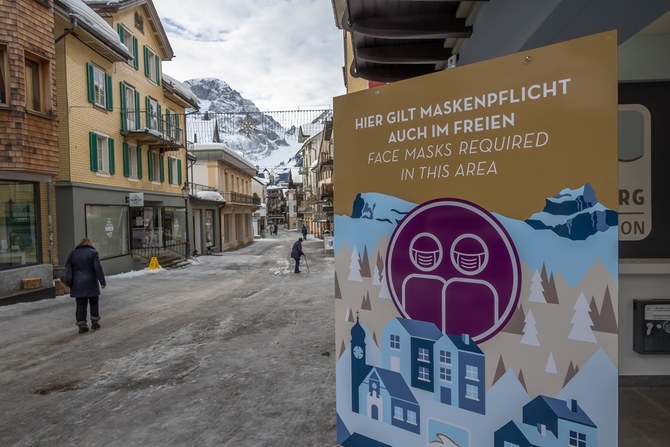
GENEVA: Facing a new surge in COVID-19 cases, the Swiss government is preparing to step up mask requirements and increase restrictions on people who haven’t been vaccinated or recovered from the illness.
Government might even shut restaurants, bars and fitness clubs.
The count of daily deaths linked to the pandemic hit its highest level since January on Friday.
Health Minister Alain Berset laid out two alternative proposals in the wake of a sharp upswing in cases in recent months, in a country where about two-thirds of the population is fully vaccinated — fewer than in some of its Western European neighbors.
One would in essence withdraw the “negative test” criterion that allows people who have not recovered or been vaccinated from attending some events, and would require mask-wearing and seated-only consumption of food and drinks indoors. Another, tougher alternative would shut all public indoor areas where masks can’t be worn all the time –- notably dining areas, discos, fitness clubs and bars.
The situation is “not uplifting,” Berset said, adding: “We’re getting back to a place where we don’t want to be.”
The two proposals will be considered and the government will decide in coordination with local leaders and others which path to take in coming days. The government had already tightened COVID restrictions just a week earlier.
The public health office reported Friday more than 10,100 new cases over the previous 24 hours in the country of 8.5 million, with a daily average over the latest seven days of more than 9,200 – up from less than 1,000 in early October. A total of 51 deaths linked to the pandemic were reported from Thursday to Friday, the largest daily tally since a spike in January.
That’s still far less than the previous record-high toll in late 2020 and early 2021, when 80 to 90 or more people were dying each day.
Berset said the situation in hospitals was worsening, with personnel increasingly tired and intensive care units facing greater pressure.
Switzerland’s Vaud canton, or region, announced Friday that anyone over aged 16 would be eligible for a booster dose of approved vaccines at least six months after the first jabs. That comes as the 10-19-year-old age bracket has been by far the one most hit by new infections in Switzerland in recent weeks.
Some supermarket chains have begun limiting the numbers of people who can be allowed inside their stores in recent days, and the army has been called out in small numbers so far to help support vaccination efforts in the Jura canton along the French border.

Swiss gear up for tighter rules as COVID cases keep climbing
https://arab.news/mzbeq
Swiss gear up for tighter rules as COVID cases keep climbing
- Government might even shut restaurants, bars and fitness clubs
- Health Minister laid out two alternative proposals in the wake of a sharp upswing in cases in recent months
UK pays Guantanamo detainee ‘substantial’ compensation over US torture questions
- Abu Zubaydah has been held at Guantanamo Bay without charge for 20 years
- British security services knew he was subjected to ‘enhanced interrogation’ but failed to raise concerns for 4 years
LONDON: A Saudi-born Palestinian being held without trial by the US has received a “substantial” compensation payment from the UK government, the BBC reported.
Abu Zubaydah has been imprisoned at Guantanamo Bay in Cuba for almost 20 years following his capture in Pakistan in 2002, and was subjected to “enhanced interrogation” techniques by the CIA.
He was accused of being a senior member of Al-Qaeda in the aftermath of the Sept. 11 terror attacks on the US. The allegations were later dropped but he remains in detention.
The compensation follows revelations that UK security services submitted questions to the US to be put to Abu Zubaydah by their US counterparts despite knowledge of his mistreatment.
He alleged that MI5 and MI6 had been “complicit” in torture, leading to a legal case and the subsequent compensation.
Dominic Grieve, the UK’s former attorney general, chaired a panel reviewing Abu Zubaydah’s case.
He described the compensation as “very unusual” but said the treatment of Abu Zubaydah had been “plainly” wrong, the BBC reported.
Grieve added that the security services had evidence that the “Americans were behaving in a way that should have given us cause for real concern,” and that “we (UK authorities) should have raised it with the US and, if necessary, closed down co-operation, but we failed to do that for a considerable period of time.”
Abu Zubaydah’s international legal counsel, Prof. Helen Duffy, said: “The compensation is important, it’s significant, but it’s insufficient.”
She added that more needs to be done to secure his release, stating: “These violations of his rights are not historic, they are ongoing.”
Duffy said Abu Zubaydah would continue to fight for his freedom, adding: “I am hopeful that the payment of the substantial sums will enable him to do that and to support himself when he’s in the outside world.”
He is one of 15 people still being held at Guantanamo, many without charge. Following his initial detention, he arrived at the prison camp having been the first person to be taken to a so-called CIA “black site.”
He spent time at six such locations, including in Lithuania and Poland, outside of US legal jurisdiction.
Internal MI6 messages revealed that the “enhanced interrogation” techniques he was subjected to would have “broken” the resolve of an estimated 98 percent of US special forces members had they been subjected to them.
CIA officers later decided he would be permanently cut off from the outside world, with then-President George W. Bush publicly saying Abu Zubaydah had been “plotting and planning murder.”
However, the US has since withdrawn the allegations and no longer says he was a member of Al-Qaeda.
A report by the US Senate Select Committee on Intelligence said Abu Zubaydah had been waterboarded at least 83 times, was locked in a coffin-like box for extended periods, and had been regularly assaulted. Much of his treatment would be considered torture under UK law.
Despite knowledge of his treatment, it was four years before British security services raised concerns with their American counterparts, and their submission of questions within that period had “created a market” for the torture of detainees, Duffy said.
A 2018 report by the UK Parliament’s Intelligence and Security Committee was deeply critical of the behavior of MI5 and MI6 in relation to Abu Zubaydah.
It also criticized conduct relating to Guantanamo detainee Khalid Sheikh Mohammed, widely regarded as a key architect of the Sept. 11 attacks, warning that the precedent set by Abu Zubaydah’s legal action could be used by Mohammed to bring a separate case against the UK.
MI5 and MI6 failed to comment on Abu Zubaydah’s case. Neither the UK government nor Mohammed’s legal team would comment on a possible case over his treatment.


