



Jeddah: A Saudi student who became the first to win the Larson Lab Award from the University of Colorado said it was a “humbling recognition” of his artificial intelligence research.
Faisal Darwish Al-Ghamdi, a faculty member at King Abdulaziz University, made history when he earned the title of Outstanding Graduate Student.
The award recognized his research in AI and digital twin technologies, which aim to improve energy efficiency and advance smart building solutions.
Reflecting on the award, Al-Ghamdi told Arab News he was taken by surprise.
“I felt genuine happiness and surprise, as I had no prior knowledge of the nomination process,” he said.
“It was a humbling recognition that reinforced my sense of purpose and commitment to my research.”
When asked whether being the first Saudi to receive the award added pressure, he said it was “ultimately more inspiration than pressure.
“I see this award as a responsibility rather than a destination. It motivates me to ensure that my work delivers real, measurable impact,” he added.
“I have recently begun working on building a full digital twin of the Larson Lab itself, and this strengthened my sense of responsibility to contribute research that reflects positively on Saudi scholars and demonstrates our ability to lead in advanced scientific and technological fields.”
Al-Ghamdi’s research focuses on creating real-time digital replicas of buildings using AI and live sensor data.
These digital twins can predict energy performance, detect faults early, evaluate retrofit strategies, reduce energy waste and support smarter, data-driven operational decisions.
He explained: “The most exciting application is transforming conventional ‘smart buildings’ into truly intelligent buildings,” he said.
“Many buildings today rely on static dashboards that simply display data.
“My work focuses on developing AI-powered systems that actively predict energy use, evaluate retrofit scenarios, perform automated measurement and verification, and quantify both operational and financial impacts.
“This approach allows building owners and operators to move from reactive decision-making to proactive, optimized building management that improves efficiency, comfort, and cost savings.”
Al-Ghamdi highlighted the Kingdom’s growing role in AI and smart building technologies, stating: “Saudi Arabia is positioning itself as one of the global leaders in AI and advanced technologies.
“Recent national AI initiatives announced by His Royal Highness the Crown Prince reflect a strong strategic commitment to digital transformation.”
What sets Al-Ghamdi’s work apart is the development of a real-time digital twin intelligence engine, rather than a simple visualization or dashboard.
“Instead of relying on static simulations or historical data alone, the system dynamically synchronizes the physical building with its digital counterpart using live sensor streams and validated operational schedules.
“This enables high-fidelity prediction, early fault detection, automated measurement and verification, and reliable retrofit decision-making,” he explained.
Reflecting on what inspired him to pursue this path, Al-Ghamdi said: “It was a combination of curiosity and timing. The world is rapidly moving toward intelligent, data-driven systems, and Saudi Arabia has demonstrated clear leadership in this transformation.”
Balancing life as a student and faculty member, he said, is challenging but rewarding.
“I often say that my dream job is exactly what I am doing now. I genuinely enjoy being a student, learning, experimenting and improving, while also being a researcher and educator who shares knowledge with others.
“I was deeply inspired by my late father, may God have mercy on him, who devoted much of his life to opening schools in rural areas. Teaching, learning and contributing through education have always been central to my motivation.”
During his time in the US, Al-Ghamdi observed the talent of Saudi students across all levels of education.
“I have seen Saudi students excel across all academic levels, from undergraduate studies to advanced PhD research. This gives me strong confidence in the Kingdom’s future.”
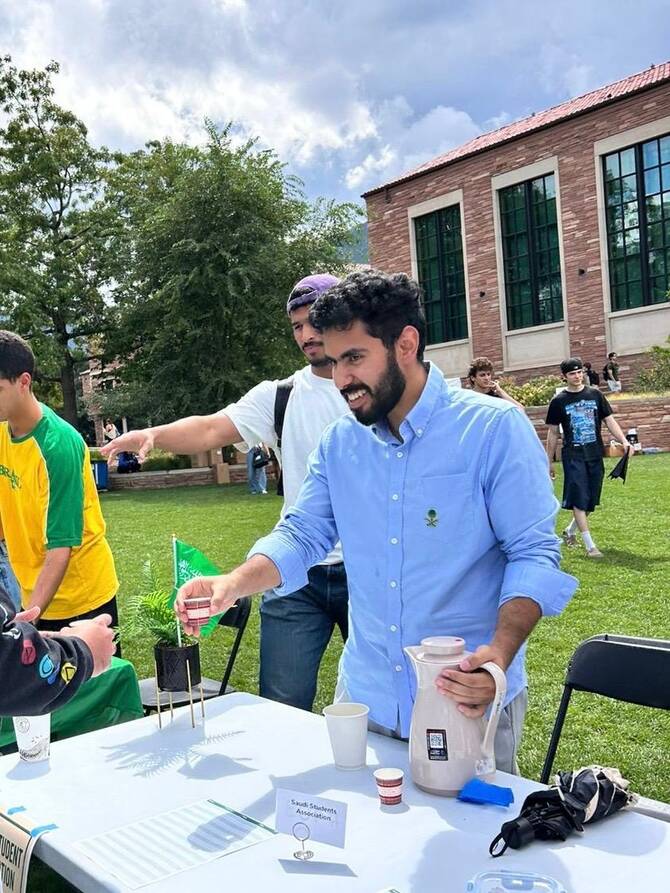
Through his role as president of the Saudi Students Association, he has engaged with people from diverse disciplines, witnessing their capabilities and drive firsthand.
“My advice is to fully embrace international opportunities, actively build academic and professional networks, and approach every experience as a long-term investment in learning.
“With focus and persistence, Saudi students can lead and innovate at the global level.”
Although Al-Ghamdi is fully released from King Abdulaziz University to pursue his degree abroad, he emphasized the strong support he continues to receive from his home institution.
“The trust, encouragement, and institutional backing from university leadership and faculty members have been invaluable.
“In addition, the continuous support from the Saudi Cultural Mission in the United States played a critical role in enabling me to focus on research and academic excellence.”


