

Pakistan central bank governor appointed as chair of global Islamic finance body

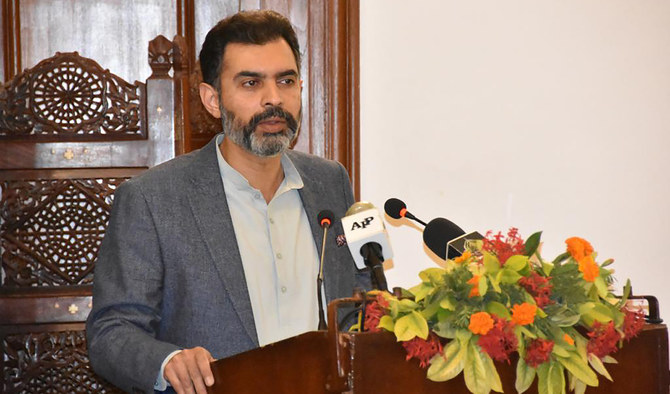
State Bank of Pakistan Governor Raza Baqir speaks at the inaugural ceremony of the mobile application "Boltay Huroof" in Karachi, Pakistan, on November 14, 2021. (Photo courtesy: State Bank of Pakistan/File)
Short Url
Updated 10 December 2021
Follow

Pakistan central bank governor appointed as chair of global Islamic finance body

  • The Islamic Financial Services Board is one of the main standard-setting bodies for Islamic finance around the world
  • Governor Reza Baqir says he wants to provide 'high-quality intellectual guidance' to the Islamic financial industry with the help of other council members

ISLAMABAD: Pakistan central bank governor Dr. Reza Baqir was appointed chairman of the Council of Islamic Financial Services Board (IFSB), Malaysia, for the year 2022 in a ceremony held in Abu Dhabi on Thursday.

According to an official handout issued by the State Bank of Pakistan (SBP) on Friday, Baqir took over the position from his counterpart in the United Arab Emirates and thanked him for leading the council "in an excellent manner."

The 188-member IFSB is counted among the main standard-setting bodies for Islamic finance around the world.

Established in 2003 in Kuala Lumpur, Malaysia, it has so far issued 24 standards, seven guidance notes and three technical notes for the Islamic financial services industry.

"Speaking on the occasion, Governor SBP said that he felt deeply honored to assume the Chairmanship of the Council of IFSB," said the official statement. "He thanked his fellow Council members for placing their trust in him. He also expressed his sincere gratitude to Mr. Khaled Mohamed Balama Al Tameemi – Governor Central Bank of UAE for leading the Council for the year 2021 in an excellent manner."
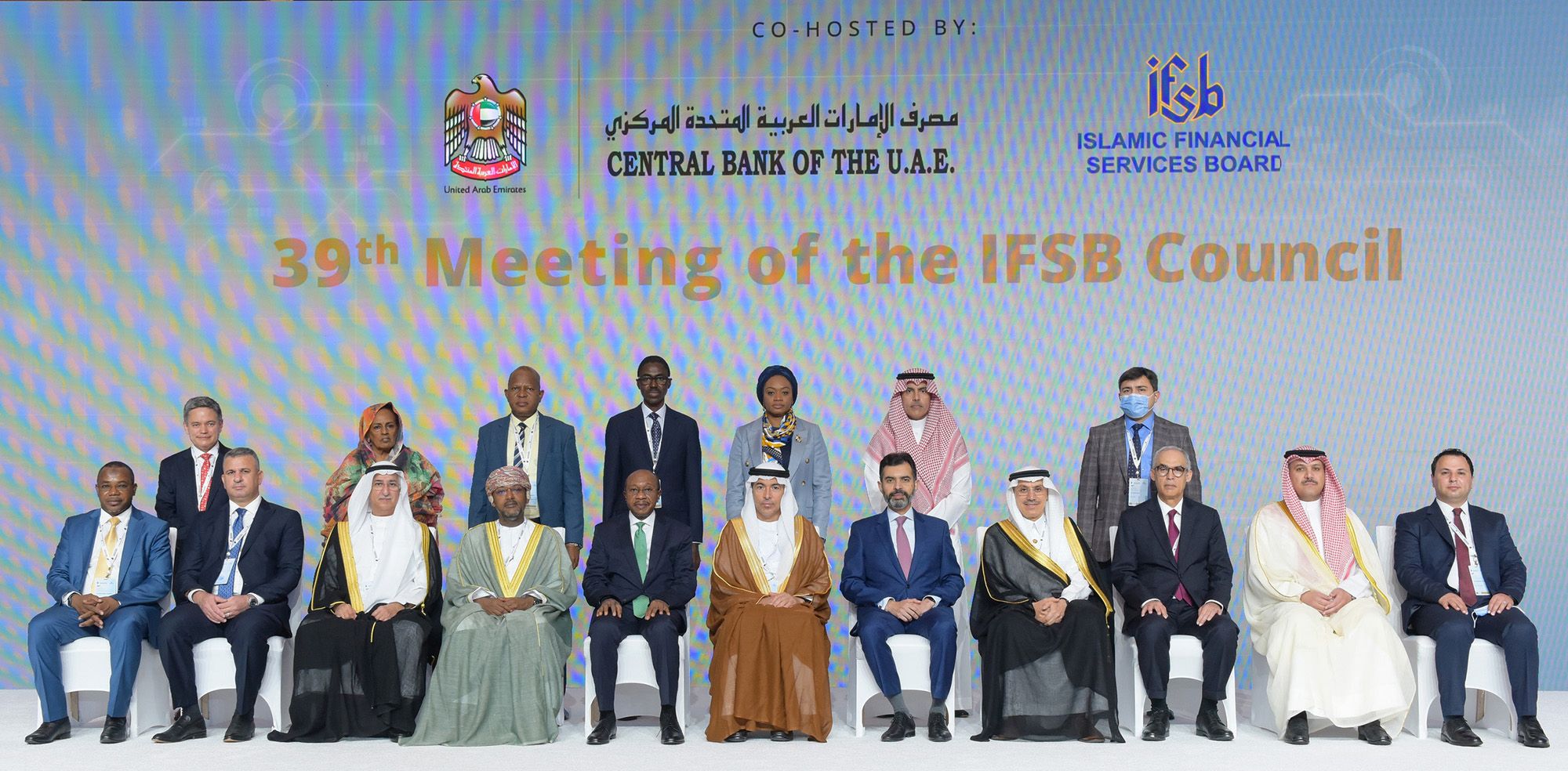


Pakistan central bank governor Dr. Reza Baqir is addressing a ceremony in Karachi, Pakistan, on November 14, 2021. (Photo courtesy: State Bank of Pakistan/File)

According to the IFSB's global Islamic financial services stability report, 2021, the total worth of the Islamic Financial Services Industry (Islamic Banking, Islamic Capital Markets and Takaful) was estimated at $2.70 trillion in 2020.

The S&P Global Ratings said in May the international Islamic finance industry was expected to grow 10 to 12 percent over 2021-2022 due to the issuance of Islamic bonds.

It added the industry continued to expand during the COVID-19 pandemic, though at a slower pace.

Information provided by the SBP said there were currently five full-fledged Islamic banks in Pakistan while 17 conventional banks were operating standalone Islamic banking branches to offer a wide range of Shariah-compliant financial solutions.

It added the market share of the Islamic banking industry assets and deposits in the overall banking sector of the country stood at 17 percent and 18.7 percent, respectively.

Pakistan's central bank governor told the ceremony in Abu Dhabi he wanted to provide "high-quality intellectual guidance to global Islamic finance industry" with the support of fellow council members.

"He also pledged to transform the IFSB as one of the most progressive and robust standard setting body globally," the handout said.


Police arrest 49 suspected militants in Pakistan’s Punjab in a month

Updated 6 sec ago
Follow

Police arrest 49 suspected militants in Pakistan’s Punjab in a month

  • The development follows a steep rise in militancy-related deaths in Pakistan last year
  • Authorities have lodged cases against the arrested suspects affiliated with banned outfits

ISLAMABAD: The counter-terrorism department (CTD) of Punjab police has arrested 49 militants in different areas of Pakistan’s most populous province in a month and foiled a major terror plan, the CTD said on Saturday.

Pakistan is currently facing an uptick in militant attacks, mainly by the Tehreek-e-Taliban Pakistan (TTP), in its northwestern Khyber Pakhtunkhwa (KP) province, which borders Punjab.

The attacks in KP have forced authorities in Punjab to heighten security and take pre-emptive measures in view of potential spillover of militants into the country’s most populous province.

CTD officials arrested these militants in 425 intelligence-based operations and seized weapons, explosives and other prohibited materials from the arrestees, according to a CTD spokesperson.

“Forty-four cases have been registered against the arrested terrorists and further investigation is being carried out,” the spokesperson said in a statement.

The development comes a steep rise in militancy-related deaths in Pakistan in 2025. According to statistics released by the Pakistan Institute for Conflict and Security Studies (PICSS) last month, combat-related deaths in 2025 rose 73 percent to 3,387. These included 2,115 militants, 664 security forces personnel, 580 civilians and 28 members of pro-government peace committees, the think tank said.

CTD conducted 6,131 combing operations in the province and arrested 599 suspects, according to the statement. Around 570 police reports were registered against these suspects, which led to 477 recoveries.

In Nov., the Punjab government had launched the country’s “first” mobile counterterrorism unit to monitor complex security operations in real time, while in Sept. the province announced the arrest of 90 suspected militants in a three-month counter-terrorism sweep.

Pakistan has struggled to contain the surging in militancy in KP since a fragile truce between the Pakistani Taliban and Islamabad broke down in Nov. 2022. The country faces another decades-long insurgency by Baloch separatists in its southwestern Balochistan province.

Islamabad has frequently accused Afghanistan of allowing the use of its soil and India of backing militant groups for attacks against Pakistan. Kabul and New Delhi deny the allegation.