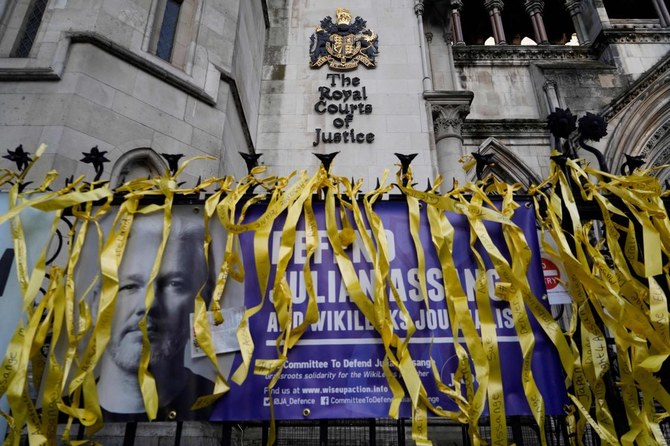
LONDON: WikiLeaks’ Julian Assange on Friday moved a step closer to facing criminal charges in the United States for breaking spying law and conspiring to hack government computers after Washington won an appeal over his extradition in an English court.
US authorities accuse Australian-born Assange, 50, of 18 counts relating to WikiLeaks’ release of vast troves of confidential US military records and diplomatic cables which they said had put lives in danger.
His supporters cast Assange as an anti-establishment hero who has been victimized by the United States for exposing US wrongdoing in Afghanistan and Iraq.
The United States won an appeal against a ruling by a London District Judge that Assange should not be extradited because he would likely commit suicide in a US prison.
“The court allows the appeal,” Judge Timothy Holroyde said.
The judge said he was satisfied with a package of assurances given by the United States about the conditions of Assange’s detention including a pledge not to hold him in a so-called “ADX” maximum-security prison in Colorado and that he would be transferred to Australia to serve his sentence if convicted.
But further hurdles remain before Assange can be sent to the United States: the legal wrangling is likely to go to the Supreme Court, the final court of appeal.
Assange’s fiancée, Stella Moris, said his legal team would appeal the decision.
“How can it be fair, how can it be right, how can it be possible, to extradite Julian to the very country which plotted to kill him?” she said. “We will appeal this decision at the earliest possible moment.”
Judge Holroyde said the case must now be remitted to Westminster Magistrates’ Court with the direction judges send it to the British government to decide whether or not Assange should be extradited.
Assange, who denies any wrongdoing, was not in court. He remains in London’s high-security Belmarsh prison, where he has been for more than two and a half years.
WikiLeaks came to prominence when it published a US military video in 2010 showing a 2007 attack by Apache helicopters in Baghdad that killed a dozen people, including two Reuters news staff. It then released thousands of secret classified files and diplomatic cables.
US prosecutors and Western security officials regard Assange as a reckless and dangerous enemy of the state whose actions imperiled the lives of agents named in the leaked material.
His admirers have hailed Assange as a hero for exposing what they describe as abuse of power by modern states and for championing free speech.


![]()

WikiLeaks founder Assange one step closer to extradition to United States
Short Url
https://arab.news/nhbdf
WikiLeaks founder Assange one step closer to extradition to United States
- Assange, 50, is currently being held at London’s high-security Belmarsh Prison


Latest updates






© 2026 SAUDI RESEARCH & PUBLISHING COMPANY, All Rights Reserved And subject to Terms of Use Agreement.