

GCC seeks to strengthen cooperation with Pakistan in all fields

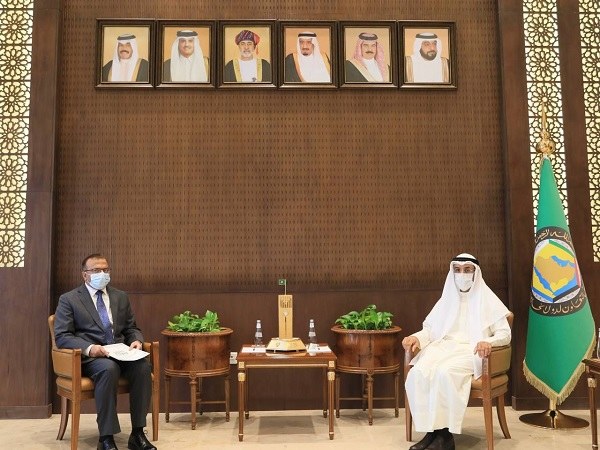
Pakistan's envoy to Saudi Arabia, Bilal Akbar, left, calls on Secretary General of the Gulf Cooperation Council (GCC) in Riyadh, Saudi Arabia, on December 9, 2021. (Photo courtesy: GCC)
Short Url
Updated 10 December 2021
Follow

GCC seeks to strengthen cooperation with Pakistan in all fields

  • GCC secretary general reviews regional security with Pakistan’s ambassador to Saudi Arabia on Thursday 
  • In April, after a gap of 13 years, Pakistan and GCC resumed negotiations on a free trade agreement

ISLAMABAD: The Gulf Cooperation Council (GCC) said on Thursday it wants to strengthen cooperation with Pakistan in all fields.

The GCC is a regional, intergovernmental political and economic union that consists of Bahrain, Kuwait, Oman, Qatar, Saudi Arabia, and the United Arab Emirates.

The plans to enhance cooperation were discussed by GCC secretary general Nayef bin Falah Al-Hajjraf and Pakistan’s ambassador to Saudi Arabia, Bilal Akbar, during a meeting at the council’s main headquarters in Riyadh

“The Secretary-General of the Gulf Cooperation Council stresses the importance of the Gulf-Pakistan relations and the need to strengthen them in all fields,” the GCC said in a statement after the meeting.

“The meeting dealt with a review of the relations between the GCC countries with the Islamic Republic of Pakistan in various fields, as well as the latest current political developments in the region, and the efforts made to coordinate to enhance security and stability.”

In April, after a gap of 13 years, Pakistan and the GCC resumed negotiations on a free trade agreement (FTA).

Talks on the FTA started in 2004, but after two rounds of talks in 2006 and 2008, only a broader outline was reached.

The intention to resume the negotiations was declared during Saudi Crown Prince Mohammed bin Salman’s visit to Islamabad in 2019, but they were further delayed by the coronavirus outbreak.


Pakistan to send over 10,000 workers to Italy over three years after securing employment quota

Updated 4 sec ago
Follow

Pakistan to send over 10,000 workers to Italy over three years after securing employment quota

  • Government says Italy will admit 3,500 workers annually under seasonal and non-seasonal labor schemes
  • It calls the deal a 'milestone' as Italy becomes the first European country to allocate job quota for Pakistan

ISLAMABAD: Pakistan has secured a quota of 10,500 jobs from Italy over the next three years, an official statement said on Saturday, opening legal employment pathways for Pakistani workers in Europe under Italy’s seasonal and non-seasonal labor programs.

Under the arrangement, 3,500 Pakistani workers will be employed in Italy each year, including 1,500 seasonal workers hired for time-bound roles, and 2,000 non-seasonal workers for longer-term employment across sectors.

The Ministry of Overseas Pakistanis and Human Resource Development said Italy is the first European country to allocate a dedicated labor quota to Pakistan, describing the move as a milestone in Pakistan’s efforts to expand overseas employment opportunities beyond traditional labor markets in the Middle East.

“After prolonged efforts, doors to employment for the Pakistani workforce in Italy are about to open,” Federal Minister for Overseas Pakistanis Chaudhry Salik Hussain said, calling the quota allocation a “historic milestone.”

The jobs will be available across multiple sectors, including shipbreaking, hospitality, healthcare and agriculture, with opportunities for skilled and semi-skilled workers in professions such as welding, technical trades, food services, housekeeping, nursing, medical technology and farming.

The agreement comes as Pakistan seeks to diversify overseas employment destinations for its workforce and increase remittance inflows, which remain a key source of foreign exchange for the country’s economy.

The ministry said a second meeting of the Pakistan-Italy Joint Working Group on labor cooperation is scheduled to be held in Islamabad in February 2026, where implementation and future cooperation are expected to be discussed.