

Pakistan to send over 10,000 workers to Italy over three years after securing employment quota

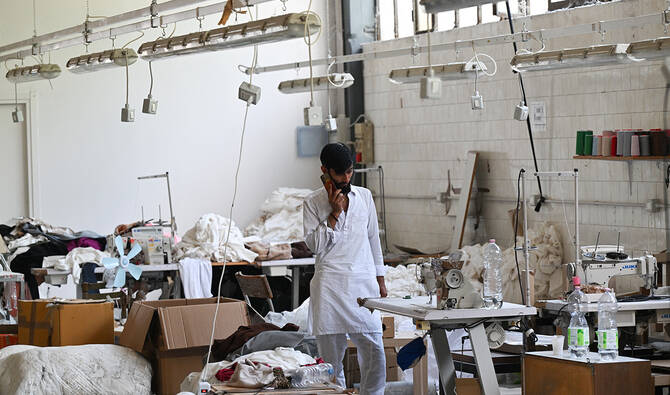
A Pakistani worker gives a phone call during a permanent strike in a fast-fashion outlet factory owned by a Chinese company in Prato, central Italy, on August 1, 2025. (AFP/ file)
Short Url
Updated 27 December 2025
Follow

Pakistan to send over 10,000 workers to Italy over three years after securing employment quota

  • Government says Italy will admit 3,500 workers annually under seasonal and non-seasonal labor schemes
  • It calls the deal a 'milestone' as Italy becomes the first European country to allocate job quota for Pakistan

ISLAMABAD: Pakistan has secured a quota of 10,500 jobs from Italy over the next three years, an official statement said on Saturday, opening legal employment pathways for Pakistani workers in Europe under Italy’s seasonal and non-seasonal labor programs.

Under the arrangement, 3,500 Pakistani workers will be employed in Italy each year, including 1,500 seasonal workers hired for time-bound roles, and 2,000 non-seasonal workers for longer-term employment across sectors.

The Ministry of Overseas Pakistanis and Human Resource Development said Italy is the first European country to allocate a dedicated labor quota to Pakistan, describing the move as a milestone in Pakistan’s efforts to expand overseas employment opportunities beyond traditional labor markets in the Middle East.

“After prolonged efforts, doors to employment for the Pakistani workforce in Italy are about to open,” Federal Minister for Overseas Pakistanis Chaudhry Salik Hussain said, calling the quota allocation a “historic milestone.”

The jobs will be available across multiple sectors, including shipbreaking, hospitality, healthcare and agriculture, with opportunities for skilled and semi-skilled workers in professions such as welding, technical trades, food services, housekeeping, nursing, medical technology and farming.

The agreement comes as Pakistan seeks to diversify overseas employment destinations for its workforce and increase remittance inflows, which remain a key source of foreign exchange for the country’s economy.

The ministry said a second meeting of the Pakistan-Italy Joint Working Group on labor cooperation is scheduled to be held in Islamabad in February 2026, where implementation and future cooperation are expected to be discussed.


Pakistan footwear sector flags used imports as barrier to export growth

Updated 5 sec ago
Follow

Pakistan footwear sector flags used imports as barrier to export growth

  • Industry says production capacity far exceeds domestic consumption, signaling export potential
  • Its delegation tells commerce minister up to 40 percent of domestic market met through used shoe imports

KARACHI: Pakistan’s leather and footwear industry has warned that rising imports of used shoes are distorting the domestic market and limiting export growth, according to a commerce ministry statement issued on Thursday after industry representatives met Commerce Minister Jam Kamal Khan.

The meeting focused on export potential, domestic market challenges and regulatory concerns linked to the import of second-hand footwear, which industry leaders say is undermining local manufacturers despite significant production capacity.

“Pakistan’s annual footwear consumption is estimated at around 550 million pairs, while the country has an installed production capacity of nearly 700 million pairs annually, indicating significant potential for both domestic supply and export expansion,” the delegation said, according to the commerce ministry statement.

“A considerable portion of this capacity remains underutilized due to market distortions created by the growing influx of used footwear imports,” it added.

Industry representatives told the minister that around 30-40 percent of Pakistan’s domestic footwear market is currently supplied through imports of used shoes, many of which enter the country under the broader customs category of used clothing and accessories.

They said branded footwear is often imported at very low declared values under this classification, creating what they described as unfair competition for domestic manufacturers.

To address the issue, the delegation proposed introducing a separate Harmonized System (HS) code for used footwear, which would allow regulators to better track imports, improve customs valuation and introduce sector-specific regulatory measures.

The commerce ministry said the proposal has been placed on the agenda of the Tariff Policy Board and could eventually be considered as part of the upcoming federal budget following consultations and approvals.

The commerce minister acknowledged the importance of the leather and footwear sector as a potential export driver and reiterated the government’s support for local manufacturing and export-led growth, the statement said.

He also encouraged industry stakeholders to expand exports while ensuring locally produced footwear remains affordable for domestic consumers.

Both sides agreed to maintain close coordination to help the sector boost employment, increase production and expand Pakistan’s presence in international footwear markets.