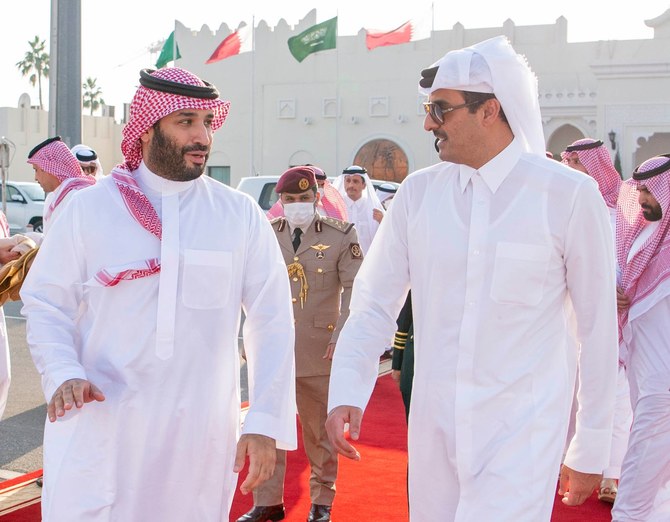


RIYADH: Saudi Arabia’s Prince Mohammed bin Salman on Thursday concluded a two-day visit to the Qatari capital, Doha, aimed at bolstering relations.
Prince Mohammed and Emir Sheikh Tamim held a round of talks to discuss regional and international issues and the bilateral opportunities available in the political, military, security, economic, commercial, investment, industrial, cultural, sports, environment, energy and infrastructure fields.
The emir and crown prince co-chaired the 6th Saudi-Qatari Coordination Council meeting, and said they were “satisfied with what was achieved during the session,” a joint statement released following the crown prince’s visit said.
The two sides agreed to enhance cooperation on all political issues and develop common positions that preserve both countries’ security and stability. They also agreed to continue military cooperation, strengthen the exchange of information, visits and joint training, benefit from expertise in specialized fields, exchange scholarships for military colleges and academies, and activate the security agreements signed between them.
Saudi Arabia and Qatar said they were keen to develop economic and commercial cooperation, increase the volume of intra-trade, facilitate the flow of trade movement, and take advantage of economic, commercial and industrial opportunities.

Riyadh and Doha also agreed to coordinate their positions on regional and international issues. (Twitter/@KSAMOFA)
The two sides also agreed to enhance cooperation on international climate policies and renewable energy, implement a circular carbon economy, and contribute to the sustainability of demand for global energy supplies. The Kingdom thanked Qatar for supporting important green initiatives in the Middle East, including its announcement to plant one million trees before the World Cup next year, and to plant 10 million trees by 2030.
Other areas of cooperation both counties pledged to develop include air transport, telecommunications and information technology, cybersecurity, financial technologies, digital marketing, and providing incentives to the business sectors in both countries, “especially during Qatar’s hosting of the 2022 World Cup, in a way that contributes to the success of this major event and achieves the two countries’ 2030 visions,” the statement said.
“The two sides agreed on the need to coordinate efforts to highlight the positive image of the citizens of the two countries, especially the youth,” the statement added, including organizing festivals, seminars, and cultural and entertainment conferences.
Riyadh and Doha also agreed to coordinate their positions on regional and international issues “to serve their interests and enhance security and stability in the region and the world.”
They affirmed their commitment to the AlUla declaration, achieving peace in the Middle East, and the importance of reaching a comprehensive settlement of the Palestinian-Israeli conflict. They also called for concerted international efforts to provide humanitarian aid to the Palestinian people.
On Yemen, the two sides said they were united in their efforts to find a comprehensive political solution to the crisis, and Qatari praised the Kingdom’s initiative to end the war and the suffering of the Yemeni people.
Saudi Arabia and Qatar welcomed the success of the recent elections in Iraq, and said they hoped the new Iraqi government will continue to work for the security, stability and development of the country. They also welcomed the agreements reached by the parties to the transitional phase in Sudan, and affirmed their continued support for its security and stability and the prosperity of the Sudanese people.
“The two sides stressed the importance of carrying out comprehensive reforms to ensure that Lebanon overcomes its crises, and that it does not become a launch pad for any actions that destabilize the security and stability of the region or a corridor for drug trafficking,” the joint statement said.

Saudi Arabia’s Prince Mohammed bin Salman leaves Doha following a two-day visit and is seen off by Qatari Emir Sheikh Tamim bin Hamad. (Twitter/@KSAMOFA)
They also called for the need to reach a political solution to the Syrian and Libyan crisis, and expressed support for the efforts of the UN special envoy for Syria.
Saudi Arabia and Qatar said they would continue to support security and stability in Afghanistan so it does not become a safe haven for terrorists and extremists, and called for increased international efforts to combat terrorism and support relief and humanitarian work.
The Kingdom praised the Qatar-led mediation efforts to achieve peace in Afghanistan and its vital role in evacuating foreign citizens and resuming operations at Kabul Airport.
Qatar praised the Kingdom for calling an extraordinary meeting for the Organization of Islamic Cooperation countries to discuss the situation in Afghanistan, which will be held in Pakistan on Dec. 19.
They also stressed the need to cooperate and seriously and effectively deal with Iran’s nuclear and missile program with all its components and repercussions in a way that contributes to achieving regional and international security and stability. They emphasized the principles of good neighborliness and respect for UN resolutions and international legitimacy, and sparing the region from all destabilizing activities.
Prince Mohammed sent a cable to Sheikh Tamim following his visit, thanking him for the warm reception and hospitality he and his accompanying delegation received.
He said the talks he held over the past two days “confirmed the strength of the relations between the two brotherly countries and the common desire to deepen cooperation in all fields,” Saudi Press Agency reported.
Qatar was the fourth stop in the crown prince’s tour of Gulf countries, following the UAE and Oman. His whirlwind tour also includes visits to Bahrain and Kuwait.