

Six countries including US urge Ethiopian government to cease illegal detentions

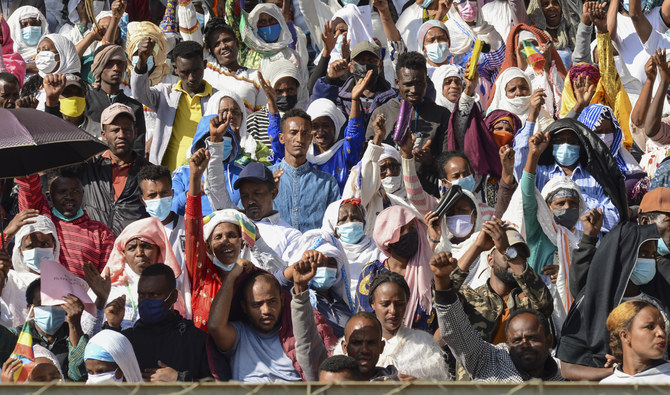
Tigrayan residents of Ethiopia's capital attend an event organized by the city administration to protest against the Tigray People's Liberation Front (TPLF), at the Abebe Bikila stadium in Addis Ababa, Ethiopia, Sunday, Dec. 5, 2021. (AP/FILE)
Short Url
Updated 07 December 2021
Follow

Six countries including US urge Ethiopian government to cease illegal detentions

WASHINGTON: Six countries including the US expressed concern on Monday over reports of widespread arrests by Ethiopia of Tigrayan citizens based on ethnicity in connection with the country’s year-old conflict, urging the government to stop acts they said likely violate international law.

The US, Britain, Canada, Australia, Denmark and the Netherlands cited reports by the Ethiopian Human Rights Commission and the rights group Amnesty International on widespread arrests of ethnic Tigrayans, including Orthodox priests, older people and mothers with children.

The countries said they are “profoundly concerned” about the detentions of people without charges, adding that the government’s announcement of a state of emergency last month offered “no justification” for mass detentions.

“Individuals are being arrested and detained without charges or a court hearing and are reportedly being held in inhumane conditions. Many of these acts likely constitute violations of international law and must cease immediately,” the six countries said in a joint statement.

They urged Ethiopia’s government to allow unhindered access by international monitors.

Prime Minister Abiy Ahmed’s spokesperson Billene Seyoum and Ethiopian government spokesperson Legesse Tulu did not immediately respond to requests for comment on the statement.

The conflict between Ethiopian’s federal government and the leadership of Tigray has killed thousands of civilians, forced millions to flee their homes and made more than 9 million people dependent on food aid.

Ethiopia, Africa’s second-largest nation and a regional diplomatic heavyweight, was once an ally for Western security forces seeking to counter Islamist extremism. Relations have soured amid increasing allegations of human rights abuses committed during the conflict.

The joint statement reiterated grave concern over human rights abuses including sexual violence and ongoing reports of atrocities committed by all sides.

“It is clear that there is no military solution to this conflict, and we denounce any and all violence against civilians, past, present and future,” the statement said.

Both sides in Ethiopia accuse each other of committing atrocities and both have denied the allegations.

The six countries in the statement called on the parties to the conflict to negotiate a sustainable cease-fire, reiterating calls from the United States and others for Ethiopia’s government and Tigrayan forces to declare a cease-fire to allow humanitarian aid to enter Tigray.


UN’s top court opens Myanmar Rohingya genocide case

Updated 6 sec ago
Follow

UN’s top court opens Myanmar Rohingya genocide case

  • The Gambia filed a case against Myanmar at the UN’s top court in 2019
  • Verdict expected to impact Israel’s genocide case over war on Gaza

DHAKA: The International Court of Justice on Monday opened a landmark case accusing Myanmar of genocide against its mostly Muslim Rohingya minority.

The Gambia filed a case against Myanmar at the UN’s top court in 2019, two years after a military offensive forced hundreds of thousands of Rohingya from their homes into neighboring Bangladesh.

The hearings will last three weeks and conclude on Jan. 29.

“The ICJ must secure justice for the persecuted Rohingya. This process should not take much longer, as we all know that justice delayed is justice denied,” said Asma Begum, who has been living in the Kutupalong refugee camp in Bangladesh’s Cox’s Bazar district since 2017.

A mostly Muslim ethnic minority, the Rohingya have lived for centuries in Myanmar’s western Rakhine state but were stripped of their citizenship in the 1980s and have faced systemic persecution ever since.

In 2017 alone, some 750,000 of them fled military atrocities and crossed to Bangladesh, in what the UN has called a textbook case of ethnic cleansing by Myanmar.

Today, about 1.3 million Rohingya shelter in 33 camps in Cox’s Bazar, turning the coastal district into the world’s largest refugee settlement.

“We experienced horrific acts such as arson, killings and rape in 2017, and fled to Bangladesh,” Begum told Arab News.

“I believe the ICJ verdict will pave the way for our repatriation to our homeland. The world should not forget us.”

A UN fact-finding mission has concluded that the Myanmar 2017 offensive included “genocidal acts” — an accusation rejected by Myanmar, which said it was a “clearance operation” against militants.

Now, there is hope for justice and a new future for those who have been displaced for years.

“We also have the right to live with dignity. I want to return to my homeland and live the rest of my life in my ancestral land. My children will reconnect with their roots and be able to build their own future,” said Syed Ahmed, who fled Myanmar in 2017 and has since been raising his four children in the Kutupalong camp.

“Despite the delay, I am optimistic that the perpetrators will be held accountable through the ICJ verdict. It will set a strong precedent for the world.”

The Myanmar trial is the first genocide case in more than a decade to be taken up by the ICJ. The outcome will also impact the genocide case that Israel is facing over its war on Gaza.

“The momentum of this case at the ICJ will send a strong message to all those (places) around the world where crimes against humanity have been committed,” Nur Khan, a Bangladeshi lawyer and human rights activist, told Arab News.

“The ICJ will play a significant role in ensuring justice regarding accusations of genocide in other parts of the world, such as the genocide and crimes against humanity committed by Israel against the people of Gaza.”