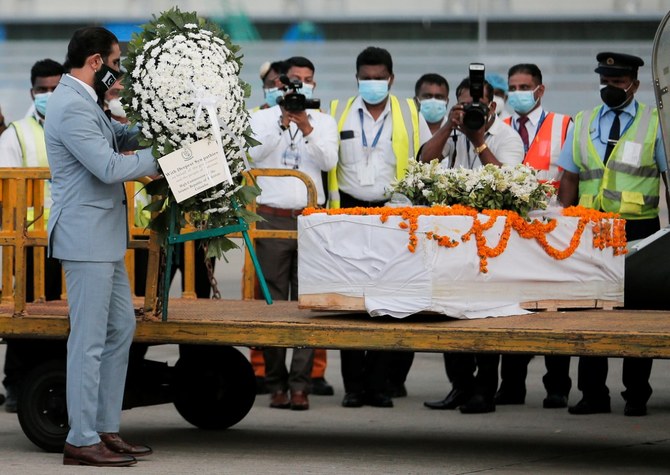
ISLAMABAD: Prime Minister Imran Khan on Monday sought the implementation of a ‘comprehensive strategy’ against violence, as a SriLankan Airlines flight arrived in Colombo with the remains of Priyantha Kumara, a Sri Lankan factory manager who had worked in Pakistan for many years and last week was lynched by a Muslim mob over blasphemy allegations.
On Friday, a mob attacked and killed Kumara, who had worked at a garment factory in the city of Sialkot in Pakistan’s Punjab province. The crowd also publicly burned the Sri Lankan national’s body over what police have said are accusations he desecrated religious posters.
Blasphemy is considered a deeply sensitive issue in Pakistan and carries the death penalty. International and domestic rights groups say accusations of blasphemy have often been used to intimidate religious minorities and settle personal scores.
Prime Minister Imran Khan chaired a meeting attended by Chief of Army Staff General Qamar Jawed Bajwa and senior members of the cabinet to review security in the country after the lynching incident.
“The participants of the meeting were of the view that individuals and mobs cannot be allowed to take the law into their hands and such incidents cannot be tolerated,” a statement issued by the Prime Minister Office said. “Therefore, a comprehensive strategy shall be implemented to curb such incidents and strict punishments to all the perpetrators shall be ensured.”
“The meeting expressed serious concern over the cruel act of killing of Sri Lankan national Priyantha Diyawadanage in Sialkot and expressed the resolve to bring the perpetrators to justice”.
A spokesperson for Sialkot police, Khurram Shehzad, said 132 people had been arrested so far in the case, after being identified with the help of CCTV footage.
“Police has arrested seven more of the prime suspects including key suspect Imtaiz aka Billi who was involved in torture and disrespecting the dead body,” Shehzad told Arab News in a phone interview, saying 26 key suspects had been remanded in police custody.
Human Rights Minister Dr. Shireen Mazari told media it was time to fully implement existing policies to combat violence, including the National Action Plan (NAP), a counter-terrorism strategy that was devised in 2014 after militants attacked an army-run school in Peshawar, killing 134 children.
“This lynching was not the first of its kind,” Mazari told Dawn. “It’s now time to take definitive action as the state.”
Meanwhile, Kumara’s remains were transported from the Pakistani city of Lahore via SriLankan Airlines flight UL-186 at 12:30pm on Monday.
The flight landed in Colombo at around 5pm where Kumara’s remains were received by Pakistan’s acting high commissioner in Colombo, Tanvir Ahmed, along with other Sri Lankan officials.
“Pakistan Acting High Commissioner Tanvir Ahmad and Press Secretary Kalsoom Qaiser received the mortal remains and conveyed the sympathies of the people and government of Pakistan to the relatives of the deceased present at the airport,” the Pakistan high commission in Colombo said in a statement.
Representatives from all walks of life visited the Pakistan High Commission on the occasion, the statement added: “They came from Sri Lankan Parliament, Coordinators for the Prime Minister of Sri Lanka for all religions including Hinduism,Christianity, Buddhism & Islam. All of them expressed their satisfaction over the quick action of the Pakistan Government in apprehension of the perpetrators of the Sialkot tragedy.”
On Monday, a delegation of the ruling Pakistan Tehreek-e-Insaf (PTI) party met with Sri Lankan high commissioner Mohan Wijewickrama in Islamabad and condoled with him over Kumara’s death.
“This was a horrific murder and we are concerned the way it was carried out. But we have seen that the government of Pakistan has immediately taken all possible actions at the highest level and they have assured to the family and to us that very stringent actions will be taken against the culprits,” Wijewickrama told the delegates. “And we are seeing it now that a large number of people have been arrested and remanded. So, we believe that the government of Pakistan is very sincere on this issue.”
Pakistani leaders, including PM Khan and Foreign Minister Shah Mahmood Qureshi, have said Islamabad is working closely with Sri Lankan authorities on the case. Top Pakistani leaders have promised accountability after the Sri Lankan leadership demanded Islamabad ensure justice in the case.
Few issues are as galvanizing in Pakistan as blasphemy, and even the slightest suggestions of an insult to Islam have been known to supercharge protests and incite lynching. Perpetrators of violence in the name of blasphemy often go unpunished.


![]()

PM seeks ‘comprehensive strategy’ against violence as Sri Lanka lynching victim’s remains reach Colombo
Short Url
https://arab.news/n94u6
PM seeks ‘comprehensive strategy’ against violence as Sri Lanka lynching victim’s remains reach Colombo
- Priyantha Kumara was killed and his body publicly burnt by a Muslim mob in Pakistan’s Sialkot city last week
- Islamabad has assured Sri Lanka all those involved in the crime will be brought to justice, PM personally overseeing probe
Latest updates


© 2026 SAUDI RESEARCH & PUBLISHING COMPANY, All Rights Reserved And subject to Terms of Use Agreement.