Sri Lankan president says expects justice from Pakistan after lynching of citizen over alleged blasphemy

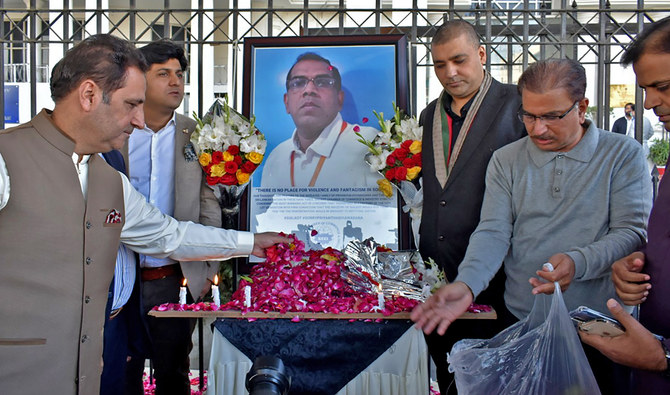
Businessmen put candles and rose petals next to the portrait of Priyantha Kumara Diyawadana, a Sri Lankan national who was lynched by a mob in Sialkot, Pakistan, as they pay tribute to him outside the Sialkot Chamber of Commerce and Industry on December 4, 2021. (AP)
Short Url
Updated 04 December 2021
Follow

Sri Lankan president says expects justice from Pakistan after lynching of citizen over alleged blasphemy

  • Priyantha Kumara Diyawadana was beaten to death and set ablaze by mob in an incident Pakistan’s prime minister described as ‘day of shame’
  • President Gotabaya Rajapaksa urges the government to ensure the safety of all other Sri Lankan nationals in Pakistan

COLOMBO: Sri Lankan President Gotabaya Rajapaksa said on Saturday he was deeply saddened by the brutal assassination of a citizen in Pakistan on blasphemy allegation, but praised the administration in Islamabad for taking steps to ensure justice.

Priyantha Kumara Diyawadana, who worked at a factory in Pakistan’s eastern city of Sialkot, was beaten to death and set ablaze by a mob on Friday, in an incident that Prime Minister Imran Khan described as a “day of shame” for Pakistan.

Sri Lankan foreign ministry spokesperson Sugeeshwara Gunaratne told Arab News the victim was in his late forties and survived by his wife and two children below 10 years of age.

The Pakistani prime minister said in a Twitter post he had spoken to the Sri Lankan president “to convey our nation’s anger & shame” over Diyawadana’s killing in Sialkot city, adding that over a hundred people had been arrested in the case and would be prosecuted.

“As an ardent friend of Pakistan, Sri Lanka commends the actions taken by the Government of Pakistan led by Prime Minister Imran Khan to ensure justice, immediately after this brutal assassination,” the Sri Lankan president said. “The Sri Lankan Government and the people of Sri Lanka look forward with great confidence on the future steps that will be taken by the Government of Pakistan in this regard.”

“I also urge the Government of Pakistan to ensure the safety of all other Sri Lankans living in Pakistan,” he said.

Armagan Gondal, a police chief in Sialkot district where the killing occurred in Pakistan’s Punjab province, told media factory workers had accused the victim of desecrating posters bearing the name of Islam’s Prophet Muhammad (Peace Be Upon Him).

Sri Lankan Prime Minister Mahinda Rajapaksa said it was “shocking” to see the brutal and fatal attack on Diyawadana by extremist mobs in Pakistan.

“My heart goes out to his wife and family,” he wrote on Twitter. “Sri Lanka and her people are confident that PM Imran Khan will keep to his commitment to bring all those involved to justice.”

The Sri Lankan foreign ministry said it was in the process of verifying the incident with Pakistani authorities, adding that it expected Islamabad to take “required action” to investigate the matter and ensure justice.

“The Sri Lanka High Commission in Islamabad is in the process of verifying the details of the incident from the Pakistan authorities,” it said in a tweet.

“Sri Lanka expects that the #Pakistan authorities will take required action to investigate and ensure justice. We are awaiting results of further #investigations and working with all parties concerned to bring the remains home.”

Sri Lanka’s Muslim Civil Society Alliance also expressed shock and dismay over the lynching of a national in Pakistan, calling it a “barbaric crime.”

“This is an extremely shameful and barbaric crime and should not be tolerated,” it said in a statement. “Extrajudicial vigilantism cannot be condoned at any cost by anyone, no matter which religion, ethnicity or nationality they belong to.”

In his message on Twitter, Pakistan’s information minister Chaudhry Fawad Hussain said he had been thinking what to write on the Sialkot lynching since words had lost their value after such incidents.

“Such incidents only pain us for 48 hours and then everything returns to normal and conscience remains buried until the next such incident occurs,” he wrote on the social media platform.

“This apathy is an indication of a bigger storm,” Hussain continued. “Rivers of blood have flown before us in countries [around the world].”

Few issues are as galvanizing in Pakistan as blasphemy, and even the slightest suggestion of an insult to Islam can supercharge protests and incite lynching.

Video footage of the incident in Sialkot shared on electronic and social media showed hundreds of people gathered outside the factory, amid plumes of smoke rising from a spot in the center of the crowd where the perpetrators had reportedly burnt the body of the victim after beating him to death.

Other videos showed a mob dragging a man’s heavily bruised body out to the street, where they burned it in the presence of hundreds of demonstrators who cheered on the killers.

Many in the mob made no attempt to hide their identity and some took selfies in front of the burning corpse.

The slogans chanted in the social media videos were the same used by supporters of the Tehreek-e-Labbaik Pakistan (TLP), a religious political party that has railed against blasphemy on its rise to prominence.

The TLP has in the past paralyzed the country with protests, including an anti-France campaign after Paris-based satirical magazine Charlie Hebdo last year republished cartoons depicting the Prophet Muhammad (PBUH). The group was only unbanned last month and its leader freed from detention after another period of civil unrest in which seven police officers were killed.

Friday’s attack came less than a week after a Muslim mob burned a police station and four police posts in northwest Pakistan after officers refused to hand over a man accused of desecrating Islam’s holy book, the Qur’an. No officers were hurt in the attacks in Charsadda, a district in the Khyber Pakhtunkhwa province.


Opposition demands Imran Khan hospital transfer as government assures specialized examination

Updated 4 sec ago
Follow

Opposition demands Imran Khan hospital transfer as government assures specialized examination

  • Khan’s family says he spoke to his sons for 20 minutes, calls for urgent treatment under personal doctors
  • Former health minister warns ex-PM’s vision loss could be ‘irreversible’ without immediate intervention

ISLAMABAD: Pakistan’s opposition protest entered its second day on Saturday as its leaders demanded that jailed former prime minister Imran Khan be shifted to a private hospital for urgent eye treatment, amid the government’s assurance that his examination would be conducted at a specialized medical institution.

A group of leaders belonging to Tehreek-e-Tahafuz-e-Ayeen-e-Pakistan — or the Movement to Protect the Constitution of Pakistan — gathered outside Parliament House a day after its members started a sit-in, as police maintained a heavy security presence around the building and nearby roads.

Salman Akram Raja, the secretary general of Khan’s Pakistan Tehreek-e-Insaf (PTI) party, called for the former premier’s early transfer for treatment at Islamabad’s Shifa International Hospital.

“We have been told that there is consent to take him to Shifa International,” he said in a video message. “If that is the case, there should be no delay. We are also being told that one member of Khan’s family will be allowed to accompany him.”

Raja said Khan’s treatment should come first, followed by his release.

“Restoration of the Constitution and rule of law in this country has now become inevitable,” he added.

Separately, Mustafa Nawaz Khokhar, another politician, told a news conference at the National Press Club that the opposition’s only demand was that Khan be granted full access to the required medical facilities.

“He has already lost vision in one eye,” he told the media.

“His treatment should take place in the presence of his family,” he continued. “Until this demand is met, we will not step back.”

Dr. Zafar Mirza, a former health minister under Khan’s administration who accompanied Khokhar, said Khan was suffering from central retinal vein occlusion, a serious eye condition that can lead to permanent vision loss if not treated promptly.

“If intervention is not carried out even now, it is possible that he may never be able to see from one eye again,” he said, warning that the extent of the damage remained unclear and could be irreversible.

Earlier in the day, Khan’s legal team filed a petition in the Islamabad High Court seeking suspension of his 17-year prison term in a graft case and his release on medical grounds, citing what they described as his deteriorating health.

Khan’s sister, Aleema Khan, said in a post on X that the former premier had spoken to his sons for about 20 minutes following a direction from the chief justice of Pakistan and that the family was now awaiting urgent treatment at Shifa International Hospital under the supervision of his personal doctors.

“We cannot and will not tolerate any further delay,” she said.

Information Minister Attaullah Tarar said in a social media post that Khan’s further examination and treatment would be conducted at a “specialized medical institution” and that a detailed report would be submitted to the Supreme Court.

“Conjecture, speculation and efforts to turn this into political rhetoric and mileage for vested interests may please be avoided,” he added.

The opposition protest followed a report submitted to the Supreme Court this month by amicus curiae Barrister Salman Safdar, who visited Khan at Rawalpindi’s Adiala jail and recommended that the seriousness of his ocular condition be independently assessed without delay.

Medical documents cited in the filing mentioned drastically reduced vision in Khan’s right eye, which led prison authorities to take him to a government hospital where he underwent an intravitreal injection.

Khan’s party said his family and legal team were not informed about the development, which was first mentioned in a local media report.

The PTI has blamed the government for negligence leading to damage to Khan’s vision, though the allegation has been denied by federal ministers who say that the case is being monitored by the country’s top court while promising “best possible treatment.”

Support for Khan also came from former Pakistani cricketers who played under his captaincy during Pakistan’s 1992 World Cup victory.

Ramiz Raja said on X that seeing Khan “suffer and lose sight in one eye is an emotional meltdown,” while Wasim Akram wished him “strength, a speedy recovery, and a full return to good health.”

Waqar Younis urged that politics be put aside and called for Khan’s timely treatment.

Khan, 73, has been in custody since August 2023 in connection with multiple cases that he and his party say are politically motivated, an allegation the government denies.