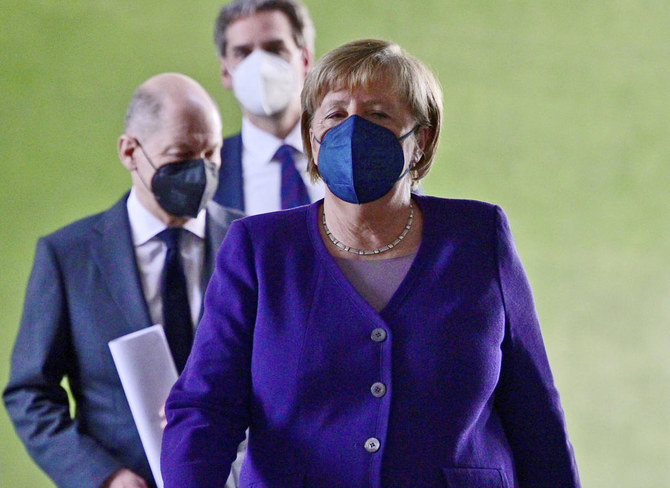
BERLIN: German Chancellor Angela Merkel said Thursday that people who aren’t vaccinated will be excluded from nonessential stores, cultural and recreational venues.
And parliament will consider a general vaccine mandate as part of efforts to curb coronavirus infections that again topped 70,000 newly confirmed cases in a 24-hour period.
Speaking after a meeting with federal and state leaders, Merkel said the measures were necessary in light of concerns that hospitals in Germany could become overloaded with people suffering COVID-19 infections, which are more likely to be serious in those who haven’t been vaccinated.
“The situation in our country is serious,” Merkel told reporters in Berlin, calling the measure an “act of national solidarity.”
She said officials also agreed to require masks in schools, impose new limits on private meetings and aim for 30 million vaccinations by the end of the year — an effort that will be boosted by allowing dentists and pharmacists to administer the shots.
Merkel herself backed the most contentious proposal of imposing a general vaccine mandate. She said parliament would debate the proposal with input from the country’s national ethics committee.
If passed, it could take effect as early as February, Merkel said, adding that she would have voted in favor of the measure if she were still a member of parliament.
About 68.7 percent of the population in Germany is fully vaccinated, far below the minimum of 75 percent the government is aiming for.
There have been large protests against pandemic measures in the past in Germany and the vaccine mandate is likely to be opposed by a minority, though opinion polls show most Germans are in favor.
Finance Minister Olaf Scholz, who is expected to be elected chancellor by a center-left coalition next week, has also backed a general vaccine mandate, but favors letting lawmakers vote on the issue according to their personal conscience rather than party lines.
“If we had a higher vaccination rate, we wouldn’t be discussing this now,”he said.
The rise in COVID-19 cases over the past several weeks and the arrival of the new omicron variant have prompted warnings from scientists and doctors that medical services in the country could become overstretched in the coming weeks unless drastic action is taken. Some hospitals in the south and east of the country have already transferred patients to other parts of Germany because of a shortage of intensive care beds.
Agreeing what measures to take has been complicated by Germany’s political structure — with the 16 states responsible for many of the regulations — and the ongoing transition at the federal level.
Germany’s disease control agency reported 73,209 newly confirmed cases Thursday. The Robert Koch Institute also reported 388 new deaths from COVID-19, taking the total since the start of the pandemic to 102,178.
To reduce the pressure on hospitals over the festive period, the sale of fireworks traditionally set off during New Year’s in Germany will be banned. Each year, hospitals treat hundreds of people with serious injuries because of mishandled fireworks.
The new measures will take effect once Germany’s 16 states incorporate them into existing rules, likely in the coming days.

Germany backs restrictions for unvaccinated as mandate looms
Short Url
https://arab.news/6e9rg
Germany backs restrictions for unvaccinated as mandate looms
- Measures were necessary in light of concerns that hospitals in Germany could become overloaded
- “The situation in our country is serious,” Merkel told reporters in Berlin, calling the measure an “act of national solidarity”
Cuba pays tribute to soldiers killed in Maduro capture
- President Miguel Diaz-Canel and Castro, the 94-year-old retired former Cuban leader, were present in full military uniform to receive the soldiers’ remains
- Twenty-three Venezuelan soldiers were also killed in the US strike that saw Maduro and his wife whisked away to stand trial in New York
HAVANA: Cuba paid tribute on Thursday to 32 soldiers killed in the US military strike that ousted Venezuelan leader Nicolas Maduro, in a ceremony attended by revolutionary leader Raul Castro.
Havana, under pressure from US President Donald Trump, had decreed two days of tribute for the men, some of whom had been assigned to Maduro’s protection team.
Twenty-one of the soldiers were from the Cuban interior ministry, which oversees the intelligence services, officials have said. The others were from the military.
President Miguel Diaz-Canel and Castro, the 94-year-old retired former Cuban leader, were present in full military uniform to receive the soldiers’ remains early Thursday.
Their urns, draped in Cuban flags, were unloaded from a plane at Havana’s Jose Marti International Airport, according to footage broadcast on state TV.
At the event, Interior Minister General Lazaro Alberto Alvarez expressed the country’s respect and gratitude for the soldiers he said had “fought to the last bullet” during US bombings and a raid by US special forces who seized Maduro and his wife from their Caracas residence on January 3.
“We do not receive them with resignation; we do so with profound pride,” the minister added, and said the United States “will never be able to buy the dignity of the Cuban people.”
The soldiers’ bodies were then transported in Jeeps to the Ministry of the Revolutionary Armed Forces, with Cubans lining the streets and applauding the procession.
Residents of the capital can pay their respects throughout the day, which will close with a gathering outside the US embassy in Havana.
‘Manipulation’
The homage serves as an opportunity for Cuba to make a display of national unity at a time it is batting away pressure from US President Donald Trump.
Trump on Sunday urged Cuba to “make a deal,” the nature of which he did not divulge, or face the consequences.
The Republican president, who says Washington is now effectively running Venezuela, has vowed to cut off all oil and money that Caracas had been providing to ailing Cuba.
Cuba, which is struggling through its worst economic crisis in decades, has reacted defiantly to the US threats even as it reels from the loss of a key source of economic support.
Havana has dismissed as “political manipulation” a US announcement of humanitarian aid for victims of Hurricane Melissa, which hit last October and killed nearly 60 people across the Caribbean.
“The US government is exploiting what might seem like a humanitarian gesture for opportunistic purposes and political manipulation,” Cuba’s foreign ministry said in a statement in response.
It added Washington had not been in touch about the delivery, which it would welcome “without conditions.”
Jeremy Lewin, the senior US official for foreign assistance, on Thursday cautioned Havana not to “politicize” the help.
“We look at this as the first, the beginning of what we hope will be a much broader ability to deliver assistance directly to the Cuban people,” he said.
US-Cuba relations have been tense for decades but hit a new low after the US capture of Maduro and his wife.
Twenty-three Venezuelan soldiers were also killed in the US strike that saw Maduro and his wife whisked away to stand trial in New York on drug-trafficking charges.
Havana, under pressure from US President Donald Trump, had decreed two days of tribute for the men, some of whom had been assigned to Maduro’s protection team.
Twenty-one of the soldiers were from the Cuban interior ministry, which oversees the intelligence services, officials have said. The others were from the military.
President Miguel Diaz-Canel and Castro, the 94-year-old retired former Cuban leader, were present in full military uniform to receive the soldiers’ remains early Thursday.
Their urns, draped in Cuban flags, were unloaded from a plane at Havana’s Jose Marti International Airport, according to footage broadcast on state TV.
At the event, Interior Minister General Lazaro Alberto Alvarez expressed the country’s respect and gratitude for the soldiers he said had “fought to the last bullet” during US bombings and a raid by US special forces who seized Maduro and his wife from their Caracas residence on January 3.
“We do not receive them with resignation; we do so with profound pride,” the minister added, and said the United States “will never be able to buy the dignity of the Cuban people.”
The soldiers’ bodies were then transported in Jeeps to the Ministry of the Revolutionary Armed Forces, with Cubans lining the streets and applauding the procession.
Residents of the capital can pay their respects throughout the day, which will close with a gathering outside the US embassy in Havana.
‘Manipulation’
The homage serves as an opportunity for Cuba to make a display of national unity at a time it is batting away pressure from US President Donald Trump.
Trump on Sunday urged Cuba to “make a deal,” the nature of which he did not divulge, or face the consequences.
The Republican president, who says Washington is now effectively running Venezuela, has vowed to cut off all oil and money that Caracas had been providing to ailing Cuba.
Cuba, which is struggling through its worst economic crisis in decades, has reacted defiantly to the US threats even as it reels from the loss of a key source of economic support.
Havana has dismissed as “political manipulation” a US announcement of humanitarian aid for victims of Hurricane Melissa, which hit last October and killed nearly 60 people across the Caribbean.
“The US government is exploiting what might seem like a humanitarian gesture for opportunistic purposes and political manipulation,” Cuba’s foreign ministry said in a statement in response.
It added Washington had not been in touch about the delivery, which it would welcome “without conditions.”
Jeremy Lewin, the senior US official for foreign assistance, on Thursday cautioned Havana not to “politicize” the help.
“We look at this as the first, the beginning of what we hope will be a much broader ability to deliver assistance directly to the Cuban people,” he said.
US-Cuba relations have been tense for decades but hit a new low after the US capture of Maduro and his wife.
Twenty-three Venezuelan soldiers were also killed in the US strike that saw Maduro and his wife whisked away to stand trial in New York on drug-trafficking charges.
© 2026 SAUDI RESEARCH & PUBLISHING COMPANY, All Rights Reserved And subject to Terms of Use Agreement.


