

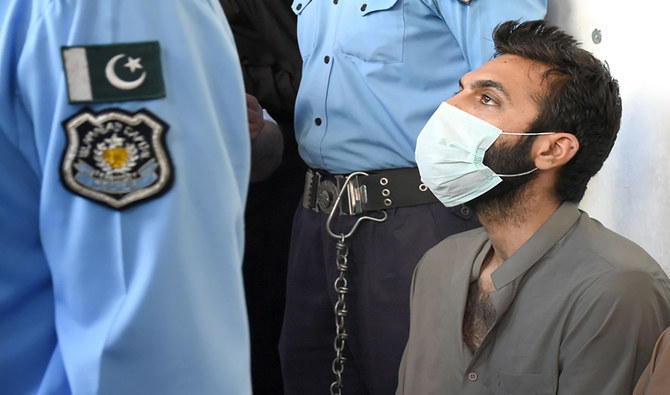

ISLAMABAD: The legal team for Zahir Jaffer, the main accused in the grisly July murder of Noor Mukadam, filed an application in a sessions court in Islamabad on Wednesday requesting that a medical board be set up to assess the mental health of the key suspect.
Last month Zahir Jaffer was expelled from the court after he ‘disrupted’ a trial hearing in which witnesses were being cross-examined. Just a week earlier, police officers had to carry Jaffer out of the courtroom building after he used indecent language and misbehaved with the judge during a hearing. Islamabad police have also registered a criminal case against Jaffer for using “abusive language” inside the courtroom and attempting suicide on the court premises.
In Wednesday’s application, Jaffer’s lawyer said that the accused was a “chronic patient of mental disorder / Schizo-affective disorder due to drug psychosis and the same was the position at the time of his arrest on 20.07.2021.”
The team asked the court to authorize setting up a medical board “to determine the lunacy / mental health of accused Zahir Jaffer in the interest of justice.”
“Local police and investigating agency, remained fail or willingly avoided to disclosed the mental health condition of accused Zahir Jaffar to the record and courts due to social / complaint’s influence as the complainant is an ambassador and has good connections in the power corridors,” the application added.
Mukadam, 27, the daughter of Shaukat Mukadam, Pakistan’s former ambassador to South Korea and Kazakhstan, was found beheaded at a residence in Islamabad’s upscale F-7/4 neighborhood on July 20. The prime suspect, Jaffer, was arrested from the crime scene on the day of the murder and has been in custody since.
At his indictment hearing in October, Jaffer admitted he had committed the “crime” but appealed to the judge to release him from jail and put him under house arrest.
The murder trial that began in October is one of the most closely watched in Pakistan’s recent history, as the case has sparked public outrage and grabbed media attention unlike any other recent crime against women.
The transcript of the CCTV footage showing events that preceded Mukadam’s murder was submitted by the prosecution last month. It said the victim had jumped from the first floor of the chief accused’s house but was prevented by staff from leaving the premises.
Others charged in the case include Jaffer’s parents, Zakir Jaffer and Asmat Adamjee, three of their household staff, Iftikhar, Jan Muhammad and Jameel, and six workers from Therapy Works, a counselling center from where Jaffer had received certification to become a therapist and where he had been receiving treatment in the weeks leading up to the murder.


