

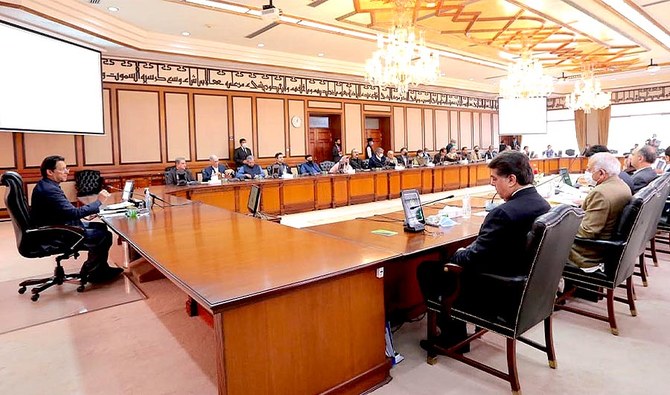

KARACHI: The federal cabinet on Tuesday rejected a recently-released audit report pointing to billions of rupees in irregularities in COVID-19 expenditures, the vaccination process and the Ehsaas social safety net relief program launched during the pandemic.
An audit of COVID-19 spending was one of five conditions imposed by the International Monetary Fund (IMF) during recent talks for the resumption of a stalled $6 billion loan program for Pakistan.
The report, conducted by the Auditor General of Pakistan, was released by the ministry of finance last Friday and pointed out irregularities in government interventions to ensure availability of five essential items — sugar, wheat flour, oil and ghee, pulses and rice — at Utility Stores at subsidised rates. It also found “non-transparent procurement” of equipment from China by the National Disaster Management Authority (NDMA).
“The cabinet rejected the audit report on COVID-19 spending and asked three relevant organizations to give their presentations in this regard,” Information Minister Chaudhry Fawad Hussain said at a press conference after a cabinet meeting on Tuesday.
Hussain said the finance ministry had already rejected the audit report and the head of the Ehsaas program, Dr. Sania Nishtar, had clarified the position of her organization.
According to the audit report, the NDMA initiated a procurement process and started emergency procurements directly from China, including for biomedical equipment, testing kits and PPEs. The total disbursements on account of procurements from China as of June, 30, 2020 amounted to $62.2 million, according to the audit report.
“During audit, number of short comings were observed related to planning, initiation and execution of procurements by NDMA in all the three phases”, the report reads.
However, NDMA denied any breach of rules, saying the emergency procurements were made as per the law and after codal formalities were waived. The procurement was conducted through the Embassy of Pakistan in China and the Chinese Government provided a list of shortlisted firms or vendors for emergency procurement, it said.
The report also highlighted the loss to the public exchequer on account of the purchase of ventilators at higher rates from Sinopharm Fortune Way Company.
“The difference in price per ventilator was $7,100,” the report said. “Procurement of same equipment at the same time at a higher rate resulted in loss of $994,000 to the public exchequer.”
The authority held that due to an increased demand of ventilators and their critical requirement, the prices of ventilators with immediate deliveries and delayed deliveries showed a lot of difference in price. Finally after negotiating with the firm, an agreement was signed.
The audit said the firm generated an invoice of $1.977 million instead of $1.277 million and the claimed amount was paid in advance without confirmation of the total price approved, according to the report.
“The overpayment made to the Chinese firm led to excess payment of $700,000,” the report reads.
Accepting the audit observation, the NDMA said it was actively seeking a refund from Sinopharm Fortune International Trading Corp, Beijing.
Out of an allocated COVID-19 budget of Rs50 billion for the Utility Stores Corporation (USC), Rs10 billion was released to provide five essential food items including wheat flour (Atta), sugar, ghee, pulses, and rice at subsidized rates to vulnerable segments of the society.
The audit report pointed to irregularities of more than Rs5 billion in purchases of sugar, ghee and flour by the Utility Stores Corporation as well as the purchase of ghee and edible oil worth Rs1.40 billion which was unfit for human consumption.
The management of USC procured ghee and cooking oils for Rs1,601.964 million without competitive tendering process and without obtaining competitive rates, according to the audit report.
“It transpired that the companies that had provided ghee/oil for Rs 1,406.396 million to the USC had been declared providing unfit ghee/oil to the public by the Punjab Food Authority,” the report added.
After the audit recommended an investigation, USC management insisted no rules were violated for procurement and no product could be placed at any outlet unless its quality was certified and an ISO certificate was received from a concerned manufacturer.
On Saturday, the Pakistani finance ministry said the audit report was discussed in detail by officials of the Auditor General of Pakistan with the IMF in June 2021 as well as during the recently concluded 6th review.
“The IMF was fully satisfied that there was no case of fraud and embezzlement,” the ministry said. “Majority of the Paras and observations included in the report relate to procedural shortcomings due to emergency procurements.”
The IMF was also informed that divisions and organizations had noted the shortcomings in the audit report and taken remedial measures, according to the finance ministry.


