

‘You couldn’t be more welcome,’ Prince William tells Afghan refugees

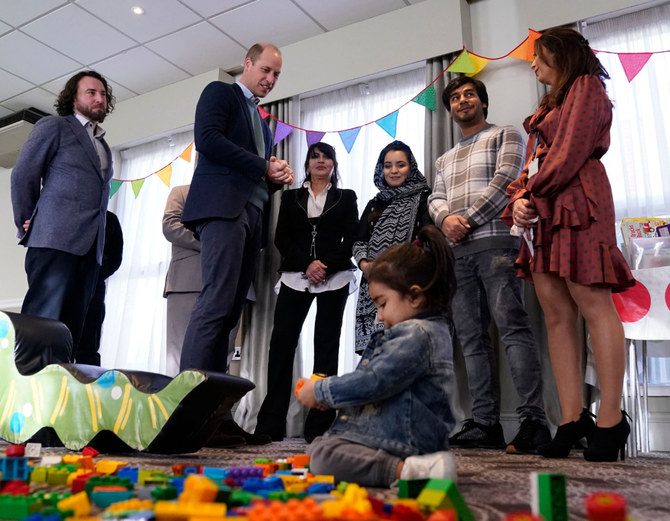
Britain's Prince William, Duke of Cambridge (2nd L) watches young children playing during a visit to a hotel in Leeds, northern England on November 30, 2021 which is being used to accommodate refugees evacuated from Afghanistan. (AFP)
Short Url
Updated 30 November 2021
Follow

‘You couldn’t be more welcome,’ Prince William tells Afghan refugees

  • Around 7,000 people evacuated to Britain
  • Refugee describes ‘horrific’ airport scenes

LONDON: Prince William has told Afghan refugees who recently arrived in Britain that they were welcome in the country and praised their bravery after risking their lives working alongside British forces in Afghanistan.

The prince visited families housed in a hotel for refugees evacuated from Kabul this year.

He told families who had been forced to leave behind everything they knew and loved at short notice: “The most important thing is that you are safe now. You have a bright future. You couldn't be more welcome. Thank you for all you have done for us.”

The hotel, which is unnamed for security reasons, hosts around 175 refugees who are waiting on the government to find them long-term accommodation.

The prince was met with applause by the refugees on his arrival.

One Afghan, Hussain Saeedi Samangan, told the Daily Mail that he and his family’s escape from Kabul had been difficult, as were their initial experiences in their UK quarantine hotel, but said they felt very welcome in Yorkshire and were optimistic of a “bright, exciting future” in Britain.

Samangan added that he never believed Kabul would fall to the Taliban.

“It took everyone by surprise. You will have seen for yourself what it was like in the media. We had some very traumatic moments before the evacuation. But we were lucky to receive the help the British government were giving in getting us to the airport, compared to others who spent many hours at the gate. So we had a smoother path to get here.”

Asked by the prince whether he thought this generation of the Taliban would be different, he replied: “No. We know what the Taliban wants, we know they have not changed and that we couldn't trust them.”

Another Afghan, 33-year-old Kabul airport firefighter Haroom Shahab, told the royal that he and his family had to wait for 28 hours at the airport to move just 200 meters in order to get on a plane to the UK.

He described “horrific” scenes with thousands of people hurtling toward the runways, leaving the planes unable to land.

“They were running, they were desperate, in front of the oncoming aircraft. That was very hard for us,” he said. “We were trying to get out of the country because our lives have been torn to shreds. When we got to the UK we finally knew we would be safe. The Taliban are killing people without compassion, policemen and their families just gunned down. Anyone with a link to British or NATO forces or government.”

Shahab said he hoped to take up his old profession once again and become a firefighter in the UK.

Britain evacuated around 7,000 people from Afghanistan when the country fell to the Taliban in August and September this year. 

The government has pledged to continue to bring those who worked alongside British or NATO forces during the 20-year occupation into the UK from Afghanistan.


More than 100 dead in torrential rain and floods across southern Africa

Updated 5 sec ago
Follow

More than 100 dead in torrential rain and floods across southern Africa

  • South Africa has reported at least 19 deaths in two of its northern provinces following heavy rains
  • Tourists and staff members were evacuated this week by helicopter from flooded camps

JOHANNESBURG: Torrential rains and flooding have killed more than 100 people in South Africa, Mozambique and Zimbabwe, and authorities warned Friday that more severe weather was expected across several countries in southern Africa.
South Africa has reported at least 19 deaths in two of its northern provinces following heavy rains that began last month and led to severe flooding.
Tourists and staff members were evacuated this week by helicopter from flooded camps to other areas in the renowned Kruger National Park, which is closed to visitors while parts of it are inaccessible because of washed out roads and bridges, South Africa’s national parks agency said.
In neighboring Mozambique, the Institute for Disaster Management and Risk Reduction said 103 people had died in an unusually severe rainy season since late last year. Those deaths were from various causes including electrocution from lightning strikes, drowning in floods, infrastructure collapse caused by the severe weather and cholera, the institute said.
The worst flooding in Mozambique has been in the central and southern regions, where more than 200,000 people have been affected, thousands of homes have been damaged, while tens of thousands face evacuation, the World Food Program said.
Zimbabwe’s disaster management agency said that 70 people have died and more than 1,000 homes have been destroyed in heavy rains since the beginning of the year, while infrastructure including schools, roads and bridges collapsed.
Flooding has also hit the island nation of Madagascar off the coast of Africa as well as Malawi and Zambia. Authorities in Madagascar said 11 people died in floods since late November.
The United States’ Famine Early Warning System said flooding was reported or expected in at least seven southern African nations, possibly due to the presence of the La Nina weather phenomenon that can bring heavy rains to parts of southeastern Africa.
South African President Cyril Ramaphosa visited flood-stricken areas in the northern Limpopo province on Thursday and said that region had received around 400 millimeters (more than 15 inches) of rain in less than a week. He said that in one district he visited “there are 36 houses that have just been wiped away from the face of the Earth. Everything is gone ... the roofs, the walls, the fences, everything.”
The flooding occurred in the Limpopo and Mpumalanaga provinces in the north, and the South African Weather Service issued a red-level 10 alert for parts of the country for Friday, warning of more heavy rain and flooding that poses a threat to lives and could cause widespread infrastructure damage.
The huge Kruger wildlife park, which covers some 22,000 square kilometers (7,722 square miles) across the Limpopo and Mpumalanga provinces, has been impacted by severe flooding and around 600 tourists and staff members have been evacuated from camps to high-lying areas in the park, Kruger National Park spokesperson Reynold Thakhuli said.
He couldn’t immediately say how many people there were in the park, which has been closed to visitors after several rivers burst their banks and flooded camps, restaurants and other areas. The parks agency said precautions were being taken and no deaths or injuries had been reported at Kruger.
The South African army sent helicopters to rescue other people trapped on the roofs of their houses or in trees in northern parts of the country, it said. An army helicopter also rescued border post officers and police officers stranded at a flooded checkpoint on the South Africa-Zimbabwe border.
Southern Africa has experienced a series of extreme weather events in recent years, including devastating cyclones and a scorching drought that caused a food crisis in parts of a region that often suffers food shortages.
The World Food Program said more than 70,000 hectares (about 173,000 acres) of crops in Mozambique, including staples such as rice and corn, have been waterlogged in the current flooding, worsening food insecurity for thousands of small-scale farmers who rely on their harvests for food.